
Google has launched a massive “debugging” project that has nothing to do with dodgy software.
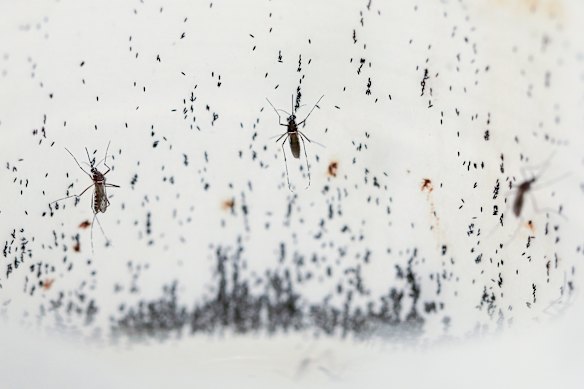
The tech giant has applied to the US government for permission to release 32 million mosquitoes across California and Florida.
The mission is run through Debug, an Alphabet-owned program aimed at slashing numbers of the world’s deadliest animals to curb the diseases they spread, including West Nile Virus and Dengue fever.
The program employs a variation of an Australian-pioneered method, which harnesses a bacterium that stops viruses replicating within the insects and turns their eggs sterile.
It’s a move that might need to be considered in Australia after a hyper-aggressive Asian mosquito species was discovered for the first time on the mainland.
So how does it all work? And why is Google involved at all?
The Australian-developed technique
Wolbachia is a bacterium that naturally infects about half of all insect species. But not Aedes aegypti, the mosquito species notorious for carrying Dengue, Zika, Chikungunya and yellow fever.
A major breakthrough in disease control came in 2009. Australian scientists found infecting Aedes aegypti with Wolbachia stopped the replication of the dengue virus within the mosquitoes. Without virus replication, disease cannot spread.
Scientists suspect the bacteria outcompete viruses within mosquitoes. Both pathogens need cholesterol, for example, and if you’ve got a population of Wolbachia within mozzies hoovering up all the cholesterol, the viruses “starve”.
The bacteria also turbocharge a mozzie’s immune system, which helps repel viral infection.
Could Wolbachia-infected mosquitoes stop diseases spreading in the real world? The first field trials began in Cairns. By 2021, the technique had its strongest evidence, with a randomised controlled trial in Yogyakarta, Indonesia, that found Wolbachia-infected mozzies led to a 77 per cent plunge in dengue cases.
This research grew into the World Mosquito Program, founded by pioneering Wolbachia scientist Scott O’Neill, who led early research at the University of Queensland and Monash University.
The program has unleashed anti-viral mozzies across 15 countries including Australia (in Queensland), Brazil, Colombia, Sri Lanka, Vietnam and Mexico. The method has prevented an estimated 1.2 million cases of dengue and almost 80,000 hospitalisations.
The World Mosquito Program and Google’s Debug both harness this miracle bacteria. But they use vastly different tactics.
The replacement paradigm v Google’s sterility method
You can do two things with Wolbachia: stealthily infect an entire mosquito population, so disease can’t spread. Or you crash the population itself.
The difference hinges on the sex of the infected mosquitoes that are released.
Senior director of field entomology with the World Mosquito Program, Associate Professor Greg Devine, says his program uses the “Wolbachia replacement” technique.
“It’s replacing the wild mosquito population with mosquitoes that are carrying Wolbachia. So the population is still there, but it’s a much more benign one that is not unable to transmit dengue,” he says.
World Mosquito program.
It works by releasing both male and female mosquitoes infected with Wolbachia. A key biological phenomenon called cytoplasmic incompatibility comes into play here – another trick of the bacteria.
If a Wolbachia male mates with a wild female mosquito, her eggs will die. But if a wild male mosquito mates with a Wolbachia female, the eggs will survive – and result in Wolbachia-infected offspring. As will the mating of Wolbachia infected males and females.
That confers an advantage to the bacteria-carrying mosquitoes. So, with just one or two big releases of infected mozzies, the Wolbachia individuals can take over entire populations, drastically slashing transmission of dengue fever and other viruses.
Google’s Debug program, on the other hand, aims to cut down mosquito numbers.
For this method, only Wolbachia males are released. Mosquitoes only breed once and females keep the sperm for life for different broods. If they breed with an infected male, they will never produce fertile eggs.
“A single mating from a Wolbachia-infected male can effectively sterilise the female that it comes into contact with,” Devine says. “That’s what Debug are interested in.”
Google’s release initially tested in Australia
A CSIRO-backed proof-of-concept study for Debug was undertaken in Innisfail on Queensland’s Cassowary Coast in 2018.
Professor Nigel Beebe from the University of Queensland and his colleagues released 3 million Wolbachia-infected male mosquitoes across three urban areas.
“Boys don’t bite,” he says. “They’re just nectar feeders, so they don’t blood feed. So it’s completely safe to release them, and they’re very good at finding the girls.”
The results of the study were impressive.
“We pushed the population down by over 80 per cent in the three towns. And in one town, we almost eradicated them.”
There are two drawbacks to this sterility method.
One is that it requires continual season-to-season releases of male mosquitoes to work. The World Mosquito Program’s method, in comparison, works long-term once Wolbachia is embedded in the population after a few big releases. This less-intensive method suits the program’s focus on low-income countries.
Debug’s sterility method also requires the separation of male and female mozzies, a finicky task to say the least.
That’s where the Google-backed “uber-engineers” came in, Beebe says. “They developed a sex-sorting machine that can sort the boys from the girls at an incredibly high ratio.”
Why is Google involved?
Debug is backed by Verily Health, a life sciences company that originally emerged from Alphabet’s semi-secret research facility, Google X.
In March this year, Verily spun out from Alphabet and became an independent company. But before that, Google fully acquired Debug and removed it from Verily’s portfolio, The Guardian reported.
Part of Google’s interest, Beebe says, was driven by someone high up in management who became intrigued by mosquitos after studying them in university.
But will we ever need the Google-backed Debug technique here?
The WMP’s technique works “beautifully well” in Queensland, Beebe says. “Twenty years ago, each summer, we’d get a dengue outbreak from people going back from Bali or something like that. Now we don’t.”
But the population-crashing technique could be an option if a different species – the ferocious Asian tiger mosquito – makes the leap from the Torres Strait to the Australian mainland, as experts fear.
Just last week, six were detected on the mainland for the first time, near the tip of Cape York.
The aim would be to eradicate the species entirely, rather than just reduce its virus-carrying ability.
“It’s a temperate species that could spread to Melbourne,” Beebe says. “And it’s incredibly aggressive. We do not want it here.”
The Examine newsletter explains and analyses science with a rigorous focus on the evidence. Sign up to get it each week.
 Angus Dalton is the science reporter for The Sydney Morning Herald.Connect via X or email.
From our partners
Disclaimer : This story is auto aggregated by a computer programme and has not been created or edited by DOWNTHENEWS. Publisher: www.smh.com.au