It’s late evening in a hostel room in Jaipur. Three laptops glow in the dim light, screens filled with lines of code, UI mockups, and endless tabs. Between college assignments, back-to-back classes, and hurried meals, three young students sit hunched over their screens — debating features, fixing bugs, and building something they believe in.
What started as conversations between friends is now taking shape as ‘Swappr’ — an app designed to make buying, selling, and swapping items on campus simpler, smarter, and more engaging.
“At its core, we just love building this,” Garvit Dudeja, founder of Swappr, tells The Better India. “We don’t think about what will happen after a week or 10 days. If you love building something, everything else just flows.”
From college idea to campus solution
Garvit, a second-year engineering student at Malaviya National Institute of Technology (MNIT) Jaipur, didn’t begin his journey with Swappr alone. Along with Priyansh Joshi, his college mate, and Lakshya Mangla, a school friend now studying at Vellore Institute of Technology (VIT), the trio slowly pieced together an idea rooted in a very familiar student problem.
It began during their early college days, when Garvit and Priyansh were experimenting with a merchandise venture. “We used to take orders from cafes and restaurants. Things were going well initially, but later we faced issues, and we even got scammed,” recalls Priyansh.
“So we decided to shut it down and start something new.”
That “something new” came from observing their own lives.
Students often buy things impulsively: a keyboard, headphones, sneakers, or something else they feel they need at the time, only to realise months later that they barely use them. The usual solution? Selling them on chaotic WhatsApp groups where listings get buried, prices drop unfairly, or deals fall through.
“We saw this happening everywhere,” explains Lakshya. “People were unable to sell items at the right value, or they rushed into selling to friends at lower prices. We thought, why not create a platform that solves this?”
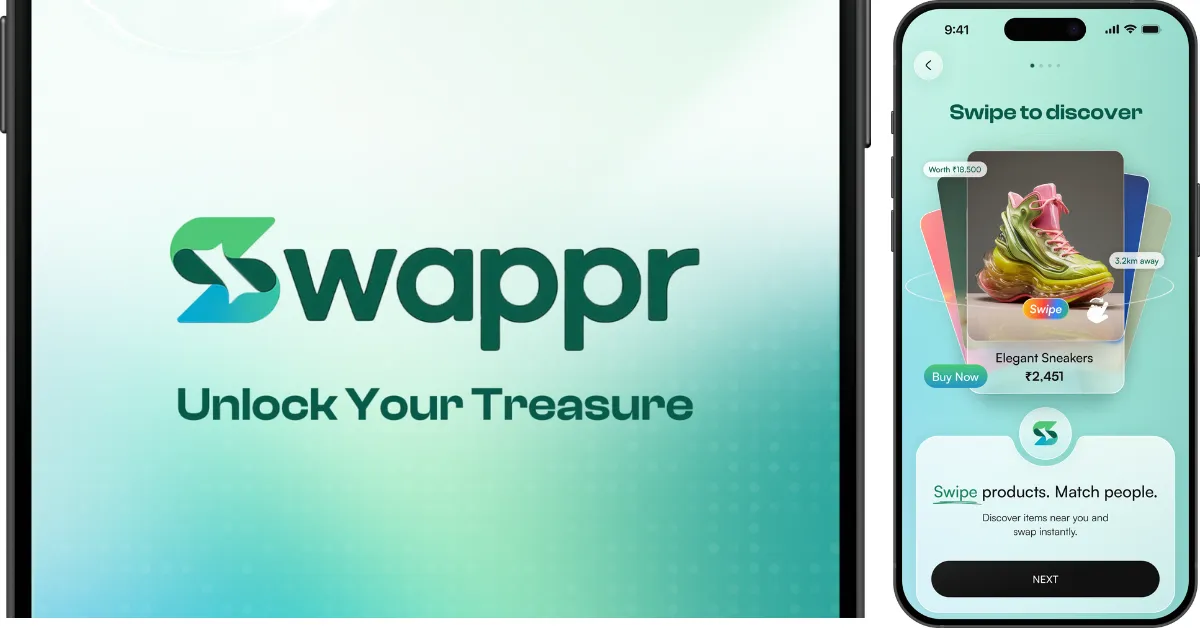
That thought became Swappr, a swipe-based app where students can list things they no longer use, find products nearby, and connect with others on campus.
It didn’t feel like a big leap, because students were already doing something similar every day. Students were used to scrolling, swiping, saving products, and comparing choices online. Garvit and his friends wanted to bring that same ease into something far more practical: helping students get value from things lying unused in their hostel rooms.
“We wanted to make it engaging, as two of the most addictive things today are shopping and swiping. So we thought, why not combine both?” adds Garvit.
So, on Swappr, students swipe through listings, match when both sides are interested, and then start a conversation. It feels simple, almost like browsing through things a friend might have put up for sale, only with a better chance of finding the right match.
To keep students coming back, the team also built in rewards, coupons, and brand deals, making the experience feel useful, affordable, and a little exciting.
“People of our age want instant gratification,” Garvit adds. “Just like cashback apps or rewards systems — even small incentives create excitement. That dopamine rush matters.”
So Swappr integrates brand deals, rewards, and coupons as a core part of the user journey.
Building between classes, cold DMs and funding gaps
The journey from idea to impact didn’t happen overnight. It unfolded over months of trial, persistence, and small wins that slowly built momentum.
Swappr began taking shape in June 2025 when Garvit and Priyansh decided to start fresh after their first venture didn’t work out. What followed were months of building from scratch, without funding, without a team, and often without certainty.
“In the beginning, we didn’t even have money,” Garvit recalls. “But we had belief.”
The early days were defined by hustle. From cold messaging hundreds of people to pitching brands and setting up back-to-back meetings, the founders did everything themselves.
“I personally DMed around 250–300 people,” Garvit says. “We were taking around four meetings a day, managing college alongside. It was hectic, but we were enjoying it.”
Lakshya, who joined the team after reconnecting with Garvit, focused on partnerships and marketing, while Garvit and Priyansh led product and tech. Despite being in different cities, they built a rhythm anchored in clarity and trust.
/filters:format(webp)/english-betterindia/media/media_files/2026/07/06/swappr-2026-07-06-16-33-52.png)
For a brief period, progress slowed due to a lack of funds. But that pause turned into a turning point.
In December 2025, the team secured RS 21 lakh in funding through Google’s ‘Fund My Crazy’ campus innovation challenge — a nationwide initiative encouraging students to solve real-world problems using tools like Google Gemini AI.
Swappr stood out among more than 29,000 entries across India. For the team, the recognition reflected both the idea and the thought behind it.
“Swappr worked because it was solving a real, everyday campus problem,” Garvit explains. “And we were using AI not just as a tool but as a way to think through the problem better.”
The moment of winning still feels surreal to the team. “We were at the Mumbai airport, just staring at the trophy; it felt surreal,” they recall.
For Garvit, the impact was deeply personal. “When I told my mom the amount, she didn’t ask anything at first. And when I finally said Rs 21 lakh, she just started crying. That moment meant everything.”
With funding in place, the team accelerated development, preparing for a revamped version of Swappr, set to launch in June.
How AI helped the team build faster
While the idea was rooted in everyday student experiences, technology, especially AI, played a critical role in shaping Swappr from the ground up.
In its early stages, Google Gemini AI acted almost like a ‘digital co-founder’ for the team.
“We used it to stress-test our ideas,” Garvit shares. “To understand where users might face friction and how we could solve it better.”
AI helped the team at almost every stage of building Swappr.
Before writing the actual code, they used it to understand who their users were, what students might need, and where they could face problems while using the app.
“Before even writing code, we could visualise how the app would look and function,” he explains. “That helped us pivot quickly.”
Today, AI is built into the app itself.
/filters:format(webp)/english-betterindia/media/media_files/2026/07/06/swappr-2026-07-06-16-34-40.png)
It helps students find better swap matches based on what they like, what they browse, and what they list. It also helps check listings so that unsafe, irrelevant, or joke posts do not remain on the platform.
For users, it shows up in simple but impactful ways.
“For example, if someone uploads a product, the app can generate a detailed description or even suggest the right price range,” the team explains.
But building this wasn’t without challenges.
One of the biggest hurdles was solving what the founders call the ‘double coincidence of wants’ — ensuring both users in a swap find equal value.
Their solution was a hybrid barter system, allowing users to balance exchanges with cash when needed. Another challenge was trust. In the early days, users uploaded everything from random objects to joke listings, even treating the app like a meme platform.
“We had people putting up question papers, random items, even their own photos,” Garvit laughs. “We had to go back and fix that.”
Today, with AI-powered moderation and stricter filters, the platform ensures a cleaner, safer experience.
So far, Swappr has been tested across around 10 colleges in Jaipur and Bhopal, with nearly 1,700 students interacting with the platform, the team says, a number that continues to grow.
With its official launch approaching, the team is now focused on scaling both its technology and its impact, one campus at a time.
From earbuds to sneakers: How students are using Swappr
For students like Piyush Aggarwal, a second-year undergraduate, Swappr quickly became useful in everyday life.
“I first heard about it through a friend who was a campus ambassador,” he says. “I had some things to sell and some to buy, so I decided to try it.”
His first listing? A pair of earbuds.
“I swapped them for sneakers,” he adds. “It was a great experience. A lot of people were interested in my products.” What stood out most to him was the interface.
“It feels like a game,” he explains. “You get rewards on login, swipe through items, and discover things easily. It’s very engaging.”
For students on a tight budget, the platform offers a practical advantage.
“We don’t always have the money to buy new things,” Piyush adds. “But by swapping items we don’t need, we can get things we want.”
He also highlights the app’s AI-based pricing feature. “I had bought my earbuds for Rs 2,400 and expected to sell them for Rs 1,200 or so,” he says. “But the app suggested I could get Rs 1,500–1,600, and it was accurate.”
Similarly, Jatin, another second-year student from MNIT Jaipur, recalls how Swappr quickly became popular on campus. “It became a hype,” he says. “Everyone was talking about it, even if they didn’t fully understand it at first.”
/filters:format(webp)/english-betterindia/media/media_files/2026/07/06/swappr-2026-07-06-16-37-39.png)
When he finally tried the app, it led to more than just a transaction.
“I swapped a book and ended up meeting someone who also likes reading,” he shares. “That’s the best part. It’s not just about exchanging items, it’s about connecting.”
This sense of community is something the founders are intentionally building towards.
Beyond transactions, they envision ‘Swap Zones’ in cafes or public spaces where users can meet, exchange products, and interact in person.
Can swapping make student life more sustainable?
While Swappr began as a campus solution, its impact could extend far beyond convenience.
The founders are particularly focused on sustainability. “If you swap a smartphone, you can save around 60 kg of carbon emissions,” Garvit explains. “So if two phones are swapped, that’s 120 kg saved instantly.”
Unlike tree planting, which takes years to show results, swapping creates immediate environmental impact by reducing manufacturing demand.
The team is even exploring carbon credit models, where the environmental savings from swaps could translate into measurable value for businesses.
But for them, the bigger goal is cultural. “Today’s generation is already moving towards sustainability,” says Garvit. “People prefer reuse and sharing, not just buying new things.”
And Swappr taps directly into that mindset, making sustainability feel responsible, rewarding, and social.
‘Just keep building’
For Garvit, Priyansh, and Lakshya, Swappr is still just the beginning. Their journey from hostel brainstorming sessions to securing funding and launching across campuses has taught them lessons they hope other young innovators can carry forward.
/filters:format(webp)/english-betterindia/media/media_files/2026/07/06/swappr-2026-07-06-16-38-15.png)
“Just keep trying, believing in yourself and working hard towards your goals,” says Lakshya. Priyansh adds another layer to that advice. “If you’re building in a team, trust is the most important thing. You need people you can rely on.”
Back in that hostel room, the laptops are still open. There are still bugs to fix, features to refine, and a big launch ahead.
But somewhere between the lines of code and countless late-night discussions, three students have already built something meaningful: an app and a growing community shaped by trust, sustainability, and the simple joy of creating something together.
All images courtesy Garvit Dudeja
Disclaimer : This story is auto aggregated by a computer programme and has not been created or edited by DOWNTHENEWS. Publisher: thebetterindia.com