
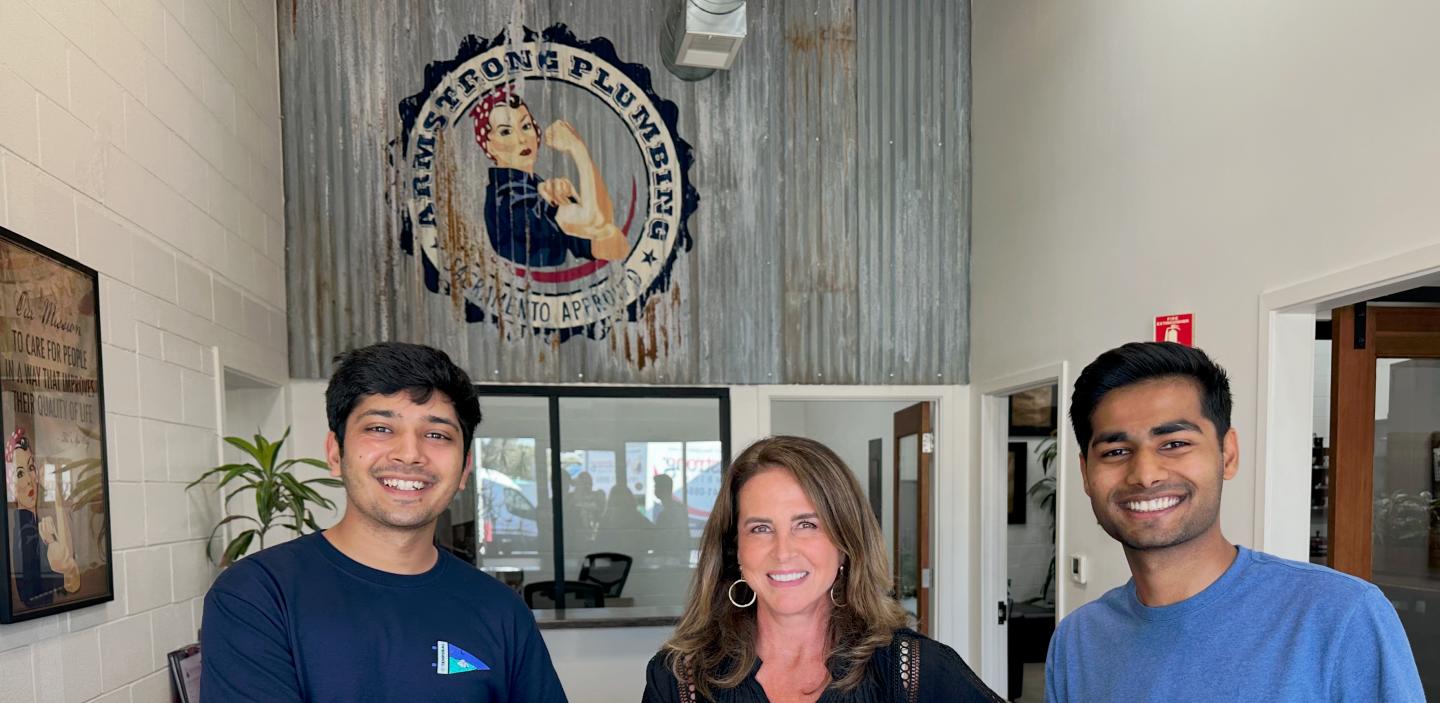
When Marcelle Flowers’ staff told her that two students were waiting at the counter of her Sacramento plumbing shop, she grabbed her wallet. She assumed they were selling chocolate bars for a soccer team.
“I literally said, you have five minutes,” recalled Flowers, now 62 years old. It was June 2024 and a deal to sell her business, Armstrong Plumbing, had fallen through months earlier. She was also “really opposed to AI,” she told Fortune. She feared it would take her people and “take all the jobs.”
The visitors were AJ Jain and Aditya Ketkar, two engineers in their mid-20s whose energy startup had just fizzled. They had spent that spring walking into about 140 contractors’ shops across Northern California, carrying a diary instead of laptops and offering no sales pitch.
“People were not treating us like salesmen,” Jain said. “Curious kids was, like, our persona,”
They had built exactly one thing worth showing: an automated appointment-reminder call for a San Francisco electrician.
Two years later, their company, Broccoli AI, has raised $52 million across its Series A and Series B. Khosla Ventures led both rounds, with Y Combinator and Operator Partners also participating. The raise was $22 million in Series A and $30 million in Series B, nine months apart, Jain, the company’s co-founder and CEO, told Fortune.
The Series A had not previously been announced. Broccoli is valued at $300 million post-money, according to a person familiar with the matter (Broccoli declined to comment on its valuation). The company had earlier raised in a $1.5 million seed round after going through Y Combinator.
And Marcelle Flowers is now working with the company. She got an apartment in San Francisco to work for them, and her life changed.
“If you had told me that I’d be running an AI company in the heart of San Francisco I would have laughed you out of the room,” Flowers said. “Like, furthest thing from my mind.”
What the company sells
Broccoli sells AI agents to plumbing, HVAC and electrical companies. They answer inbound calls, book jobs directly into the scheduling software the contractor already uses, follow up on open estimates, and renew service memberships.
The company says more than 1,500 businesses now use it, including Ace Hardware Home Services, Mr. Electric and Any Hour Group. In the past seven months it has added roofing, pool care, garage doors, home improvement, and exteriors.
Revenue has tripled since the Series A, Jain said, and headcount has grown from 15 people as of 12 months ago to more than 150. The company said the new money will go toward hiring engineers and salespeople as well as speeding up product development.
Owners wanted someone to answer the phone after the office emptied out at 5 p.m., close the books and chase the estimates technicians wrote up, Jain said. The company says its AI does work equivalent to roughly 30% of a typical contractor’s office staff.
‘The American Dream is still alive’
Jain, 27, is the first engineer in a family of business owners on both sides. He and Ketkar met at BITS Pilani in India in 2016 and have been starting companies together since 2017: a delivery app for closed college campuses, an interview-prep bootcamp, and, after Y Combinator, a universal API for electric vehicles that took them to London. They signed eight customers there in two years. “We couldn’t scale that business, even after raising a seed round from YC,” Jain said.
They arrived in San Francisco in January 2024. That May and June they went door to door across the Bay Area, then Stockton, Lodi, Modesto and Sacramento. They wanted an owner to build with.
At the utilities they had worked with before, Jain explained, he used to deal with product managers at 5,000-person companies. A contractor-owner, on the other hand, “cares about solving their customer’s problem.” Owners took them along on smoke breaks and told them how their fathers had started the business.
“The surprising thing is the American Dream is still alive,” Jain said, describing himself and Ketkar as two curious strangers who were met with trust and openness. “No one looked at our accents, our color.”
The turning point was when they met Flowers, who gave them five minutes that changed their lives, Jain said. It was eerie since it almost didn’t happen; Armstrong Plumbing was the only cold call they made twice.
They played her a recording of their one product, an automated call reminding customers of upcoming appointments. Flowers had just lost the employee who made those calls for her shop and hadn’t replaced her. “That hooks me,” she said.
Once the product worked for Flowers, her word of mouth took Broccoli from one customer to 10, and the door-knocking stopped. “She was the operator who helped us create this,” Jain said. “She’s the soul of the company.”
The woman at the counter
To understand this unlikely alliance, it helps to understand where Flowers came from. Born in 1963, she grew up in a blue-collar family in Anaheim, Calif., one of five children. Her father was a commercial plumber who built restaurants, hotels and schools, and plumbers were regulars at the family breakfast table, while her mother stayed home. “Very, very much Brady Bunch family,” Flowers said.
She was the middle child, and the “hellraiser.” At 14, she sat her parents down at dinner and told them they were done raising her. “From here on out, I got this,” she recalled saying, describing herself as “barely a high school graduate.” She got pregnant at 19, had her son at 20 and raised him as a single mother. “I really went sideways for a while,” she said. She found her faith at 26.
She has a name for that stretch of life, roughly ages 16 to 26: “the stupid stage.” Decades of hiring young tradesmen gave her patience for men still in it. “I have a lot of grace for people because I was one of those,” she said.
She joined her father’s company in 1995, then opened its residential service-and-repair business in 2011. She said she grew it from about $1 million to $8 million in seven years with no outside capital, operating in a “very male-dominated” field.
COVID hit hard. She said she was sick for about nine months with long COVID, and the business “tanked.” She had already battled cancer twice, she said, both times diagnosed as terminal, and was not expected to live past 35. “I have been through hell and high water in my life,” she said. After she failed to sell the business in 2023, something told her to “wait till June,” and that’s when she met the Broccoli boys. Then a five-minute pitch turned into a half-four consultation.
Within two days, Flowers recalled, Jain and Ketkar had loaded the reminder bot with her scripts. But her real pain was the answering service. She was paying $5,000 a month for one that booked jobs into her software 33% of the time and asked whether the founders could do for inbound calls what they’d done for outbound. “We had that in 10 days,” she said.
For about three months, Jain said, the founders stopped writing code in San Francisco and began doing it from Flowers’ shop in Sacramento while she explained how a contracting business worked. “They didn’t speak trade,” Flowers said. “They knew nothing about a plunger and a toilet.” She became their first customer, then an adviser, then COO.
Fans of AMC’s Halt and Catch Fire series will recognize the arrangement. In the show, John Bosworth, the Texas computer-company salesman played by Toby Huss, ends up running the business side of a startup founded by a far younger coder: part operator, part surrogate parent. She also designed the logo, the brand colors and the first trade-show booth. “In my own heart they were like my two kids,” Flowers said of her ostensible bosses. “I didn’t assume the mom role. I probably did a little bit.”
‘Not taking away jobs’
Jain and Flowers both say AI is a teammate rather than a replacement. Jain said a call-center representative at a Utah customer threatened to quit if the owner and his wife took Broccoli away. “It’s not taking away jobs,” Jain said. “It’s making jobs.” Owners who never took vacations now do, he said.
Still, Jain acknowledged limits to what he’s built. The AI is “maybe good at like 80% of the tasks,” he said, with the other 20% needing human judgment. Emergencies such as a flooding basement or a fire go to people in the contractor’s office.
Jain sees Broccoli as a “business in a box” that could let a young technician in, say, Columbus, Ohio, start a company without first hiring a receptionist and a bookkeeper.
By his telling, Broccoli has built maybe 1% of what it plans to, and his company competes with the AI labs “not just for talent, even for real estate,” Jain said. Its San Francisco office shares a parking lot with Cognition, and at least 30% of his engineers still work on-site with customers. Jain said he was in Utah visiting a customer the week before and was headed to Arkansas that Sunday to visit another.
“Half of the week is an existing customer who we are working with on a product that we’ve not even released yet,” he said. “We are at a scale which is, like, a growth-stage company, but you’re still in the zero-to-one phase because there’s so much more to build.”
Disclaimer : This story is auto aggregated by a computer programme and has not been created or edited by DOWNTHENEWS. Publisher: fortune.com




