

A billionaire technology investor who struck it rich with WiseTech Global has donated $10 million to buy 7000 hectares of cattle and logging land in the Great Dividing Range and turn it into a nature reserve.
In one of Australia’s biggest ever philanthropic gifts for land conservation, Mike and Sue Gregg from Sydney’s northern beaches funded the purchase of six adjoining properties in the mountains south-west of Port Macquarie by the private land conservancy they co-founded last year.
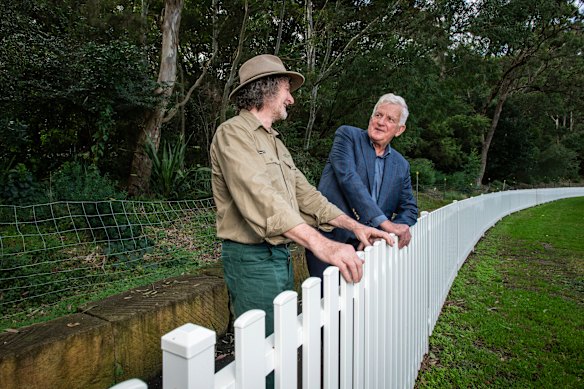
The charity, called Great Southern Land Conservancy, is helmed by Atticus Fleming, former head of the NSW National Parks and Wildlife Service. Gregg’s Shearwater Capital office in Edgecliff is a short walk from Trumper Oval where the two men met playing cricket in the late 1980s when Fleming was about 19 and Gregg 39.
“Generally, if we’re doing something significant, we like to know the CEO of the organisation, or the senior people of that organisation,” Gregg told this masthead in a rare media interview. “It’s a bit like my day job as an investor – you’re basically investing in people.”
With the final purchase completed last week, Fleming said the now-combined Eaglehawk-Misty Mountains property included tall moist forest, steep rainforest-clad gorges, wild rivers, and rich grassy woodlands, and was a haven for koalas, greater gliders and other threatened species.
The 7000 hectares, or 70 square kilometres, are equivalent to the size of the entire eastern suburbs plus part of the City of Sydney, or double the Inner West Council area. It stretches from Cottan-Bimbang National Park in the north between Walcha and Wauchope to the foothills adjacent Bugan Nature Reserve in the south.
Gregg was an early investor in ASX-listed software company WiseTech and debuted on the AFR Rich List in 2017 after the float. In 2025, he ranked 150th with an estimated $1.1 billion fortune.
Gregg said his wife, Sue, was the driving force behind the conservancy, and she came up with the name. They found it “really exciting” to work together on an ambitious project, after having separately “dabbled” in charity, he said.
“We found we had made a bit more money than we ever thought we would and to us that came with responsibility – we’ve got to think about how we’re going to do something with this, and it’s not buying a big yacht,” Gregg said.
“We’ve travelled quite a bit, and to some remote places – we went to Galapagos, we went to Easter Island, we’ve been to Macquarie Island, we’ve been to Africa. You see commonalities everywhere. The problems come when people cut down trees – ferals follow them, weeds follow them and suddenly you’ve got this environment that’s buggered. And once it’s buggered, it’s very hard to fix.”
A pivotal moment came about 10 years ago when the couple visited an Australian Wildlife Conservancy property on the Gulf of Carpentaria, taking a helicopter flight and then walking along a remote beach. Gregg said he rated this experience up with seeing turtle tracks on the sand in Galapagos.
Gregg said the environment was under-served by philanthropy compared with other causes such as medical research and the arts. Only about 4 per cent of philanthropic giving in Australia goes to environmental causes, industry figures say.
Sue Gregg, in her first ever public comments, provided a handwritten statement that said: “We found ourselves in the very fortunate position to do some good. We love nature and wildlife. So, we thought, preserving and restoring land was the best thing we could do with our money. There are many great causes in the world. We chose conservation of the Great Southern Land – Australia.”
Peak body Australian Land Conservation Alliance chief executive Jody Gunn said private conservancies such as Australian Wildlife Conservancy, Bush Heritage Australia, and The Nature Conservancy Australia played an essential role in nature protection in Australia.
The largest single philanthropic gift for land conservation in Australia is thought to have been an anonymous $21 million donation for the purchase of the 350,000-hectare Vergemont Station in western Queensland by The Nature Conservancy. Gunn said $10 million was probably the largest such donation in NSW.
“A gift of this scale has the potential for significant contributions to biodiversity and regional communities where delivered,” Gunn said.
Great Southern Land Conservancy’s other acquisitions include the 1300-hectare Morven Creek property west of Yamba and the 745-hectare Lands End property between Grafton and Glen Innes.
The Perth-based Wright-Burt Foundation co-funded the Morven Creek purchase, which adjoins Washpool National Park and has pockets of internationally significant rainforest and old-growth remnants.
Fleming said Lands End was a stronghold of greater gliders and other threatened species next to Guy Fawkes National Park. It included a perpetual lease over a tract of state forest, which provided an opportunity to argue that logging would be illegal.
“What we’re trying to do as an organisation is protect really important pieces of land for conservation, but also use the management to be strategic so that we can use each of these properties as a catalyst for broader impact,” Fleming said.
The Eaglehawk-Misty Mountains land has koalas, greater gliders, long-nosed potoroos, parma wallabies, spotted-tail quolls, stuttering frogs, Davies’ tree frogs, glossy black cockatoos, brown treecreepers, Stephens’ banded snakes and Manning River helmeted turtles. The wildlife will be monitored by 280 camera traps across 70 sites, and Fleming expects an intensive drone-base koala survey in mid-2026 to show that the reserve protects the largest population of koalas on private land in NSW.
The land will be managed for conservation, including management of fire, feral animals and weeds, while previously cleared areas will be restored. Some of Eaglehawk-Misty Mountains had been used for private native forestry until recently.
“Even for the last property that we acquired, the last piece of the puzzle, when I was inspecting that property with the ecologists, the logging trucks were taking giant blackbutt logs out,” Fleming said.
The charity would consider entering a conservation agreement with the NSW government for permanent protection, he said.
Get to the heart of what’s happening with climate change and the environment. Sign up for our fortnightly Environment newsletter.
 Caitlin Fitzsimmons is the environment and climate reporter for The Sydney Morning Herald. She was previously the social affairs reporter and the Money editor.Connect via email.
From our partners
Disclaimer : This story is auto aggregated by a computer programme and has not been created or edited by DOWNTHENEWS. Publisher: www.smh.com.au


