
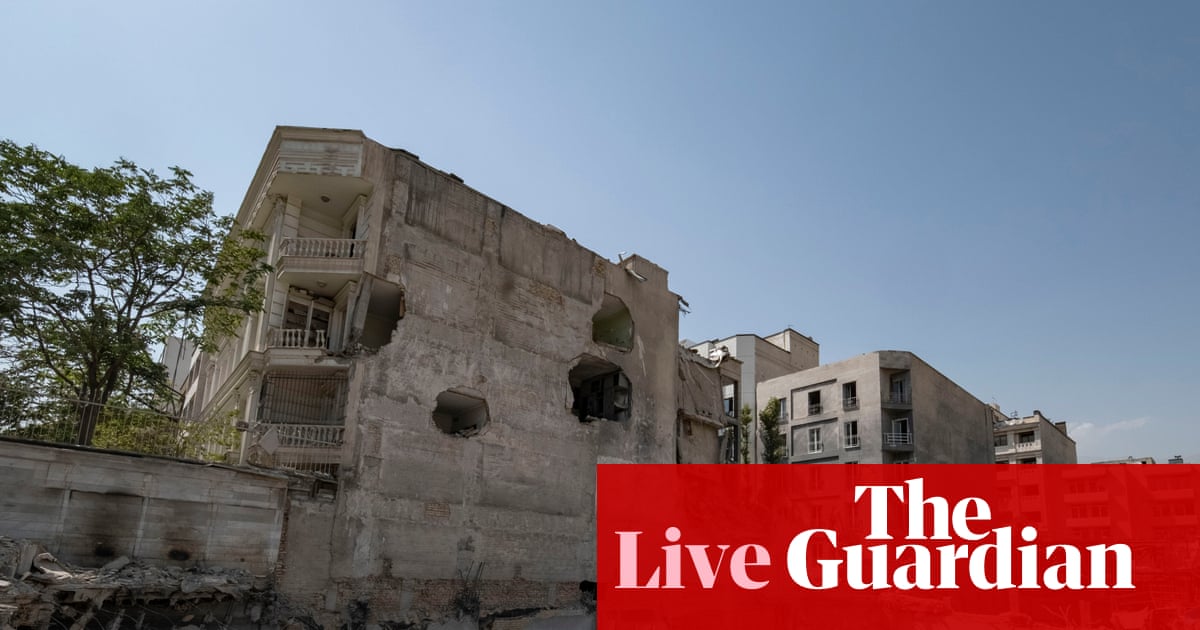
US central command (Centcom) has announced another night of strikes against Iranian targets.
This is the 13th consecutive night of strikes aimed to hold Iran accountable and diminish threats from the Islamic Revolutionary Guard Corps to commercial shipping.”
Iranian state media are reporting that multiple explosions have been heard in Iran’s southern city of Ahvaz.
Earlier on Thursday, Donald Trump has said he was close to deciding whether to launch “a massive attack” against Iran, on a scale larger than strikes already witnessed during the months-long conflict.
He acknowledged that such a decision would have consequences but said he had not yet made a final determination.
The US has ended its latest round of strikes against Iran, more than two hours after they began.
In a statement, US central command said that this 13th consecutive night of strikes targeted “Iranian military command centers, drone storage facilities, communication networks, coastal surveillance sites, and maritime capabilities.”
Iranian media has reported the sounds of explosions in the south of the country, close to the strait of Hormuz, as well as in the capital Tehran.
Iran rejected a US ceasefire proposal, communicated to Tehran by the prime minister of Iraq, the New York Times has reported.
Quoting anonymous Iranian and Iraqi offcials, the New York Times reports that after meeting Donald Trump in Washington earlier this month, prime minister Ali al-Zaidi travelled to Tehran and met with senior leadership. According to their report, Iranina officials were not interested in a temporary deal that “left the question of control over the Strait of Hormuz unresolved.”
As the violence between the US and Iran has escalated, Donald Trump has continued to claim over recent weeks that Iran is desperate to make a deal to end the fighting.
Speaking on the outskirts of the Asean conference in Manila on Thursday, secretary of state Marco Rubio said Iran was “begging for a deal”, and insisted “they need to come to their senses” and that they will “pay a very heavy price for the things they are doing.”
The UK government has said it is “ready to defend itself” after Iran’s military warned that any bases being used by the US were “legitimate targets”.
The UK has allowed the US to launch “defensive” operations from British bases hosting American planes since the start of its war on Iran but has refused to help in offensive operations.
That policy has not been altered by the new prime minister, Andy Burnham, who was notified last week that a decision had been made to extend the agreement with the US.
Iran’s Islamic Revolutionary Guard Corps said on Thursday that “any base used for aggression against Iranian territory constitutes a legitimate target for our forces”.
The IRGC also accused the “British monarchy regime” of causing being the “primary cause of hardships in our region with a black record of partitioning Islamic nations, widespread massacres, imposing despotic regimes, and organising the occupation of Palestine”.
It warned the government “not to weigh down its record any further”.
A spokesperson for the British government said: “Our armed forces are ready to keep the United Kingdom safe from any kind of attacks, whether it’s on our soil or from abroad. The UK stands ready 24/7 to defend itself.
Iranian media is reporting that air defences have been activated in Tehran to counter a “hostile threat”.
The Iranian capital has largely been spared from the US strikes launched since the ceasefire broke down earlier this month. Tehran came under attack for the first time in this latest round of strikes last week.
More reports of explosions heard across Iran’s south, as the US launches a 13th consecutive round of airstrikes.
State media is reporting explosions on Qeshm Island and in Bandar Abbas.
Bandar Abbas, on the strait of Hormuz is the headquarters of the Iranian navy, and has been hit by strikes every night since the latest escalation began nearly two weeks ago.
Earlier this week, the Guardian heard from Iranians living near the port, who said loud explosions followed by prolonged power cuts have become the norm over the past week.
We always had power cuts, but the hours have now extended and I fear I can’t rely on my online work any more. The war is far from the end and daily life is becoming harder under the bombs, power cuts and internet shutdowns. It’s truly hell here.”
The record of the number of US service members killed in the war with Iran has decreased on the Pentagon’s Defense Casualty Analysis System.
The website, which tracks US casualties across a range of conflicts, had shown 18 dead on Wednesday, according to the New York Times. However, by Thursday, that number had lowered to 14.
Four US service members have been killed in the last week, as fighting between the two sides has escalated.
The New York Times quotes a Pentagon press secretary as saying the change in the count is due to “temporary data disruptions”.
However, the papers also carries quotes from ananoymous military officials who said that the Trump administration decided to remove the four service members killed over the past week, because their deaths “occurred after President Trump declared a cease-fire in the war in April.”
Amid reports of US shortages of vital munitions, Reuters has heard from current and former US officials who say the Houthi threats to impose a naval blockade could further strain the US military.
Donald Trump suggested this week that any move to obstruct shipping in the Red Sea could draw the US in.
But Reuters reports it may not be so simple for the US military.
Taking on the Houthis would mean stretching American resources already focused on fighting Iran and maintaining the United States’ own blockade of Iranian ports in the Gulf.
Jason Campbell, a former senior Pentagon official, said that addressing the Red Sea threat could mean shifting US warships from the Gulf closer to Yemen to allow the military to carry out operations against the militants and defend against Houthi missiles.
And if US Navy vessels and aircraft have to start shooting down Houthi drones and missiles, it could also worsen what experts have warned are diminished stockpiles of U.S munitions and air defence interceptors.
The rate at which the US military is exhausting some of its most advanced weapons is a point of “great tension inside the Trump administration”, CBS News reports.
The dwindling stockpiles of defensive interceptors and long-range missiles have become a pressure point for top military and civilian leaders who are weighing the demands of the war with Iran against maintaining readiness to deter other adversaries, including China.”
The CBS report highlights the inability of the US to produce these weapons fast enough to keep pace with the rate they are being expended in the war against Iran.
US defence secretary Pete Hegseth appeared before the Senate appropriation committee this week, and requested $67bn in emergency defense funds for his department for 2026. He also demanded a $454bn increase for 2027 military spending, to a total of almost $1.5tn.
“Without these funds, we face critical shortfalls,” Hegseth told the Senate panel, warning that it would threaten the defence department’s ability to “pay our service members, rapidly replenish equipment and munitions, and sustain vital operations without disruption”.
US central command (Centcom) has announced another night of strikes against Iranian targets.
This is the 13th consecutive night of strikes aimed to hold Iran accountable and diminish threats from the Islamic Revolutionary Guard Corps to commercial shipping.”
Iranian state media are reporting that multiple explosions have been heard in Iran’s southern city of Ahvaz.
Earlier on Thursday, Donald Trump has said he was close to deciding whether to launch “a massive attack” against Iran, on a scale larger than strikes already witnessed during the months-long conflict.
He acknowledged that such a decision would have consequences but said he had not yet made a final determination.
Despite the success of the two Chinese supertankers bypassing the Houthi blockade of the Bab el-Mandeb strait, at least two other vessels chartered by the same company and scheduled to pick up Saudi crude at the Yanbu port later this month have slowed their advance.
Data shows the vessels are due to enter the Res Sea, but are making small circles in the Gulf of Aden.
The delays are a sign of the effect the Houthi threats could have on the market. Full avoidance of the Red Sea, through which a quarter of global container trade passes on its way to and from the Suez canal, requires rerouting around Africa via the Cape of Good Hope. That journey roughly doubles the voyage length and adds an estimated $2m-$2.5m in cost for each transit.
Two Chinese supertankers carrying a combined 4m barrels of Saudi Arabian oil exited the Red Sea via the Bab el-Mandeb strait on Thursday, apparently escaping the blockade on shipments of Saudi oil by the Houthis.
Their transit came as other Saudi vessels came under attack.
The Singaporean-flagged VLCC Xin Long Yang, which made a U-turn and paused in the middle of the Red Sea on Tuesday, resumed its journey southward late on Wednesday, shipping data showed. The Chinese-flagged VLCC Cosnew Lake followed and both tankers exited the Red Sea later on Thursday, the data showed.
The Xin Long Yang was heading to the port of Qinzhou in southern Guangxi province, while Cosnew Lake is expected to discharge its cargo at the port of Huizhou, in the southern Chinese province of Guangdong, the data showed.
Both vessels indicated through their automatic identification system transmitters that there were Chinese crew onboard.
Experts say the transit of the Chinese tanker suggest the Houthis are being selective in the vessels they target – and that the blockade is being enforced differently depending on the flag or destination.
Donald Trump’s suggestion that the US could use Iranian frozen assets to pay for war damage comes as his administration threatened to step up attacks, and Yemen’s Houthis struck Saudi shipping and sent oil prices soaring.
Trump said the US would hold Iran responsible for the Houthis’ actions and warned both would soon receive a “major military punishment”.
On Thursday Brent crude surged past $100 a barrel for the first time since May, up 7%.
European Central Bank president Christine Lagarde warned “the energy shock could intensify further” and push up inflation, feeding speculation about a September eurozone interest rate hike.
German defence minister Boris Pistorius, meanwhile, warned of “dire consequences” for oil-importing economies and said “nothing – absolutely nothing – suggests that a ceasefire, let alone peace, could be reached”.
Donald Trump has suggested that damage caused to shipping by Iranian attacks could be paid for using Tehran’s assets frozen overseas.
Please let this statement serve to represent, until further notice, that from this point forth, any and all damages done to Ships, Cargo, or anything related thereto, will be paid for by Iranian Money that the United States has in its possession, and controls.”
It’s unclear whether the US would be able to use frozen assets in such a way; any move would probably be challenged.
Europe has faced an array of issues in its attempts to use Russian frozen assets to fund Ukraine.
-
The UN secretary general, António Guterres, warned that the Middle East is being pushed to the “edge of the unimaginable” amid mounting fears over the trajectory of the conflict. “The situation is getting out of control. It is teetering on the edge of the unimaginable. The region is being pulled into an ever-widening circle of confrontation. One crisis feeds another. One escalation triggers the next,” Guterres told a security council meeting. “As this dynamic spreads, the political objectives are becoming increasingly obscured by the confrontation itself.”
-
It comes after Donald Trump said he was close to deciding whether to launch “a massive attack” against Iran, on a scale larger than strikes already witnessed during the months-long conflict with Tehran as the US president flounders in his attempts to get a grip on the spiralling crisis in the region. Speaking to Axios, the US president said: “I am considering a massive attack. Bigger than ever before. I am close to making a decision. We are all set for it.” He acknowledged that such a decision would have consequences but said he had not yet made a final determination. Israel “would join in two minutes if I ask them to”, he added, before saying: “We don’t need anybody.”
-
Trump’s comments followed the earlier threat of “major military punishment” against Iran and the Houthis, after the Iran-backed Yemeni militia’s attacks on two Saudi Arabian oil tankers in the Red Sea. The Houthi attacks threatened the safety of a second major maritime route connecting the Suez canal to the Red Sea and Gulf of Aden. They also came amid reports that Iran had sent military advisers and drone parts to the Houthis 10 days ago. Trump wrote on social media: “If [the Houthis] do this again, the US will hold Iran responsible, in that the Houthis are a Surrogate and/or Proxy of Iran, and major military punishment will be inflicted upon Iran and, of course, the Houthis, themselves.”
-
In a separate development, Trump clarified that an announced agreement that the US would help Saudi Arabia with its civilian nuclear programme would require the kingdom to normalise relations with Israel through the Abraham Accords, a move Saudi Arabia has long resisted until there is demonstrable movement on Palestinian rights and statehood. During Thursday’s press briefing, Karoline Leavitt, the White House press secretary, reiterated that the Saudi Arabia nuclear deal is “contingent” on the kingdom on joining the Abraham Accords. “The president is always the final dealmaker, as you know… He has said, if they don’t join the Abraham accords, the deal is off,” she said. It emerged later that Trump had not spoken to Saudi Arabia about the new condition.
-
Oil prices once again surged past the symbolic $100 for a barrel of Brent crude, the international benchmark, and amid indications the price could go higher still.
“Whenever Trump starts taking about massive military action on Iran, everything changes in Iran overnight. Parents begin to stock up on food, groceries, and medicine; school administration fears opening the school, and children ask questions that no parent should have to answer. My biggest fear tonight is not anything but to watch another generation of Iranian children grow up believing that war is normal for us. We have already lived very difficultly through sanctions, inflation, and uncertainty. Another escalation and broader war would only deepen the anxiety that families carry with them every single day,” Sahar, a 38-year-old teacher from Tehran who uses only a single name, told the Guardian.
“In hospitals and medical facilities, we prepare for emergencies whenever there is a political statement of potential attacks. Even if there are no attacks taking place, the psychological impact is immediate about such ultimatums. Normal patients and families become more anxious, healthcare workers and medics worry about shortages, and people delay treatment because they fear what may happen next. The human cost of these threats on Iranians begins long before any attacks actually start,” Neda, a 31-year-old doctor from Tabriz, told the Guardian.
Iran’s top negotiator and parliamentary speaker, Mohammad Bagher Ghalibaf, has mocked the US military’s strategy aimed at degrading Tehran’s ability to control the strait of Hormuz, and suggested it has backfired.
“They wanted to punish Iran. Punished themselves with triple-digit oil instead. 10/10 strategy,” Ghalibaf said on X.
Oil prices rose above $100 a barrel for the first time in two months earlier on Thursday after the Houthis attacked two Saudi oil tankers, as a fresh escalation of the conflict threatens to compound disruption to global oil supplies.
Disclaimer : This story is auto aggregated by a computer programme and has not been created or edited by DOWNTHENEWS. Publisher: theguardian.com



