-
The fourth round of negotiations between Israeli and Lebanese officials have begun in Washington, according to Lebanon’s official National News Agency (NNA). NNA has just reported the talks “began a short while ago” at the US state department headquarters.
-
Lebanon’s health ministry said Tuesday that Israeli strikes a day earlier near a hospital in the southern city of Tyre killed four people and wounded 127 others, including 39 staff from the facility. The ministry statement said the wounded staff at the Jabal Amel hospital were “four doctors, 27 nurses, and eight [administrative] employees – four of whom are in critical condition and receiving treatment in intensive care”.
-
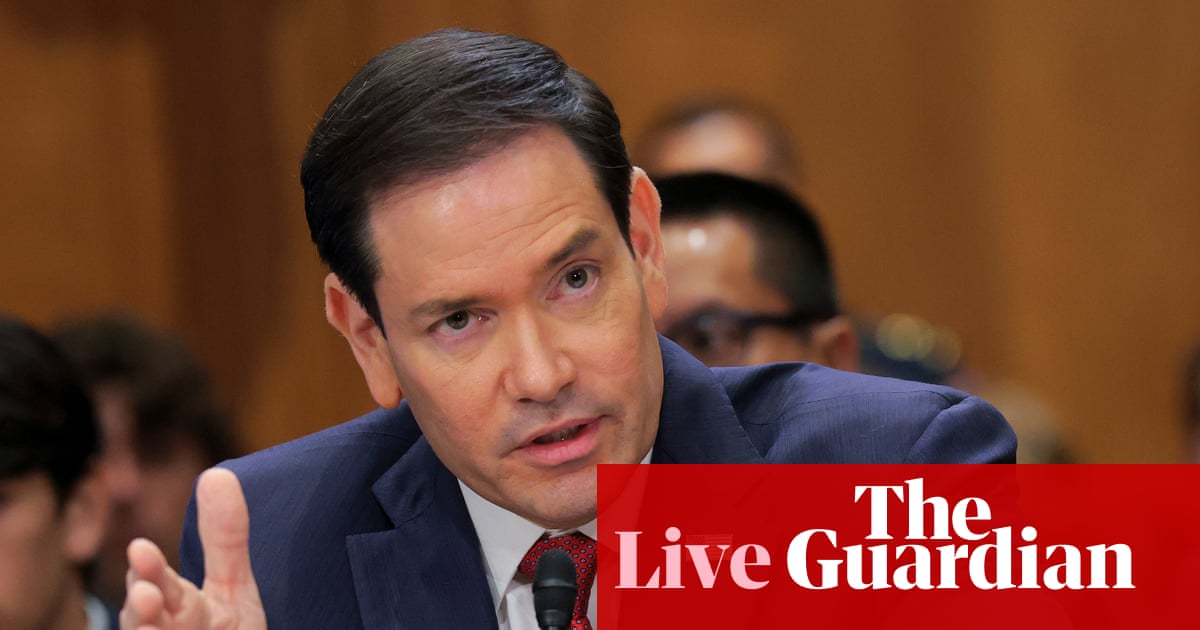
US secretary of state Marco Rubio told lawmakers on Tuesday that Iran had agreed to negotiate aspects of its nuclear programme that it previously refused to discuss. However, he said that was not a guarantee that talks will lead to a deal to end the US-Israeli war on Iran.
-
Rubio told the committee that Iran’s supreme leader Mojtaba Khamenei is alive and “increasingly engaging”. “I would imagine, given what’s happened to multiple leaders in that system, being very public is probably not something that’s recommended for them internally,” he said.
-
Rubio said he is optimistic about the potential for a resumption in nuclear talks with Iran despite a shaky ceasefire in the war looking increasingly in doubt. “They have agreed to negotiate aspects of their nuclear program that just a month ago, just a year ago, they were refusing to even mention,” Rubio told the US Senate foreign relations committee. He did not elaborate.
-
The Israeli defence minister, Israel Katz, said the US has backed plans to strike Beirut’s southern suburbs if Hezbollah attacks northern Israel. The remarks came after Israel appeared to pull back from immediate threats of attacks on Beirut’s southern suburbs, known as Dahiyeh, following an intervention by US president Donald Trump.
-
German chancellor Friedrich Merz on Tuesday called on Israel to exercise restraint in its campaign in southern Lebanon, where a three-month war with Hezbollah has killed more than 3,400 and uprooted over 1.2m people. Merz said Germany viewed the latest escalation in the south with great concern and urged Hezbollah to lay down its arms.
-
The Israel Defense Forces (IDF) has once again issued a warning telling people in the southern Lebanese city of Nabatieh to flee their homes and move north ahead of strikes. It is the third such warning in a week for one of southern Lebanon’s largest cities, home to tens of thousands of people, which has seen continued Israeli strikes in recent weeks despite a ceasefire.
-
The Lebanese armed forces said two soldiers were injured “as a result of being targeted by a hostile Israeli drone” on a road between the towns of Habbouch and Deir ez-Zahrani in southern Lebanon. There was no immediate comment from the Israeli military.
-
Lebanon’s official National News Agency (NNA) has reported at least eight deaths this morning from Israeli bombings in southern Lebanon. That is despite Donald Trump announcing an agreement to halt attacks that neither Israel or Hezbollah have publicly accepted.
Hezbollah will not accept a “partial ceasefire” with Israel, a senior official from the Iran-backed group said Tuesday, refusing to halt attacks against northern Israel in exchange for Israel sparing Beirut’s southern suburbs.
“We will not accept a partial ceasefire,” Mahmud Qomati told AFP in a written statement, adding that “the Zionist enemy should know that any aggression against the suburbs could lead to a deeper and stronger response” from the group.
On Monday, US president Donald Trump announced a deal which Lebanese officials later said involved Israel refraining from attacking Beirut’s southern suburbs in return for Hezbollah not attacking Israeli territory.
Rubio said he is optimistic about the potential for a resumption in nuclear talks with Iran despite a shaky ceasefire in the war looking increasingly in doubt.
“They have agreed to negotiate aspects of their nuclear program that just a month ago, just a year ago, they were refusing to even mention,” Rubio told the US Senate foreign relations committee. He did not elaborate.
He added, however, that it’s “not a guarantee that ultimately it will lead to a deal that’s acceptable” and that these negotiations have been made difficult by the instability of Iran’s leadership.
US secretary of state Marco Rubio has told the committee that Iran’s supreme leader Mojtaba Khamenei is alive and “increasingly engaging”.
“I would imagine, given what’s happened to multiple leaders in that system, being very public is probably not something that’s recommended for them internally,” he said.
“But that said, I think there are indications out there that he is increasingly engaging at some level, although all of his communications have been in writing and through intermediaries.”
Rubio has said Iran will not get sanctions relief for reopening the straight of Hormuz and that any relief ought to be “conditions-based”.
The US secretary of state said Iran “has to announce very clearly that Hormuz strait is open now”, which he said is the first condition in any talks with the country.
He added that Iran must also commit to specific negotiations on the disposition of highly-engaged uranium.
US secretary of state Marco Rubio told lawmakers on Tuesday that Iran had agreed to negotiate aspects of its nuclear programme that it previously refused to discuss.
However, he said that was not a guarantee that talks will lead to a deal to end the US-Israeli war on Iran.
Rubio told senators Iran had intended to build up its conventional weapons capabilities as a “shield” for its nuclear program.
“What they tried to do is they were going to try to build a conventional shield and hide behind that conventional shield,” he said, explaining why US president Donald Trump felt it was imperative to launch the war.
US secretary of state Marco Rubio faced chants from protesters who urged him to “stop killing Cubans” when he entered a Senate briefing room on Tuesday.
The protesters were quickly pulled from the room. Their chants also included “Let Cuba live!” as well as, “Repent Marco Rubio. God will forgive you for your sins. Stop killing Cubans.”
He is expected to face a litany of questions about the Trump administration’s fragile or stalling diplomatic efforts around the world when he appears for back-to-back hearings on Capitol Hill for the first time since the Iran war began.
Meanwhile, Donald Trump has tapped a close ally to serve as the country’s top intelligence official, days after Tulsi Gabbard announced her exit from the role.
The US president said that Bill Pulte, head of the Federal Housing Finance Agency (FHFA), and heir to a home construction company fortune, will serve as acting director of national intelligence.
Pulte has used his role at the FHFA to publicly level of a string of extraordinary allegations at Trump’s political opponents and enemies.
“William has deep experience managing the most sensitive matters in America,” Trump said on his Truth Social Platform.
Pulte will remain director of the FHFA, Trump said.
Gabbard, herself a controversial pick for the job, resigned last month, ending a tenure that saw her appear to be at odds with Trump over Iran war.
We have an early image of the ambassadors of Israel and Lebanon ahead of a new round of direct talks in Washington:
The fourth round of negotiations between Israeli and Lebanese officials have begun in Washington, according to Lebanon’s official National News Agency (NNA).
NNA has just reported the talks “began a short while ago” at the US state department headquarters.
We will bring you more as we get it.
Lebanon’s health ministry said Tuesday that Israeli strikes a day earlier near a hospital in the southern city of Tyre killed four people and wounded 127 others, including 39 staff from the facility.
The ministry statement said the wounded staff at the Jabal Amel hospital were “four doctors, 27 nurses, and eight [administrative] employees – four of whom are in critical condition and receiving treatment in intensive care”.
The attack “also caused severe and extensive damage across the hospital’s various floors, departments and parking lot,” it added.
German chancellor Friedrich Merz on Tuesday called on Israel to exercise restraint in its campaign in southern Lebanon, where a three-month war with Hezbollah has killed more than 3,400 and uprooted over 1.2m people.
Merz said Germany viewed the latest escalation in the south with great concern and urged Hezbollah to lay down its arms.
Disclaimer : This story is auto aggregated by a computer programme and has not been created or edited by DOWNTHENEWS. Publisher: theguardian.com