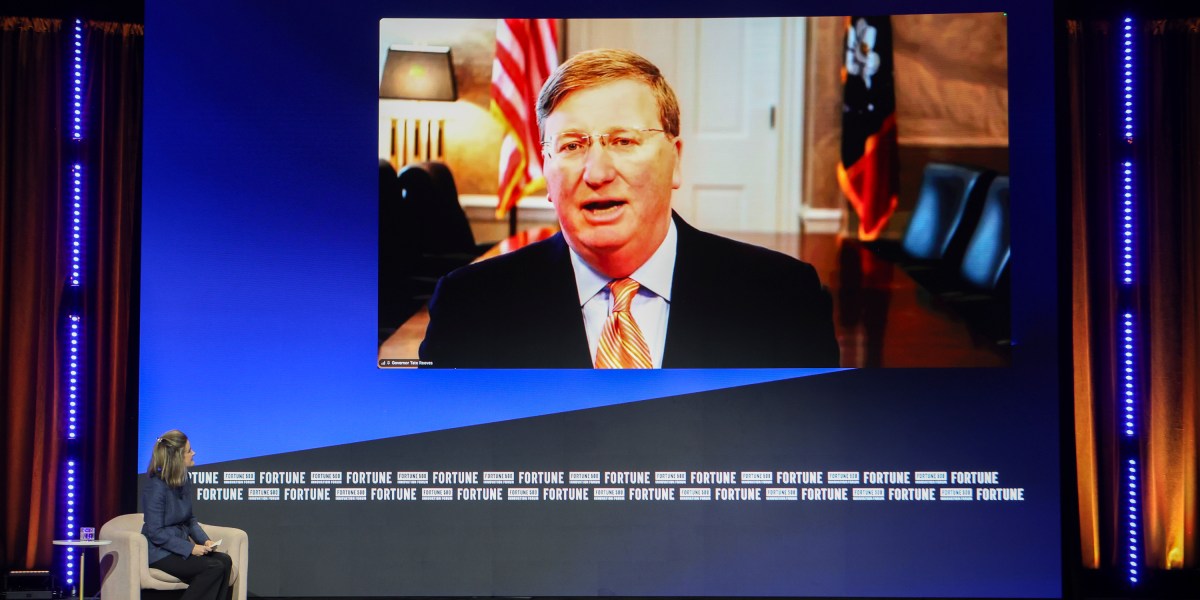
U.S. voters made their opinions on data centers known at the ballot box this month—opposing data center expansion in 52 of 53 measures in the midterm elections—but Republican Mississippi Gov. Tate Reeves believes Americans have lost track of the necessity of the AI infrastructure buildout.
Speaking with Fortune Executive Editor Lee Clifford at the Fortune 500 Innovation Forum in Detroit on Tuesday, Reeves argued many Americans don’t realize how often they rely on AI infrastructure in their day-to-day lives. He said when he meets with large groups in his state and across the U.S., he tells them to pick up and look at their cell phone, asking if they’ve used the device today, particularly their GPS.
“And if the answer is yes, then you have used a data center today, and everybody in America uses data centers regularly,” Reeves said. “And so, in terms of necessity and the need for everyday American citizens, it is without question that there is going to be a need to keep this data.”
Mississippi has 38 data center projects total, including 17 operational data centers. Earlier this year, Amazon announced a $25 billion investment in data centers in the state. However, research has overwhelmingly shown Americans oppose local data center construction on the grounds of environmental concerns, as well as fears of climbing utilities bills and electricity costs.
Reeves argued data centers’ utility goes beyond technology in his constituents’ pockets, and that they are an asset to national security. He cited litigation between the NAACP and xAI, in which the NAACP Mississippi State Conference sued the AI company on the grounds that the operation of the gas turbines used to power an xAI data center did not attain the appropriate permits outlined through the Clean Air Act. The Department of Justice moved to dismiss the lawsuit on the grounds that halting the data center’s operation would threaten “national, economic, and energy security,” as the Department of Defense requires continuous data center operations to maintain AI capabilities.
However, a federal judge denied the motion to dismiss the lawsuit last month, noting that suing xAI on the grounds of it allegedly violating the Clean Air Act did not unconstitutionally supplant executive power.
“Both the Department of War and the Department of Justice have gone on record saying how important certain data centers are to America’s ability to protect itself and to our national security, and I take them at their word,” Reeves said.
The Mississippi governor also invoked the theory pushed by billionaire investor Kevin O’Leary and President Donald Trump that foreign adversaries wanting to limit U.S. competition in the global AI race are planting negative narratives about data centers online in an effort to stoke pushback that would hamper America’s AI buildout.
“I believe that there is no doubt that, particularly in social media circles, that there is a concerted effort by some of our adversaries to make data centers unpopular,” Reeves said. “And I think they’ve been relatively successful at doing so.”
Policy experts have dismissed this theory—of which proponents have offered little evidence—as a means of scapegoating China, the U.S.’s predominant rival in the AI race.
“Anyone who doubts it should just show up to any of the communities where people are actually fighting data centers,” Ben Green, assistant professor of information at the University of Michigan, told Fortune earlier this year. “Show up to a town hall, show up to a city council meeting, and you will just very clearly see that these are people who live in this community [and] are clearly very upset about this.”
Reeves said he’s taken seriously the pushback he’s gotten from constituents about data center expansion and plans to answer questions about water use and noise pollution, which he said could be addressed by locating the AI infrastructure in industrial parks.
“We look at all of the questions that are out there surrounding data centers, and we try to make good, sound, rational decisions based upon the facts that we have available to us,” he said. “What I’ve said to the people of Mississippi is, all of these questions that are being asked are absolutely legitimate, and every single one of those questions deserves an answer.”
Disclaimer : This story is auto aggregated by a computer programme and has not been created or edited by DOWNTHENEWS. Publisher: fortune.com