
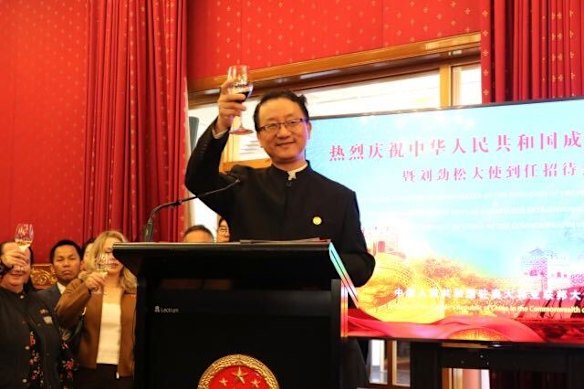

The days of the diplomatic deep freeze felt a long time ago as Beijing’s new ambassador to Australia rose to a podium at the Chinese embassy for a ceremony marking the assumption of his official duties.
Bonhomie was in the air on a dazzling spring day in the capital as Canberra’s diplomatic elite gathered to catch their first glimpse of Liu Jinsong, who presented his credentials to Governor-General Sam Mostyn last week. A soprano sung the soaring song I Love You, China; waiters laid out a traditional Chinese banquet of prawn dumplings and lamb chops.
Among those in the crowd were India’s high commissioner Nagesh Singh, Australia’s former ambassador to China Graham Fletcher and Israel’s deputy ambassador Amir Meron. Unsurprisingly, Meron did not exchange pleasantries with Iran’s charge d’ affaires Hossein Talebi (who has led the Iranian embassy since the nation’s ambassador was spectacularly expelled last year over the firebombing of Jewish sites in Sydney and Melbourne).
With Prime Minister Anthony Albanese and Foreign Minister Penny Wong in New York for the United Nations General Assembly, the government was represented by officials from their departments and the Department of Defence.
Absent was new United States ambassador David Brat, who jetted into the country last week. In a quirk of timing, the top diplomats from the world’s two superpowers are beginning their Canberra postings at the same time. Reflecting the disorientating era in which we live, it was the US embassy lashing out at Australia this week (for trying to regulate big tech) while China’s was all smiles.
Clutching a glass of red wine, the fresh-faced 54-year-old Liu proposed a toast to the future of Australia-China relations, and a successful meeting in Washington between US President Donald Trump and Chinese President Xi Jinping in Washington.
This was not time to emphasise differences but to accentuate the positive – and implore both sides to pursue even deeper ties.
“China and Australia have no historical grievances and no fundamental conflicts of interest,” Liu said.
“We should be partners of mutual trust and mutual success. We must remain true to the original aspiration and uphold the right way of conducting relations between our two countries. We must promote mutually beneficial and win-win outcomes through practical cooperation.”
As well as upgrading the China-Australia free trade agreement, Liu called for the nations to explore cooperation in areas as artificial intelligence, clean energy and green minerals.
Liu’s predecessor Xiao Qian was a savvy operator whose tenure spanned the shift as COVID-era trade restrictions melted away and normal diplomatic contact resumed. But Xiao’s charm offensive often came with a Sichuan pepper kick – as when he accused ASIO of fabricating foreign interference claims, urged Australians to be wary of Japan and warned of retaliation if Australia takes back the Port of Darwin from a Chinese-owned company.
Liu is best known for a photo taken last year when he was Beijing’s Asian Affairs chief. Following a meeting with Japanese counterpart Masaaki Kanai, Liu was filmed looking down at his opposite number dismissively as Kanai appeared to bow (he was leaning in to listen to a translator). The photo went viral in China because it seemed to suggest Japan had been forced into position of subservience after a period of rising tensions between the two nations.
Australian Institute of International Affairs chief executive Bryce Wakefield, who attended Thursday’s welcoming ceremony, says Liu should not be pigeonholed or underestimated. “His seniority, particularly as head of the Asia bureau, suggests that Beijing is taking its relationship with Australia seriously,” he argues.
“He is capable of taking a forceful public line, as seen in his dealings with Japan, but reducing him to a ‘wolf warrior’ misses the experience and policy range he brings to the Canberra posting. He seems to be more a competent technocrat who can navigate complex relations.”
Flashpoints – missiles over the Pacific, espionage accusations, trade disputes – are sure to emerge as Liu’s posting continues, straining diplomatic ties. But this was a day for sweetness, not spice.
Cut through the noise of federal politics with news, views and expert analysis. Subscribers can sign up to our weekly Inside Politics newsletter.
 Matthew Knott is the foreign affairs and national security correspondent for The Sydney Morning Herald and The Age.Connect via X, Facebook or email.
From our partners
Disclaimer : This story is auto aggregated by a computer programme and has not been created or edited by DOWNTHENEWS. Publisher: www.smh.com.au



