This story is part of The Better India’s new wildlife series, Species in Focus: 52 species. 52 stories. 52 reasons to protect India’s wildlife. One species at a time, the series explores India’s rare, endangered and lesser-known wildlife, their habitats, behaviour, ecological roles and conservation status.
In a Tamil comic, the hero is a small, spiny mammal that most people would struggle to identify.
Mullikkaattu Ithigaasam — ‘Legend of the Scrub Forest’ — was created to introduce children to the Madras hedgehog, or Mulleli, and the scrubland it calls home.
Ecologist Brawin Kumar worked with artist Venkatesh Babu on the Tamil-language comic. Through the story, they introduce children to the animal, explain its place in the ecosystem, and address some of the beliefs surrounding its spines and medicinal use.
It is an unusual conservation tool for an unusual animal.
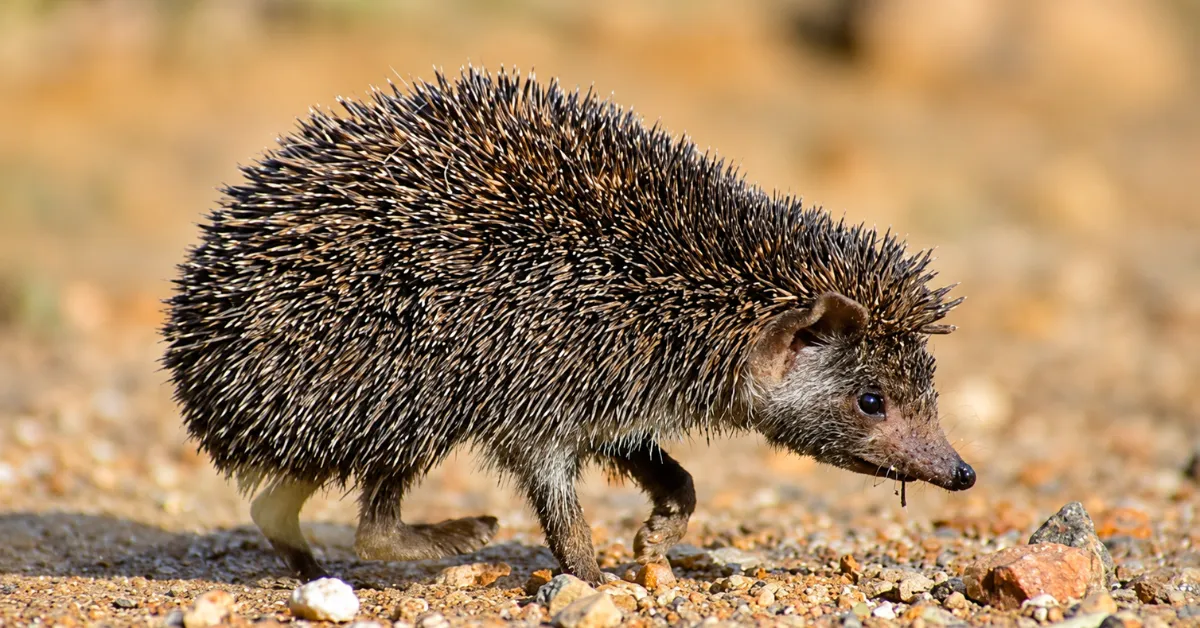
The Madras hedgehog (Paraechinus nudiventris) is endemic to peninsular India, yet remains one of the country’s least-studied mammals.
There are no reliable estimates of how many survive today.
While the comic is helping children discover an animal they may never have seen, documents and scientific studies reviewed by The Better India show why this little-known mammal is now attracting attention.
A hedgehog of the scrub
The Madras hedgehog is not the Indian hedgehog found across parts of northwestern India.
Its historical range extends across peninsular India, with records from Tamil Nadu, Kerala, Karnataka, Andhra Pradesh and Telangana.
A 2024 study by Brawin Kumar and William T Bean, published in the Journal of Threatened Taxa, examined past and present records of the species. It found that its current climatic niche is concentrated in lower-elevation, semi-arid parts of southern and central Tamil Nadu.
The researchers described the species as occurring in isolated patches and highlighted habitat loss and direct killing as threats.
The first clues came from roads
Some of the clearest evidence of road mortality does not come from a recent accident database.
In a 2018 paper published in Mammalia, Brawin Kumar, Jacques Togo and Ranjit Singh reviewed available distribution records and documented additional localities and threats.
Between 2012 and 2017, the researchers recorded the species at 103 localities in Tamil Nadu, including 18 live sightings.
They also documented roadkills. Two were recorded in 2013 — one at Kothapalayam in Tiruppur district and another at Papanasam in Tirunelveli district. The Papanasam record came from the foothills of the Kalakad–Mundanthurai Tiger Reserve.
Between June 2014 and February 2016, wind-energy workers reported 16 additional Madras hedgehogs killed along Radhapuram Road and Gangai Kondan Road in Tirunelveli district.
/filters:format(webp)/english-betterindia/media/media_files/2026/09/23/hedgehog-2026-09-23-09-38-53.png)
These records are important because they place road mortality on specific roads and within a defined period.
But they do not tell us how many hedgehogs are killed on roads across Tamil Nadu each year.
When threatened, the Madras hedgehog curls into a tight ball, raising its spines to protect itself from predators. On a road, however, that defence offers little protection from a speeding vehicle. The animal’s instinct is to curl up rather than flee, leaving its natural armour no match for a car’s wheels.
In 2024, a study published in Conservation assessed the species’ distribution using field visits, community interviews and rescue records collected between 2012 and 2022.
The researchers compiled 230 sightings across 19 districts of Tamil Nadu.
But 230 sightings should not be mistaken for 230 animals or a population estimate.
A sighting tells researchers that an animal was present at a particular place and time. It cannot establish whether populations are declining, or whether two apparently separate records belong to the same population.
That is the central challenge in understanding the species.
The IUCN currently lists the Madras hedgehog as Least Concern.
What happens beyond the map?
The picture becomes more complicated when the animal is viewed from the ground.
In Tenkasi district, a 2025 Journal of Threatened Taxa study surveyed 1,141 people across 38 villages to understand their perceptions of and interactions with the species.
The research documented reports of hunting and the use of hedgehog body parts. Among respondents who reported hunting, 38% cited the skin, 41% the spines and 19% meat.
The study also recorded roadkill and identified habitat loss and urbanisation as conservation concerns.
How much habitat is actually left?
Another 2025 study by ecologists Brawin Kumar, Thekke Thumbath Shameer, Abinesh Muthaiyan and Sophie Lund Rasmussen attempted to identify areas that could be prioritised for conservation.
Using fieldwork conducted between June 2016 and March 2023, the researchers estimated around 7,737 sq km of suitable habitat for the species in Tamil Nadu.
But the picture remains incomplete.
Tamil Nadu starts looking closer
In January 2026, the Tamil Nadu Forest Department began its first dedicated study of the Madras hedgehog in the Theri forests of Thoothukudi district.
The one-year study is intended to contribute to a conservation action plan.
The state government allocated Rs 20.5 lakh for Madras hedgehog conservation for 2025–26, according to reports.
This is where the comic returns
A tiger or an elephant needs little introduction. The Madras hedgehog has no such visibility.
Even people living alongside it may know the animal through local names, beliefs or occasional encounters rather than through conservation messaging.
Mullikkaattu Ithigaasam tries to change that by placing the hedgehog within the story of the scrub forest.
The documented deaths at Kothapalayam and Papanasam in 2013, the 16 roadkills recorded along Radhapuram and Gangai Kondan roads between 2014 and 2016, and the rescue and sighting records collected up to 2022 do not tell us how many Madras hedgehogs remain.
That is the paradox of a species currently classified as Least Concern: its formal status sits alongside a shortage of information about its population.
For now, one of the simplest ways to make the Madras hedgehog more visible may be to give it a place in the stories children grow up with.
Sources:
‘Distribution, perception, and conservation challenges of endemic Madras Hedgehog in Tenkasi District, Tamil Nadu: insights from questionnaire surveys’: By Brawin Kumar, Abinesh Muthaiyan, Published on 26 April 2025
‘Mapping the Distribution of the Endemic Madras Hedgehog Paraechinus nudiventris in Tamil Nadu, India’: By Brawin Kumar , Sophie Lund Rasmussen, Mohammed Thanvir, andMohammed Shahidh
‘Saving the Madras Hedgehog’: By V. Vijaysree, Published on 2, May 2026
‘First forest department study on Madras Hedgehog in Thoothukudi begins’: By S Godson Wisely Dass, Published on 25 January 2026
Disclaimer : This story is auto aggregated by a computer programme and has not been created or edited by DOWNTHENEWS. Publisher: thebetterindia.com