It’s a stressful time for Australian flyers because our favoured routes to Europe have been unavailable due to the conflict in the Middle East.
For those in this part of the world it’s an inconvenience that hopefully won’t – surely can’t – last for months. For many thousands of people in those countries horribly affected by the conflict, it’s a lot more than that – it’s terrifying and existential.
By comparison, our worries are small. But that doesn’t negate the fact that many travellers – those with plans locked in to travel over the next few weeks and months, as well as those conflicted about whether to travel or not – have plenty of reasonable concerns right now.
The pandemic is not a distant memory, and the Middle Eastern shut-down has pandemic vibes.
I’m writing this at a time when everything is still uncertain and events are wildly see-sawing. My flight on Qatar to Italy in June was cancelled this week, but the airline offered me another, less direct one.
Sign up for the Traveller newsletter
The latest travel news, tips and inspiration delivered to your inbox. Sign up now.
I had to think long and hard about accepting it. I don’t want to get stranded in Doha, where I wouldn’t have the protection of the Australian government or insurance, due to its “Do Not Travel” status.
I’ve flown many times across conflict zones (I think many of us have) and I’ve never felt particularly unsafe before. But this conflict’s unpredictability and the targeting of civilian infrastructure, especially in the “safe” Gulf states, made me rethink.
So I have been looking into other flights, like many people. Airlines, seizing an opportunity, have inflated prices on alternate routes – the joys of a market-based economy!
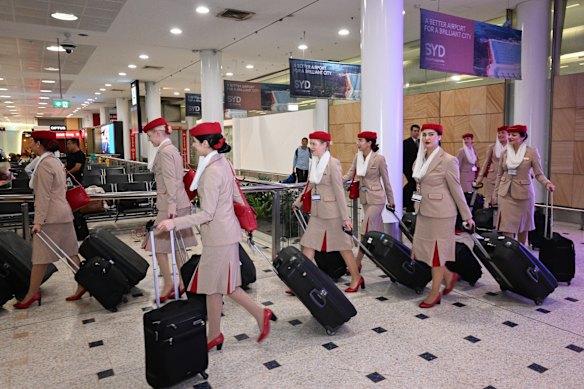
I will get there one way or another or defer the trip. One group of people who don’t have much of a choice, though, are the flight attendants, especially those contracted to Emirates, Qatar, Etihad, Oman Air and other airlines with home bases in the Middle East.
According to the New York Times, Cirium Aviation Analytics estimates that more than 52,000 flights to and from the Middle East – more than half of all flights scheduled in the region – were cancelled in the two weeks after hostilities began on February 28.
Many airline crews were stranded there at the start of the war. While they were eventually repatriated, their unions are concerned about the effect of the constant cancellations and ongoing upheaval on their jobs.
They’re required to handle it all with a tight smile. Sometimes while missiles are within a few kilometres of the plane.
The war has disrupted global oil supplies and fuel prices, putting tremendous financial strain on the fuel-dependent airline industry. Unions reasonably worry this could lead to mass layoffs of members.
And they worry about something that seems in play this time round: physical danger.
When military forces start targeting civilian airports, there’s a risk of an accident to commercial aircraft.
I don’t mean to be alarmist. Irritating disruptions due to rescheduling are probably the worst that will happen to anyone using these regional airlines. But it’s a tense moment.
I’ve always wondered how calm flight attendants truly are when faced with dangerous scenarios. The airlines obviously go to great lengths to keep passengers, crew and aircraft safe. But war is not what anyone signed up for.
Last year, when a flurry of missiles from Iran suddenly started up across the region, I was on an Emirates aircraft that took off from Athens, even as all other flights were grounded.
I arrived in Dubai to find an empty airport, with multiple flights cancelled – only then did I find out about the missiles.
On the next leg, the flight attendant told me crews that were in the air could see the missiles in the distance.
Throughout both flights, the Emirates flight attendants were the picture of calm. Maybe they’ve seen it all and it takes a lot to unsettle them. Or perhaps they’re so well-trained they have learnt how to disguise their true feelings.
When anything happens on a flight, including delays, unscheduled stops and the entertainment system failing, they’re the people we call on. We carefully watch their faces when the turbulence gets severe. We depend on them in ways that aren’t always obvious.
Professional hazards for flight attendants are many – drunk passengers, seat-reclining obsessives, rampaging football teams, medical emergencies, uncontrolled children, squabbles over locker space and travellers with a strong sense of entitlement.
They’re required to handle it all with a tight smile. Sometimes while missiles are within a few kilometres of the plane.
They deserve our gratitude – and best behaviour.
 Lee Tulloch – Lee is a best-selling novelist, columnist, editor and writer. Her distinguished career stretches back more than three decades, and includes 12 years based between New York and Paris. Lee specialises in sustainable and thoughtful travel.Connect via email.
From our partners
Disclaimer : This story is auto aggregated by a computer programme and has not been created or edited by DOWNTHENEWS. Publisher: www.smh.com.au