
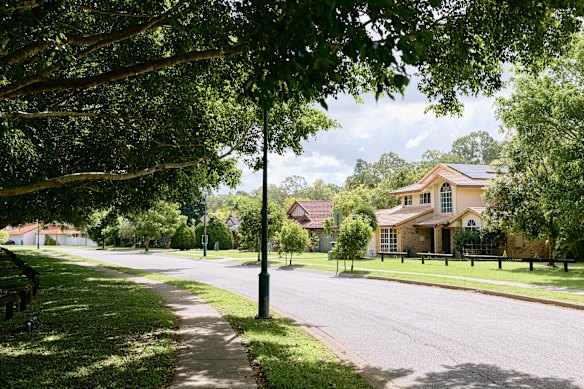
Although I’ve moved six times in the past six years, I’ve only truly called one place home for almost 30 years.
I’ve shuffled from place to place as a reporter, heading out to Queensland’s Southern Downs and down to Sydney for work but, through it all, my family home in Bridgeman Downs has been a constant.
My parents bought our first home in the suburb in the late ’90s as an empty block, part of a subdivision of an old farm. They built our house on Constellation Crescent just in time for my birth.
For the majority of my childhood, paddocks with cows and horses lined either side of the main road heading north, and the “Welcome to Brisbane” sign and the pony club were just around the corner.
Heading north also meant passing the neighbourhood’s acreage properties, which most people still think of as the norm in our suburb. It features the famous “Millionaires’ Row” – huge estates along Beams Road that were the source of neighbourhood gossip about brothers who had gone bankrupt halfway through one of the builds.
Mum sold our home last year, downsizing to the west side of town, where the rest of our family now lives. When I was helping her pack, I inevitably went down the rabbit hole of going through my childhood things. Inside one box was a finger painting of what I immediately recognised as our first home.
I knew the kidney-shaped pool, the banana tree our dog, Indiana Jones, used to sit under waiting for fruit to drop, and the garden big enough for three rowdy kids to chase said dog in laps around the house. Not featured, but just as important in my memories, were the cubby house my grandad built us and the flying fox my dad attached to it.
It wasn’t until I had lived in other places that I realised just how rare my childhood suburb was. On the very edge of Brisbane’s north, it felt very much like growing up in the country.
I saw more snakes there than I did living in Warwick, and was banned from going into nearby bushland for fear of wild dogs.
We had neighbourhood foxes, hares, possums, koalas, bats, and even a platypus. The kangaroos became such an issue, the council built fences on either side of the main road.
I was banned from going into nearby bushland for fear of wild dogs.
As I grew up, I watched the neighbouring farms get sold and subdivided. Just before I started high school, we moved a few streets over to the newest development. The blocks were smaller, but the cows at the top of the street made it feel more like the country than ever.
I spent high school and university in that home, enduring the COVID lockdown. During that decade, the animals largely disappeared and the little pockets of homes became what seemed like one sprawling housing development.
The thing is, in the early 2000s, there was not much else in Bridgeman Downs but homes. Nowadays, there are several churches, a cemetery, and one corner of ever-changing shops, where it seems nothing survives except the real estate agent.
Going to a Bridgeman Downs school was never an option, and I never played on a Bridgeman Downs sports team. Every doctor’s appointment and grocery trip involved travelling to Albany Creek or McDowall. Cafes? A drive away. Nowadays, there’s a chiropractor with a cafe attached. There’s no train station, but the 350 bus now comes every half hour instead of hourly.
The suburb has always felt a little unclaimed, divided by state and federal lines. Sure, council has improved the untamed bushland that I wasn’t allowed into as a child. The wild dogs are gone, and running tracks have taken their place. But in the absence of any proper oversight from our leaders, the private developers stepped in.
The population of Bridgeman Downs has tripled to almost 11,000 since the late ’90s, and not a single new service has been added. The subdivision of farms and acreage into new homes means a lot of young families are surrounded by schools that are at, or almost at, capacity. When my mum put our house on the market, the “in-catchment” high schools listed by the real estate agent included a private girls’ school 30 minutes away.
Maybe it’s the flow-on effect of the population boom in Chermside, which is close enough to be a hub for Bridgeman Downs residents. But it all feels like a problem that those in power could have solved along the way.
Living in the city’s west now, I see flashes of my childhood in places like Brookfield and Pullenvale – likely targets for Brisbane’s ever-growing sprawl. These suburbs have more of an identity than Bridgeman Downs ever did, with more services for a much smaller population.
I looked up our first home while writing this, but everything once familiar to me is gone. The owners who came after us essentially levelled the garden, pulling out mum’s garden beds and the hedges dad carved into tunnels for me after I read too much Enid Blyton and demanded a secret passageway.
For years, my view of Bridgeman Downs was skewed by nostalgia, no more true to life than a finger painting. It was my favourite place because I could go there and everyone I loved would be there too. Now I can see it more for what it is, and what it could be.
From our partners
Disclaimer : This story is auto aggregated by a computer programme and has not been created or edited by DOWNTHENEWS. Publisher: www.smh.com.au


