Good morning. Companies are increasingly calling on CFOs to help steer AI strategy and deliver real value.
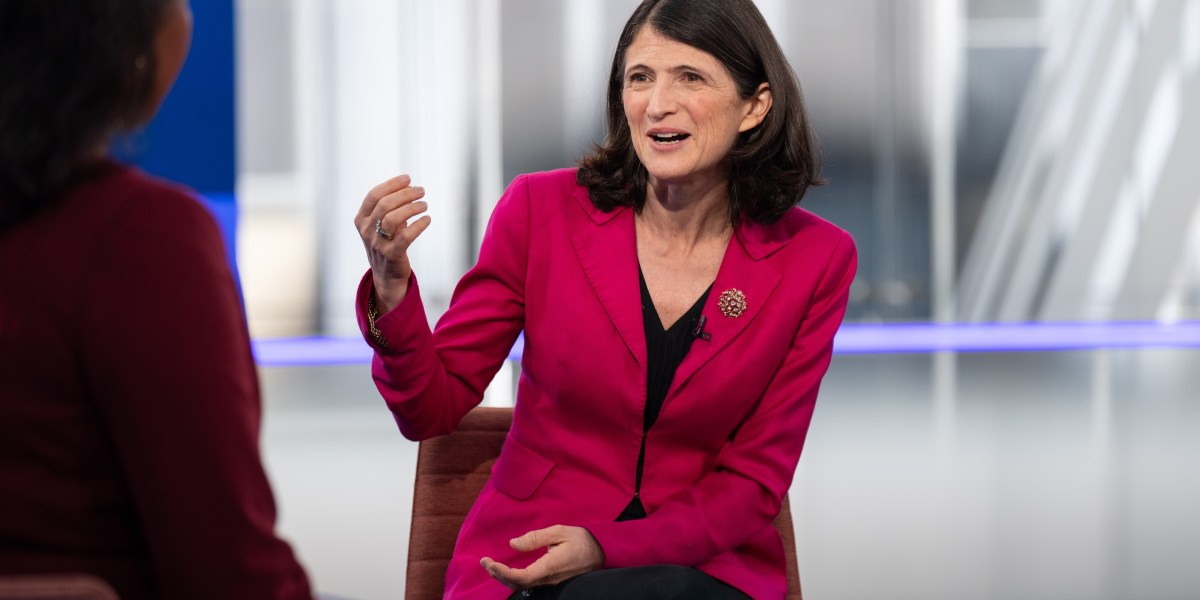
Sarah Youngwood, EVP and CFO of Nasdaq, doesn’t view AI as a standalone initiative. Instead, she sees it as an embedded capability—one that is reshaping everything from market infrastructure to internal finance operations. Over the years, AI has been a transformative force for Nasdaq. Once known primarily as a stock exchange, the company has evolved into a large-scale software and technology provider for the financial industry, which has helped fuel its return to the Fortune 500.
Nasdaq’s New York headquarters sits above Times Square, where the company’s screens beam market signals to the street. Earlier this month, I visited Youngwood, who works a few stories up in a 26th‑floor corner office with large windows and a sprawling view of the Midtown skyline. The finance team sits right outside her office, where they can easily collaborate.
Today, Nasdaq’s strategy centers on three pillars: architecting modern markets, powering the innovation economy, and building trust across the financial system. Youngwood argues that AI sits at the core of all three. Nasdaq Verafin’s Agentic AI Workforce platform, launched last year, is now used by 650 financial institutions.
The approach is beginning to deliver results. Nasdaq landed at No. 470 on the Fortune 500 this year, returning to the ranking five years after its 2021 debut.
“AI is only as good as your data,” Youngwood told me. Her advice for companies embarking on an AI journey is to first focus on the data. The next step is training your team and measuring their engagement—and leaders have to undergo training themselves. “If you don’t do it yourself, you’re not going to appreciate how extraordinary this technology is, and you also need to lead by example,” Youngwood said.
She also emphasized that you can’t stop at the first iteration. If you accept that it is an iterative process, you can end up with something that works really well, she said.
In finance, AI is going to continue to be “incredibly powerful” for forecasting. Combining macro assumptions, pipeline data, and leadership actions to enable real-time decision-making is one of the most exciting use cases, she said. But its impact spans everything from cash allocation to invoice processing and beyond. Governance and human oversight are essential to the process, she added.
I also spoke with Youngwood about how finance employees now earn belts for AI proficiency the way martial artists do, how her career background informs her decision-making, and her approach to technology investment at Nasdaq. You can read the complete article here.
Youngwood also offers advice to Gen Z when it comes to AI. You can see a clip of our studio interview here.
Sheryl Estrada
sheryl.estrada@fortune.com
Leaderboard
Fortune 500 Power Moves
David M. Denton was appointed EVP and CFO of Nike, Inc. (No. 99), effective August 17. Matthew Friend will step down as EVP and CFO at that time and remain with the company through Sept. 4. Denton joins Nike from Pfizer, Inc., where he has served as CFO and EVP since May 2022. He brings more than 30 years of finance and operating leadership experience. Before Pfizer, Denton served as CFO and EVP of Lowe’s Companies, Inc. Earlier in his career, he spent two decades at CVS Health Corporation, including as EVP and CFO.
Every Friday morning, the weekly Fortune 500 Power Moves column tracks Fortune 500 company C-suite shifts—see the most recent edition.
More notable moves
Steve Cirulis was appointed CFO and chief strategy officer at The Wendy’s Company (Nasdaq: WEN), effective June 23. Cirulis will succeed Ken Cook, who has served as CFO since 2024 and will remain in an advisory position through July. Cirulis most recently served as CFO and chief strategy officer for Potbelly Sandwich Works. Before Potbelly, Cirulis held senior strategy and finance roles at global restaurant and retail brands, including Panera Bread, McDonald’s, and Gap, Inc. His career spans nearly 30 years across the food, beverage, retail and restaurant spaces.
Axel André was named partner and CFO of TPG Inc. (Nasdaq: TPG), a global alternative asset management firm, effective July 27. André will succeed Jack Weingart, who will transition fully into his position as the CEO of TPG’s Global Wealth Solutions business. André joins TPG from Reinsurance Group of America, Inc., where he served as EVP and CFO. Before RGA, he was CFO of American Equity Life and Jackson National and earlier served as CFO and chief risk officer of the Individual and Group Retirement Services division of AIG.
Big Deal
KPMG’s 2026 Banking Technology Survey finds that AI is rapidly shifting from experimentation to real impact across the sector, with a clear majority of executives expecting it to significantly disrupt their business and operating models within three to five years. AI, payments modernization, cybersecurity, and tech-driven M&A are increasingly seen as interconnected priorities rather than separate tracks, underscoring a push to balance speed with control—advancing transformation while managing risk and delivering growth.
The survey also highlights banks’ responses to rising cyber risk and the reinvention of payments. Roughly three-quarters of institutions report more cyberattacks, with more than 90% increasing investment in defenses, and strong adoption plans for instant payment capabilities and richer data standards like ISO 20022. Technology is emerging as a key driver of M&A strategy over the next two to three years, reinforcing the idea that AI and data are now central to competitive positioning in banking, not just efficiency plays.
Going deeper
“Tesla cofounder JB Straubel’s first pitch to Elon Musk failed. Then he turned his ‘hobby’ into a $1.3 trillion success” is a Fortune article by Rachel Ventresca.
Ventresca writes: “JB Straubel had spent years building solar-powered vehicles in his spare time ‘basically as a hobby,’ he told Fortune earlier this month on the sidelines of Brainstorm Tech in Aspen, Colo. ‘That was sort of my pathway into becoming passionate about electric vehicles, and then also meeting Elon, ultimately.'” Read more here.
Overheard
“The middle manager does not go extinct. The pyramid does.”
—Brett Hurt, CEO of Love Conquers Fear, and the author of The Entrepreneur’s Essentials, writes in a Fortune opinion piece. Hurt argues: “Middle management existed because knowledge was expensive to move. AI removes that bottleneck entirely. It doesn’t just flatten the pyramid—it makes it the wrong shape.”
Disclaimer : This story is auto aggregated by a computer programme and has not been created or edited by DOWNTHENEWS. Publisher: fortune.com