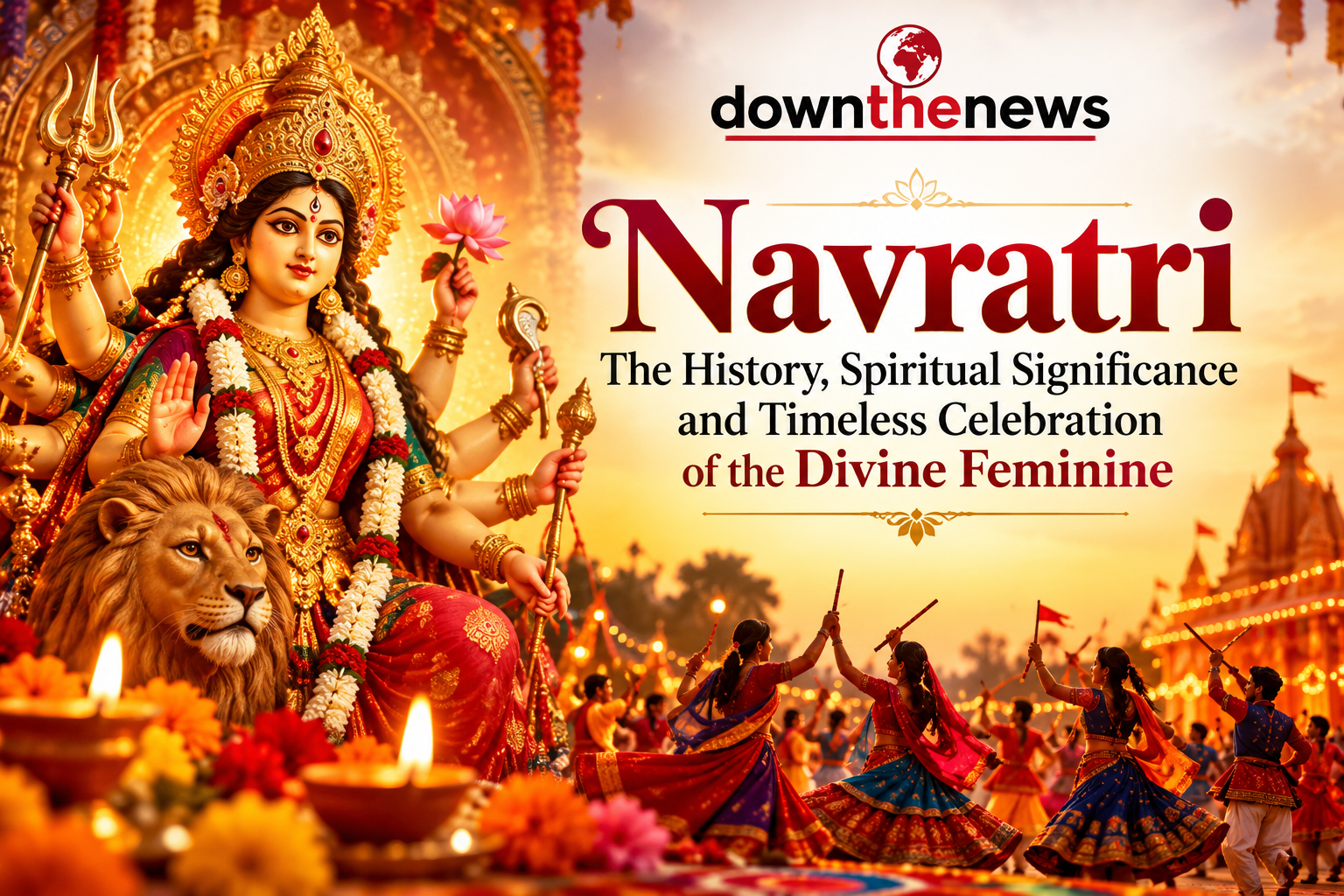
Navratris: The History, Spiritual Significance and Timeless Celebration of the Divine Feminine


Every year, as the festive spirit sweeps across India, homes glow with the light of diyas, temples echo with devotional songs, colourful pandals welcome worshippers, and communities come together in celebration. It is the arrival of Navratri, one of Hinduism’s most cherished festivals, dedicated to the worship of Goddess Durga and the divine feminine power known as Shakti.
Celebrated over nine nights and ten days, Navratri represents far more than a religious observance. It is a festival of faith, courage, discipline, renewal and the eternal triumph of good over evil. From the ancient stories of Goddess Durga’s battle against the buffalo demon Mahishasura to the vibrant Garba celebrations of Gujarat, the sacred rituals of North India and the elaborate Golu displays of South India, Navratri reflects the extraordinary diversity of India’s spiritual and cultural heritage.
For millions of devotees, these nine nights offer an opportunity to pray, fast, reflect, seek blessings and reconnect with the values of compassion, strength and righteousness. Across generations, the festival has continued to evolve while preserving its essential message: the power of truth, the strength of the feminine and the enduring victory of light over darkness.
1. What Does Navratri Mean?
The word Navratri comes from two Sanskrit words: Nava, meaning nine, and Ratri, meaning night. Together, they signify the festival of nine nights dedicated to the worship of the Goddess.
The principal deity is Goddess Durga, revered as a manifestation of Shakti, the universal energy believed to sustain creation and life. Depending on regional traditions, worship may also focus on Lakshmi, the goddess of prosperity, and Saraswati, the goddess of knowledge, learning and the arts.
Navratri is celebrated several times during the Hindu lunar calendar, but two observances are particularly prominent:
-
Chaitra Navratri: Celebrated during the Hindu lunar month of Chaitra, generally in March or April, and associated with the beginning of the Hindu lunar new year in several traditions.
-
Sharad Navratri: Celebrated during the lunar month of Ashwin, generally in September or October. It is the most widely celebrated Navratri festival in many parts of India and culminates in Vijayadashami, also known as Dussehra.
Other observances include Magha Gupta Navratri and Ashadha Gupta Navratri, which are particularly associated with specialised spiritual practices and worship of the Goddess.
Although customs differ across regions, the central theme remains consistent: honouring divine energy and celebrating the victory of righteousness over destructive forces.
2. The Ancient History of Navratri


The history of Navratri is deeply connected with India’s ancient religious traditions, the development of Goddess worship and the enduring place of Shakti in Hindu philosophy. However, the festival did not necessarily emerge as a single event at a precisely identifiable historical moment. Its present-day form developed over centuries through the blending of sacred texts, regional customs, agricultural cycles, temple traditions and community celebrations.
Goddess worship in ancient India
The worship of powerful female deities has a long history in the Indian subcontinent. Ancient religious traditions honoured goddesses associated with fertility, protection, prosperity, nature and the forces that sustain life.
Over time, diverse forms of goddess worship became integrated into Hindu religious thought. The concept of Shakti came to represent the dynamic cosmic power through which the universe functions. In Shakta traditions, the Goddess is not merely a supporting figure but the supreme divine reality itself.
Navratri provides an important annual occasion for expressing this understanding through prayer, fasting, offerings, music and ritual worship.
It is important to distinguish the broad antiquity of goddess worship from the specific history of Navratri: evidence for ancient goddess traditions does not establish that the festival was celebrated in exactly its modern form during the earliest periods of Indian civilisation.
The significance of the Devi Mahatmya
One of the most important sacred texts associated with Navratri is the Devi Mahatmya, also known as the Durga Saptashati or Chandi Path. It forms part of the Markandeya Purana and is generally dated by scholars to approximately the fifth or sixth century CE.
The text narrates the Goddess’s battles against forces threatening cosmic order. Its accounts of Madhu and Kaitabha, Mahishasura, and Shumbha and Nishumbha establish the Goddess as a powerful protector of the universe.
The Devi Mahatmya has played a major role in shaping the religious understanding of Durga and her manifestations. Recitation of its verses remains an important practice during Navratri, particularly among devotees who perform Chandi Path or related rituals.
Through its stories, the text conveys a central spiritual idea: when destructive forces threaten harmony, divine power arises to restore balance.
How Navratri developed over time
As Hindu religious practices expanded and diversified, Navratri became associated with temple worship, royal patronage, local goddesses, agricultural traditions and seasonal festivities.
Different communities developed their own ways of observing the festival. Some emphasised fasting and meditation; others organised public worship, dance, music, theatrical performances or elaborate temple ceremonies.
In eastern India, autumnal Durga Puja became a major religious and cultural institution. In western India, Garba and Dandiya Raas developed into defining features of Navratri celebrations. In northern India, devotional gatherings and the performance of the Ramayana story became closely connected with the festive season.
Consequently, Navratri is best understood as a living tradition with multiple regional histories rather than a festival that originated in one place and spread unchanged throughout the country.
3. The Legend of Goddess Durga and Mahishasura

The most widely known story associated with Sharad Navratri is the battle between Goddess Durga and Mahishasura, a powerful demon whose name means buffalo demon.
According to Hindu mythology, Mahishasura performed severe penance and received a boon that made him believe he could not be defeated by any man or god. Empowered by this protection, he began challenging the gods and threatening the established order of the universe.
Unable to overcome him, the gods united their divine energies. From their combined power emerged Goddess Durga, a radiant and formidable warrior who embodied courage, wisdom and supreme strength.
The gods equipped her with divine weapons, and she mounted a lion or tiger, depending on the artistic and regional tradition. She then confronted Mahishasura in a prolonged battle.
The demon repeatedly changed his form, attempting to escape defeat. Ultimately, Durga overcame him, restoring balance and demonstrating that arrogance and destructive power could not prevail indefinitely against righteousness.
This victory is remembered through the worship of the Goddess during Navratri and the celebration of Vijayadashami.
What does the story teach us?
The legend carries several layers of meaning beyond its mythological narrative.
-
The victory of good over evil: Destructive forces may become powerful, but they do not possess an unquestionable right to rule.
-
The power of unity: The gods’ combined energies symbolise the strength that emerges when different abilities work towards a shared purpose.
-
The strength of women: Durga defeats a formidable enemy when other divine powers have proved insufficient, establishing the Goddess as a symbol of independent strength and leadership.
-
The struggle within ourselves: In spiritual interpretations, Mahishasura can represent ego, anger, greed, arrogance and other tendencies that prevent people from living wisely.
The Goddess’s victory therefore becomes both a cosmic event in sacred mythology and a metaphor for the individual’s struggle to overcome harmful thoughts and actions.
4. Why Are Nine Nights Celebrated?
The nine nights of Navratri are traditionally devoted to nine manifestations of Goddess Durga, collectively known as the Navadurga. Each form carries a distinct name, iconography and spiritual association.

Day 1 — Maa Shailputri
The daughter of the mountains, Shailputri represents stability, purity and a strong foundation. Her worship is associated with beginning the spiritual journey with determination and devotion.

Day 2 — Maa Brahmacharini
She symbolises penance, discipline, patience and dedication. Her form reminds devotees that meaningful achievements often require perseverance and self-control.

Day 3 — Maa Chandraghanta
Associated with courage, alertness and protection, Chandraghanta represents the strength to confront difficulties without surrendering one’s sense of purpose.

Day 4 — Maa Kushmanda
She is associated with the creation of the universe and the radiance of cosmic energy. Her worship celebrates creativity, vitality and the power to bring new possibilities into existence.

Day 5 — Maa Skandamata
The mother of Skanda, or Kartikeya, she represents maternal love, compassion, protection and selfless care.

Day 6 — Maa Katyayani
Katyayani embodies courage, determination and the readiness to confront injustice. She is also associated with devotion and the fulfilment of spiritual aspirations.

Day 7 — Maa Kalaratri
Although her appearance is fierce, she is revered as a protector who destroys fear and dispels darkness. Her form reminds devotees that confronting difficult truths can be necessary for transformation.

Day 8 — Maa Mahagauri
Associated with purity, serenity, forgiveness and peace, Mahagauri represents the possibility of renewal and the cleansing of negative tendencies.

Day 9 — Maa Siddhidatri
Siddhidatri is associated with spiritual accomplishments, wisdom and divine blessings. Her worship marks the culmination of the nine-day journey.
The Navadurga tradition gives each day a distinctive spiritual focus. Devotees may offer flowers, fruits, sweets and prayers, recite sacred texts, observe fasts or meditate on the qualities represented by each form.
The particular rituals and interpretations vary among families and religious traditions. The nine forms are not merely separate deities in a sequence; they also express the many dimensions of divine feminine power, from nurturing compassion to fearless protection.
5. The Spiritual Significance of Navratri
Navratri occupies a special place in Hindu spiritual life because it brings together devotion, self-discipline, introspection and celebration.
Worship of Shakti: The divine feminine
Shakti is understood in Hindu philosophy as the energy that animates the universe. Without this dynamic power, creation, preservation and transformation would not be possible.
Goddess Durga expresses this energy through strength and protection, Lakshmi through abundance and well-being, and Saraswati through knowledge, creativity and learning.
The worship of the Goddess therefore recognises that power has many dimensions. True strength can mean defending the vulnerable, cultivating knowledge, showing compassion or bringing harmony to a community.
Fasting and self-discipline
Many devotees observe fasts during Navratri, while others follow a simplified diet or abstain from particular foods. The practices vary according to family customs, regional traditions and personal circumstances.
For many people, fasting is a form of devotion and an opportunity to develop self-control. Prayer, meditation and the recitation of sacred texts may accompany it.
The deeper emphasis is not simply on avoiding food but on becoming more conscious of one’s habits, behaviour and intentions. Fasting is not compulsory for every devotee, and religious observance can take many forms.
Inner purification and renewal
The nine nights can be understood as an invitation to examine one’s life. Devotees may reflect on resentment, jealousy, dishonesty, excessive pride or impatience and make a conscious effort to replace these tendencies with kindness, humility and discipline.
In this sense, the battle between Durga and Mahishasura becomes an inward journey. The forces of negativity are not defeated through prayer alone in a purely symbolic sense; the spiritual lesson is also to put one’s values into practice through everyday choices.
Gratitude and abundance
Navratri is also a time to express gratitude for family, livelihood, education, health, food and the natural world. Offerings made during worship represent reverence and thankfulness.
For agricultural communities, seasonal festivals have historically provided an opportunity to acknowledge the importance of rainfall, fertile soil, harvests and the rhythms of nature.
6. The Historical and Cultural Significance of Navratri Across India


One of the most remarkable features of Navratri is the way the same broad spiritual theme inspires different cultural expressions across India. The Ministry of Tourism’s festival resources highlight these regional traditions as an important part of the country’s living heritage.
Gujarat: Nine nights of Garba and Dandiya
Gujarat is internationally recognised for its vibrant Navratri celebrations. Every evening, communities gather in homes, temples, neighbourhood grounds and large public venues to perform Garba and Dandiya Raas.
Garba is traditionally performed in circular formations around a central lamp, an earthen vessel or a symbolic representation of the Goddess. The circle is often interpreted as a reminder of life’s continuity and the relationship between human existence and the divine.
Dandiya Raas, performed with decorated sticks, adds another dimension to the festivities. Traditional folk songs, rhythmic percussion and colourful clothing create an atmosphere of shared devotion and celebration.
Over time, these community traditions have expanded into large public events, attracting visitors and supporting musicians, artisans, costume designers, food vendors and event organisers. Yet neighbourhood gatherings and family celebrations remain central to the festival’s identity.
West Bengal: Durga Puja and the return of the Goddess
In West Bengal, the autumn festival is celebrated with extraordinary enthusiasm as Durga Puja. Elaborate pandals house beautifully crafted idols depicting Goddess Durga defeating Mahishasura, often accompanied by representations of Lakshmi, Saraswati, Kartikeya and Ganesha.
The festival combines sacred rituals with artistic expression, community participation, music, food and public gatherings. Artists and craftspeople spend months preparing idols and decorative structures.
A major part of the celebration is the belief that the Goddess visits her earthly home, with the final immersion of idols marking her departure. The atmosphere blends devotion with the emotions of welcome, celebration and farewell.
Although Durga Puja and Navratri are not identical in their regional practices or ritual calendars, they share a strong association with the autumn worship of the Goddess.
Northern India: Fasting, temples and Ramlila
Across northern India, Navratri commonly centres on worship of the nine forms of Durga, household prayers, temple visits, devotional singing and fasting.
In many communities, the final days include Kanya Pujan, during which young girls are ceremonially honoured as manifestations of the Goddess. Families offer food, gifts or other tokens of respect according to local custom.
The festive period also coincides with Ramlila performances in many places. These theatrical presentations narrate episodes from the Ramayana, culminating in Lord Rama’s victory over Ravana and the observance of Dussehra.
This connection brings together two major themes in Hindu tradition: the Goddess’s victory over Mahishasura and Rama’s victory over Ravana. Both express the triumph of righteousness over destructive power, although they belong to distinct mythological narratives.
Punjab and Himachal Pradesh: Devotion, fasting and pilgrimage
In Punjab and Himachal Pradesh, Navratri is observed through household worship, visits to temples, devotional gatherings and fasting according to personal and family traditions.
The wider Himalayan region has a strong tradition of goddess worship, with many temples dedicated to forms of Devi. During the festive season, devotees travel to sacred sites to seek blessings and participate in special prayers.
In Punjab, Navratri is also associated with jagrans, bhajans and the distribution of prasad in many communities. Some families observe fasts during all nine days, while others keep fasts on selected days.
In Himachal Pradesh, the festival is particularly significant at several prominent goddess temples, where worship reflects the deep-rooted cultural importance of Devi in the hill regions.
Maharashtra: Ghatasthapana and family traditions
In Maharashtra, Navratri often begins with Ghatasthapana, a ritual installation of a sacred pot or kalash representing the presence of the Goddess.
Families perform daily worship and may maintain an uninterrupted ceremonial lamp according to their traditions. Women participate in gatherings, devotional activities and rituals that strengthen social bonds.
The festival also includes Garba and Dandiya events in many communities. Its blend of domestic worship and public celebration illustrates how Navratri can be both an intimate family observance and a shared cultural occasion.
South India: Golu, Saraswati Puja and Vijayadashami
In Tamil Nadu and neighbouring regions, Navratri is associated with the beautiful tradition of Golu, also called Kolu or Bommai Golu.
Families arrange dolls and figurines on stepped platforms, depicting scenes from Hindu mythology, everyday life, cultural traditions and the natural world. Relatives, friends and neighbours visit one another’s homes, sing devotional songs and exchange small gifts or offerings.
Saraswati Puja is another important observance, honouring knowledge, education, music and the arts. Books, musical instruments and work-related tools may be ceremonially placed for worship.
On Vijayadashami, children may begin learning activities through the traditional ceremony of Vidyarambham in some southern communities. The practice symbolises an auspicious beginning to education.
The regional variations of Navratri show how a single festive period can encompass philosophy, craftsmanship, music, education and community life.
7. The Importance of the Tenth Day: Vijayadashami and Dussehra

The conclusion of Navratri is marked by Vijayadashami, also known as Dussehra. It is celebrated on the tenth day and holds profound religious and cultural significance.
In traditions centred on Goddess Durga, the day commemorates her victory over Mahishasura. In the Ramayana tradition, Dussehra celebrates Lord Rama’s defeat of Ravana. Although the narratives are different, both express the triumph of righteousness over arrogance, injustice and destructive power.
The day is also considered auspicious for beginning new ventures, undertaking educational pursuits and seeking blessings for future success. In some parts of India, families worship their tools, books, vehicles, instruments or other objects associated with their livelihood.
Vijayadashami brings the festival’s central message into focus: spiritual strength must be reflected in the way people live, work and treat others.
The ten-day festive cycle also demonstrates how religious stories can inspire distinct regional celebrations while preserving a common cultural emphasis on renewal and moral responsibility.
8. Navratri Rituals: How Devotees Observe the Festival


Navratri is observed through a range of rituals, many of which are passed down through families and communities.
Ghatasthapana or Kalash Sthapana: The festival begins with the installation of a sacred pot, often accompanied by the sowing of barley or other grains. The ritual symbolises the invocation of the Goddess, prosperity and the renewal of life.
Daily puja and aarti: Devotees offer flowers, incense, fruits, sweets and prayers to the Goddess. Many households perform morning or evening aarti, while temples organise special ceremonies and devotional singing.
Fasting: Some devotees abstain from particular foods, while others consume traditional fasting dishes made with ingredients permitted by their customs. The nature of the fast differs according to individual practice.
Recitation of sacred texts: The Durga Saptashati, Devi Mahatmya, Durga Chalisa and other devotional compositions are recited by devotees who follow these traditions.
Kanya Pujan: In many northern Indian communities, young girls are worshipped as symbolic embodiments of the divine feminine. They are traditionally offered food, blessings and gifts. The ritual also invites reflection on the importance of respecting girls and women in everyday life.
Community service and charity: Many devotees distribute food, support charitable activities and help people in need. These practices express the values of generosity, compassion and social responsibility associated with the festival.
Not every family follows every ritual. The meaning of Navratri is found in sincere devotion and the values it inspires, rather than in the number of ceremonies performed.
9. Navratri and the Empowerment of Women
One of the most significant dimensions of Navratri is its celebration of feminine power.
Goddess Durga is portrayed as fearless, independent and capable of confronting forces that threaten the universe. Lakshmi represents prosperity and well-being, while Saraswati symbolises knowledge, learning and artistic expression.
Together, these divine forms reflect the many qualities associated with feminine strength: courage, intelligence, creativity, compassion and the ability to protect and nurture life.
The festival offers an opportunity to reflect on the place of women in contemporary society. While religious traditions honour the Goddess, that reverence can also inspire practical commitments to women’s education, equal opportunities, safety, dignity and participation in public life.
The symbolism of Navratri becomes especially meaningful when respect for the divine feminine is accompanied by respect for women in homes, workplaces and communities.
Its enduring message is not limited to a few days of worship. It invites society to recognise women’s contributions and to create conditions in which girls and women can live with confidence, freedom and dignity.
10. Navratri in the Modern Era: Tradition Meets Contemporary India


Navratri has evolved considerably in modern India. While its religious foundation remains important, the festival has also become a major cultural event, a platform for artistic expression and a seasonal economic opportunity.
The rise of large-scale Garba celebrations
In Gujarat, traditional community dances now coexist with large organised events featuring professional musicians, elaborate stages, lighting systems and thousands of participants.
Ahmedabad and Vadodara are particularly associated with large-scale Garba celebrations. Traditional folk music continues to influence the festivities, while contemporary arrangements and new compositions attract younger audiences.
The expansion of organised events has created opportunities for performers, costume makers, jewellery designers, food businesses, photographers, event managers and local artisans. At the same time, many communities continue to prioritise accessible, neighbourhood-based celebrations.
Fashion, music and digital culture
Navratri has become an important occasion for Indian ethnic fashion. Chaniya cholis, kediyu outfits, embroidered dupattas, traditional jewellery and colourful accessories are widely worn during Garba and Dandiya events.
Social media has expanded the festival’s reach. Dance performances, devotional songs, fashion ideas, recipes and images of decorated temples are shared with audiences around the world.
Digital platforms also enable members of the Indian diaspora to stay connected with regional customs and organise celebrations far from their ancestral homes.
Navratri and the economy
The festival stimulates activity across several sectors, including tourism, hospitality, retail, entertainment, transport, food services and handicrafts.
In regions where celebrations attract large crowds, hotels, restaurants and local vendors benefit from increased demand. Artisans producing traditional clothing, embroidered fabrics, jewellery, idols and decorations also receive seasonal opportunities.
This economic activity demonstrates that Navratri is not only a religious occasion but also an important part of India’s cultural economy.
However, preserving the festival’s inclusive community spirit remains important as commercial events expand. Traditional music, local artists, affordable participation and respect for religious customs help maintain its cultural character.
Environmental awareness and responsible celebrations
Modern celebrations also raise questions about waste management, noise, energy consumption and the environmental impact of large gatherings.
Communities can help address these concerns by using reusable decorations, reducing single-use plastics, managing waste responsibly and choosing environmentally considerate materials for festival installations.
During Durga Puja and idol immersion, appropriate materials and adherence to local environmental guidelines can help reduce harm to rivers and other water bodies.
Responsible celebration allows people to honour religious traditions while caring for the natural world.
11. The Agricultural and Seasonal Significance of Navratri
Navratri’s autumn observance coincides with a seasonal transition in much of India. Historically, agricultural communities have marked seasonal changes through rituals, festivals and expressions of gratitude for the earth’s fertility.
The sowing of grains during Ghatasthapana, where practised, provides a visible symbol of growth and renewal. The sprouting of seeds during the festival can be understood as a reminder of life’s dependence on soil, water, sunlight and care.
Seasonal observances also bring communities together after periods of agricultural labour and in preparation for changing weather and harvest cycles.
Although the relationship between Navratri and agriculture differs by region, the festival’s imagery of fertility, abundance and renewal resonates with the importance of the natural environment in Indian cultural life.
The worship of the Goddess as a source of life also offers an opportunity to reflect on the need to protect land, water, biodiversity and the resources on which communities depend.
12. Navratri Beyond India: A Global Celebration


Navratri has travelled across continents through migration, cultural exchange and the efforts of Indian communities living abroad.
In countries such as the United States, Canada, the United Kingdom, Australia and several Gulf nations, Hindu temples and community organisations organise Navratri pujas, Garba nights, Dandiya events and Durga Puja celebrations.
For younger generations growing up outside India, these gatherings provide opportunities to learn traditional dances, understand religious stories, wear regional attire and connect with family heritage.
The celebrations also bring together people from different Indian linguistic and regional backgrounds. A Gujarati Garba event, a Bengali Durga Puja gathering or a Tamil Golu celebration may have distinct customs, yet each provides a setting for cultural continuity and community participation.
Navratri has consequently become both a religious observance and a way for the Indian diaspora to preserve traditions while sharing aspects of Indian culture with wider society.
13. What Navratri Teaches Us in Everyday Life
Beyond mythology, ceremonies and celebrations, Navratri carries lessons that remain relevant to modern life.
-
Courage: Face challenges with determination rather than allowing fear to dictate every decision.
-
Discipline: Use fasting, prayer or another chosen practice to cultivate patience and self-awareness.
-
Compassion: Extend kindness to family members, neighbours, strangers and those who need support.
-
Respect for women: Translate the reverence shown to the Goddess into dignity, fairness and equal opportunities for women and girls.
-
Knowledge: Value education, creativity and the pursuit of truth, reflecting the qualities associated with Saraswati.
-
Gratitude: Appreciate the people, opportunities and natural resources that sustain life.
-
Unity: Celebrate cultural differences while working together for the common good.
-
Renewal: Recognise that personal growth often begins with acknowledging mistakes and choosing to change.
These principles explain why Navratri continues to hold meaning across generations. Its stories are ancient, but the questions they raise about power, responsibility, courage and morality remain relevant today.
14. Conclusion: Nine Nights That Continue to Illuminate India’s Soul

Navratri is one of India’s most enduring expressions of faith, cultural diversity and devotion to the divine feminine. Rooted in sacred traditions and enriched by centuries of regional practices, the festival brings together mythology, philosophy, family customs, music, dance and community life.
From the ancient narrative of Durga’s victory over Mahishasura to the vibrant Garba grounds of Gujarat, the magnificent Durga Puja pandals of Bengal, the devotional observances of northern India and the Golu traditions of southern India, Navratri demonstrates the remarkable diversity of Hindu religious culture.
Its nine nights offer a symbolic journey through courage, discipline, creativity, compassion, wisdom and spiritual growth. Its tenth day celebrates victory and new beginnings.
Yet the festival’s greatest significance lies in the values it encourages people to carry into everyday life. The triumph of good over evil becomes meaningful when individuals choose honesty over deception, compassion over cruelty, humility over arrogance and justice over oppression.
The worship of the divine feminine becomes more powerful when accompanied by respect for women. The spirit of gratitude becomes more meaningful when it inspires care for the natural world and support for those in need.
As generations continue to celebrate Navratri in India and across the world, the festival remains a living bridge between the past and the present.
Navratri is ultimately a celebration of the strength that protects, the wisdom that guides, the compassion that heals and the hope that rises again. Its nine sacred nights remind us that even in times of darkness, the light of courage, faith and righteousness can endure.