
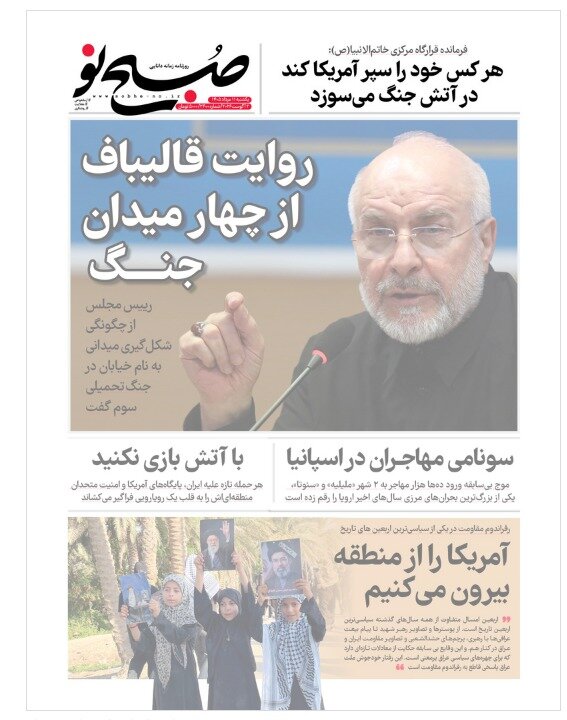
Sobh-e-No presented its view on America’s need to accept Iran’s conditions and exit the current crisis. Iran’s position regarding the Strait of Hormuz crisis is clear and non-negotiable: “Accepting Iran’s sovereignty over the Strait is the condition for a ceasefire and any kind of agreement.” This condition is not a maximalist demand but arises from on-the-ground realities and the provisions of the Islamabad memorandum, which had previously been agreed upon through Pakistan’s mediation.
As Trump himself has acknowledged and praised Iran’s resistance, the time has now come for Washington to accept this reality, move away from the path of threats and war, and step toward diplomacy based on mutual respect. Otherwise, the continuation of the crisis will not only impose high economic costs on all parties but also endanger regional stability. As analyses show, “neither threat nor attack will force Iran to retreat or surrender,” and the only way out of this crisis is acceptance of Iran’s arrangements in the Strait of Hormuz.
A cause for concern?
Shargh, in an analysis, referred to Turkey’s proposed coalition. Shargh wrote: Turkey’s geopolitical position has compelled the country to maintain a kind of balance among the European Union and NATO, Russia and the United States, as well as its neighbors on land and sea. The country also seeks, in the realm of diplomacy, to play the role of mediator in regional and international conflicts. Turkey is attempting to create a regional security system based on four major Islamic countries: Turkey, Saudi Arabia, Egypt, and Pakistan. Although Turkey implicitly prefers that Iran also join this group, the other partners in the coalition do not show much interest in this. Israel believes that this coalition seeks to fill the vacuum of Iran’s Shiite axis by creating a Sunni axis, and that the goal of this group is to encircle Israel. The experience of the US and Israeli war against Iran taught these countries that, to ensure their security, they need to move closer to one another in the absence of America’s strategic constraints and its guarantee of full defense of Israel.
Siasat-e-Rooz: A return to the era of delusion
Siasat-e-Rooz, in a commentary, addressed America’s desperation regarding the current situation in the region and how regional countries can optimally use this moment. It wrote: The United States and the Zionist regime, which have faced defeat in their direct attacks on Iran and the Resistance, are now seeking to trap Arab countries in a brother-against-brother war so that, under the cover of that safe shadow, they can rebuild themselves and continue the occupation of the region. Certainly, Iran and the other resistant nations of the region—from Iraq and Yemen to Lebanon and Palestine—will not yield to this scheme, just as Iran continues its crushing responses to aggressors and maintains the closure of the Strait of Hormuz, and Yemen bravely stands against the Saudi aggressors. The Resistance in other countries of the region is also prepared for legitimate defense and a harsh response to American–Zionist criminals and any country that joins their game. Today, regional equations are shaped not by America’s delusions and those of its partners, but by the principles of Resistance, and the delusional ones will soon have no option but to abandon their crude fantasies.
Vatan-e-Emrooz: The attack on the Egyptian port was the work of the Zionist regime, not Iran
Vatan-e-Emrooz presented its reasons for rejecting claims that Iran carried out the drone attack on two vessels in Egypt’s Damietta port: A few days ago, regional sources announced that two vessels in Egypt’s Damietta port were targeted by a drone attack. American media and sources—including The Wall Street Journal, which is considered one of the psychological warfare arms of the White House—claimed that Iran was involved in these attacks, but Iran denied the allegation. Wherever Iran has targeted, it has announced it quickly and courageously. The United States and Israel have clearly failed to achieve their goals against Iran, especially in removing the Strait of Hormuz from Iran’s control; they have also failed to bring many other countries into their aggressive campaign against Iran. Therefore, they have set their goal on portraying the Islamic Republic as a threat to the world, especially the region and particularly all Arab countries. For this reason, through false-flag operations against certain countries, they attempt to attribute such incidents to Iran. Israel, in particular, has a long history in this area, and thus some investigations indicate that the attack on the Egyptian port was carried out by the Zionist regime.
Disclaimer : This story is auto aggregated by a computer programme and has not been created or edited by DOWNTHENEWS. Publisher: tehrantimes.com








