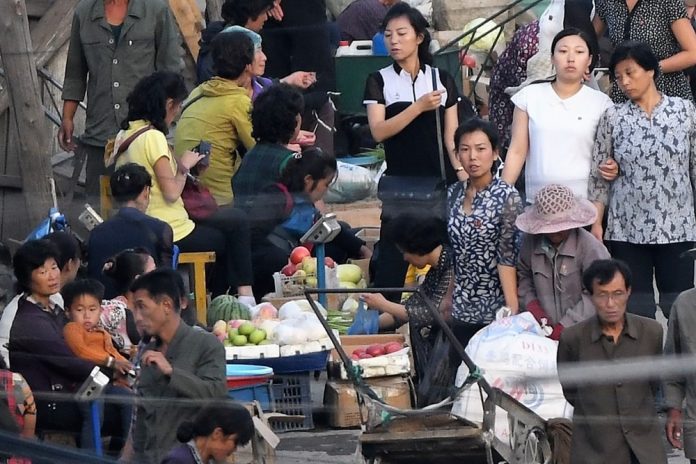
North Korean market authorities in Sinuiju, North Pyongan province, have begun requiring merchants to publicly display “item inspection tags” listing a product’s origin and sales permit status, a move some sellers say marks a further tightening of state control over the country’s markets in 2026.
A source in North Pyongan province told Daily NK on Thursday that market management offices, the state agencies that oversee day-to-day market operations, at Sinuiju’s Chaeha Market, Nammin Farmers Market and other markets throughout the city have required, since last month, that every item sold in the market first be registered with the market management office. Vendors must then obtain and display an item inspection tag bearing a stamp confirming sales permission along with the product’s origin and price, placed where customers can easily see it.
The registration requirement covers nearly everything sold in the markets, including processed foods, industrial goods and fresh produce such as fruit and vegetables. “To do business in the market now, you have to register each item you’re selling with the market management office one by one, get an item inspection tag stamped with sales permission, and post it at your stall,” the source said.
Market management offices have warned that any goods sold without a displayed tag will be confiscated in full, and enforcement is already underway, leaving merchants on edge, the source said.
Merchants suspect deeper motive behind new rule
Market authorities say the measure is meant to ensure food safety, establish price order and build a “sound market order.” Merchants largely see it differently, however, interpreting the requirement as an effort to tighten state control over the markets and fold them further into the government’s management system, since only registered and approved goods can now be sold.
“There were cases before of price tags or origin labels at state-run stores or a few big markets in Pyongyang and provincial capitals, but now it feels like this is spreading to markets across the country,” the source said. “If you don’t have the stamp, you won’t have any grounds to argue when your goods are confiscated.”
North Korean authorities have rolled out a series of measures over the years aimed at bringing markets under state management, including collecting market fees and requiring goods to be sold at state-set prices, binding North Korean people’s trading activities within official channels.
The new tag requirement is being framed as a step toward “sound market order,” but is widely interpreted as another effort to tighten state oversight of market transactions. Attention is now turning to the requirement’s potential to discourage trade and affect people’s livelihoods, the source said.
“People are asking whether they’ll have to register and get permission even for a single bundle of green onions or spinach grown in a home garden plot before they can sell it in the market,” the source said. “People are murmuring among themselves, wondering whether this is really about market order or about tightening control.”
North Korean authorities have pursued similar market-control measures elsewhere in the country, including a crackdown in Pyongsong that emptied store shelves during a “month of commercial revolution” and a sweep in Hamhung that saw officials seize household goods and route them into state-run stores. Both moves were part of a broader campaign to bring private trade under closer state supervision.
Reporting from inside North Korea
Daily NK operates networks of sources inside North Korea who document events in real-time and transmit information through secure channels. Unlike reporting based on state media, satellite imagery, or defector accounts from years past, our journalism comes directly from people currently living under the regime. We verify reports through multiple independent sources and cross-reference details before publication.
Our sources remain anonymous because contact with foreign media is treated as a capital offense in North Korea — discovery means imprisonment or execution. This network-based approach allows Daily NK to report on developments other outlets cannot access: market trends, policy implementation, public sentiment, and daily realities that never appear in official narratives.
Maintaining these secure communication channels and protecting source identities requires specialized protocols and constant vigilance. Daily NK serves as a bridge between North Koreans and the outside world, documenting what’s happening inside one of the world’s most closed societies.
Disclaimer : This story is auto aggregated by a computer programme and has not been created or edited by DOWNTHENEWS. Publisher: dailynk.com