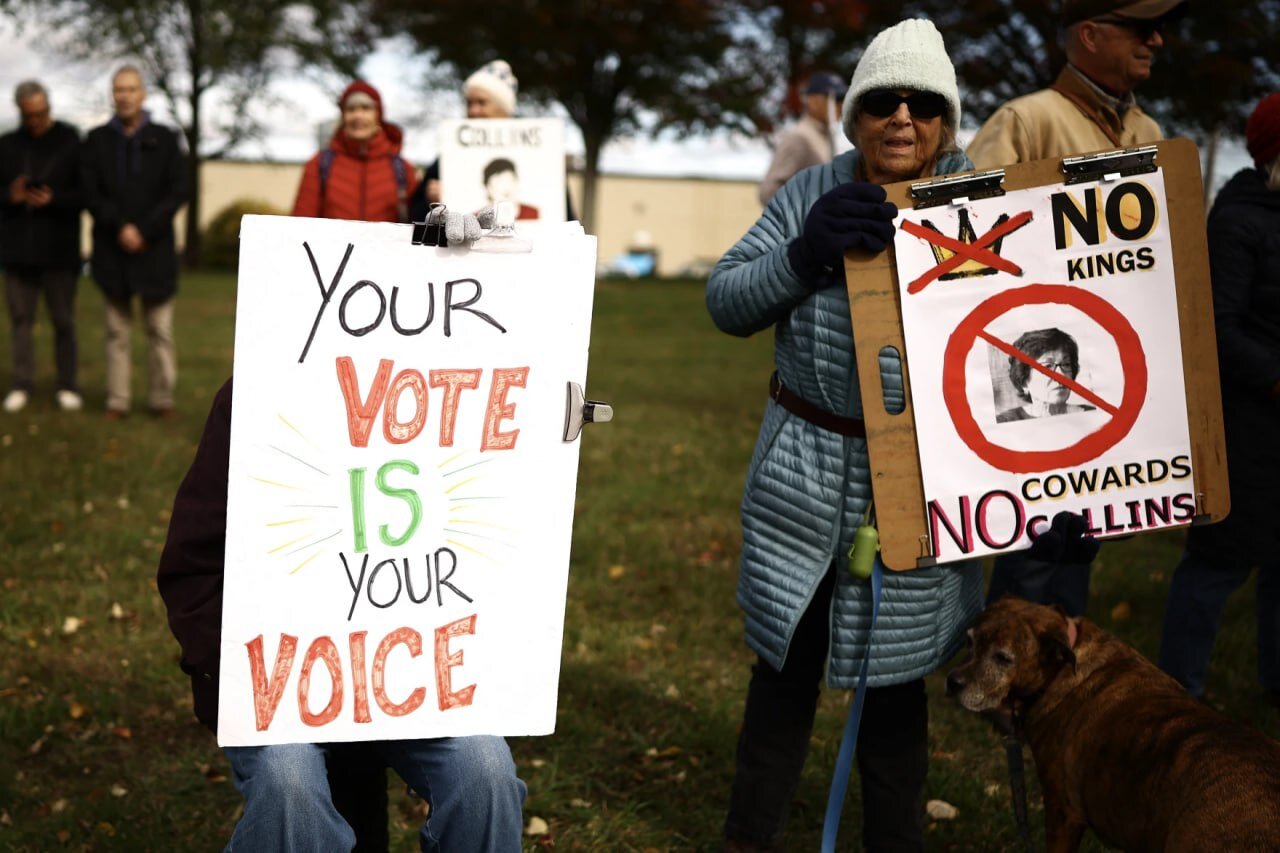
TEHRAN- The latest round of “No Kings” protests across the United States on Saturday, October 17, focused on a new objective: turning opposition to President Donald Trump’s policies into electoral participation ahead of the November 3 midterm elections.
Under the banner “No Kings: Vote Early,” thousands of events were planned across the country, including in all 50 states and Washington, D.C., according to organizers. The demonstrations featured rallies, marches, voter-education activities and efforts to encourage eligible voters to cast their ballots before Election Day.
The October 17 demonstrations marked the fourth nationwide round of the movement, which emerged in opposition to Trump’s presidency and what organizers describe as authoritarian tendencies in his administration.
The organizers framed the latest mobilization as a nonpartisan effort to promote voting and defend democratic participation, while protesters raised concerns ranging from immigration enforcement and the cost of living to the war against Iran.
A movement changes tactics
Earlier No Kings demonstrations emphasized visible opposition to Trump and his policies. This time, organizers placed greater emphasis on early voting, election access and mobilizing voters ahead of the midterms.
The shift reflects a political calculation: demonstrations can express public dissatisfaction, but electoral participation can change the balance of power in Congress and increase pressure on the administration.
According to Newsweek, roughly 3,000 events were planned nationwide, with the focus on early voting and turnout rather than conventional protest alone.
The movement has described its initiative as a nonpartisan effort to bring Americans together in defense of democracy and civil liberties. However, its political character has been contested, with some critics arguing that its activities align closely with Democratic electoral interests.
At local events, some participants openly encouraged opposition to Republican candidates, illustrating the tension between the coalition’s stated nonpartisan approach and the political objectives of some attendees.
Iran war remains among protesters’ concerns
Although early voting was the demonstrations’ central organizing theme, interviews with participants in several states showed that opposition to the war against Iran remained among the grievances motivating some protesters.
In Kalamazoo, Michigan, protester Jared Smith described the range of issues that brought him to the demonstration.
“Everything from Gaza, Iran to gas prices, grocery prices,” he said, according to local television station WWMT.
The remark linked opposition to US foreign policy with concerns about the cost of living, suggesting that some participants viewed domestic economic pressures and overseas military action as interconnected issues.
In Corydon, Indiana, 56-year-old musician Aim Me Smiley said she attended to protest what she called a “rogue” president, data-center expansion and the war in Iran, among other concerns.
Smiley had already voted early and encouraged others to participate in the electoral process, according to the Indiana Capital Chronicle.
Her comments illustrate how some demonstrators viewed the midterm elections as an opportunity to challenge the administration’s domestic and foreign policies.
However, the available interviews do not establish how widely opposition to the Iran war was shared among participants nationwide. It was one of several concerns expressed at the demonstrations rather than the movement’s principal national slogan.
White House challenges movement’s nonpartisan framing
The Trump administration criticized the No Kings movement’s characterization of its activities as nonpartisan.
White House spokesperson Lauren Bis argued that the organizers’ emphasis on voting undermined their claim to political neutrality and criticized the movement’s name.
“The fact that the ‘No Kings’ organizers are talking about voting in the upcoming election proves they should change their name,” Bis said in a statement reported by USA Today. “This November, Americans have a clear choice between President Trump and Republicans’ commonsense policies or the extreme Democrats’ radical socialist, open-border policies.”
The remarks reflect the administration’s broader effort to frame the midterm elections as a choice between Republican policies and the Democratic opposition.
The dispute also highlights a central question surrounding No Kings: whether the movement is primarily a broad-based campaign for democratic participation or an electoral mobilization that could benefit Democratic candidates.
Although organizers describe their activities as nonpartisan, some participants have explicitly called on voters to oppose Republicans. Such statements demonstrate that the movement encompasses a range of political objectives, even as its national campaign emphasizes early voting.
Can street protests translate into political change?
The October 17 demonstrations sought to translate opposition to Trump into greater participation in the midterm elections. Whether that strategy succeeds will depend not only on turnout at rallies but also on whether participants and the communities they reach ultimately cast ballots.
Local reports suggest that attendance varied considerably. In Kalamazoo, Indivisible Greater Kalamazoo estimated that more than 3,000 people attended the demonstration along Drake Road, according to WWMT. In Corydon, Indiana, about 100 people gathered for a local rally, according to the Indiana Capital Chronicle.
These figures illustrate differences between individual events but do not establish a nationwide increase or decline in participation.
The movement’s electoral strategy also raises questions about its longer-term influence. If its activities encourage previously disengaged voters to participate, No Kings could contribute to political pressure on the administration through changes in congressional representation.
Yet demonstrations alone cannot guarantee a change in policy. Their impact will depend on voter participation, electoral outcomes and the ability of activists to sustain public engagement after the rallies end.
For protesters concerned about immigration enforcement, economic pressures and the war against Iran, the immediate objective is to turn dissatisfaction into votes. Whether that translates into a significant shift in US policy will become clearer after the November 3 elections.
Disclaimer : This story is auto aggregated by a computer programme and has not been created or edited by DOWNTHENEWS. Publisher: tehrantimes.com