
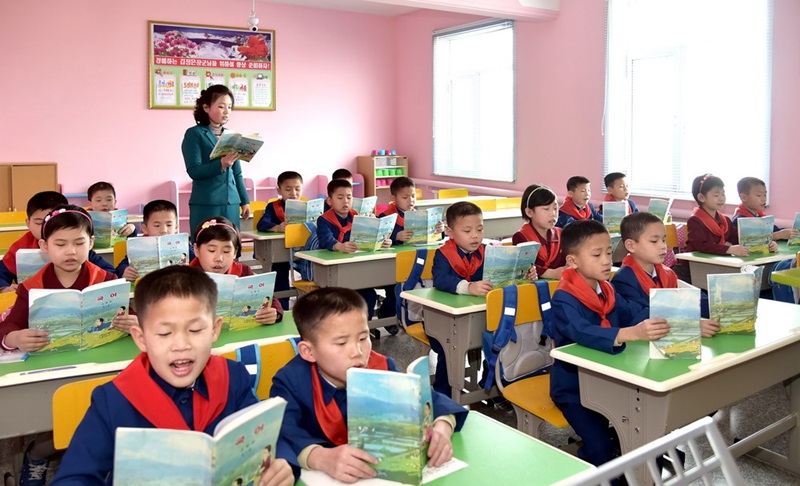
Some elementary school students in parts of North Korea are keeping two separate diaries, with one written for school censorship and the other holds their true feelings. The practice suggests that even young children have grown used to the country’s culture of surveillance.
A Daily NK source in South Hamgyong province said Tuesday that the practice has become common at some elementary schools in Hamhung. “It has recently become common for students to keep two separate diaries,” the source said. “One diary gets reviewed by the teacher. The other is a personal diary where they honestly write down their true feelings and thoughts.”
Some elementary schools in Hamhung now give daily diary homework to students in third grade and above. Homeroom teachers reportedly review those diaries alongside other daily homework, the source said.
Daily diary writing is a recent change, according to the source. Schools once assigned diary homework only during vacations, but it has since become a mandatory task at all times.
Parents discovered the practice of separate diaries by accident. They came across their children’s hidden personal diaries.
Earlier this month, the parents of a fourth grader in Hamhung found their child’s hidden diary while organizing books. “I think the teacher hates me. Sometimes it feels like she glares at me,” the diary read. “She smiles at other friends but not at me. I think it’s because I can’t help her well. I don’t want to go to school.”
Diaries reveal children’s hidden struggles
The source said the student’s family is not so poor that they skip meals. Still, they are not well-off either. The parent who read the diary felt guilty. Other parents regularly give the homeroom teacher rice or cash, but this parent could not. Believing that was why the child felt excluded, the parent wept.
Another family’s third grader wrote in a personal diary about wanting new gym clothes. The child feared asking would hurt their mother’s feelings. The same child also wrote about wanting to become a yeolseongja, a model student recognized for ideological devotion. But the child felt only children from wealthier families get that chance.
Parents of children the same age compared notes and found similar cases, the source said. That is how they learned their children were keeping personal diaries separate from the ones submitted for review at school.
These personal diaries hold feelings the children cannot share with anyone, according to the source. That includes hurt from friends or teachers. It includes a sense of relative deprivation tied to their family’s hardship. It includes hopes they know they cannot reach.
The diaries submitted at school, by contrast, reportedly contain only formulaic writing. Students reflect on small mistakes, such as slacking on chores or schoolwork, and they describe their resolutions for the future.
The pattern shows that children learn self-censorship from a young age. They learn to separate what can be said openly from what must be kept private. They now apply that habit to their own writing.
Parents who learned of the practice reacted with dismay. “It’s heartbreaking that a child already distinguishes between writing meant to be censored and writing that must be hidden,” one parent said, according to the source. Another wondered aloud how accustomed to censorship a child must be to split a diary in two.
“Here in North Korea, children are told again and again from a young age that what is said at home should not be repeated outside,” the source said. Over time, that lesson shapes children too. It teaches them to separate what can be said officially from what must stay private.
Parents who see their children’s private diary entries often say nothing about them, the source added. They rarely scold their children over what they find either. Telling a child that a parent read the diary risks closing off the only outlet the child has for honest feelings. Many parents choose to stay silent, the source said. At the same time, they are quietly resolving to pay closer attention to their children going forward.
Reporting from inside North Korea
Daily NK operates networks of sources inside North Korea who document events in real-time and transmit information through secure channels. Unlike reporting based on state media, satellite imagery, or defector accounts from years past, our journalism comes directly from people currently living under the regime. We verify reports through multiple independent sources and cross-reference details before publication.
Our sources remain anonymous because contact with foreign media is treated as a capital offense in North Korea — discovery means imprisonment or execution. This network-based approach allows Daily NK to report on developments other outlets cannot access: market trends, policy implementation, public sentiment, and daily realities that never appear in official narratives.
Maintaining these secure communication channels and protecting source identities requires specialized protocols and constant vigilance. Daily NK serves as a bridge between North Koreans and the outside world, documenting what’s happening inside one of the world’s most closed societies.
Disclaimer : This story is auto aggregated by a computer programme and has not been created or edited by DOWNTHENEWS. Publisher: dailynk.com





