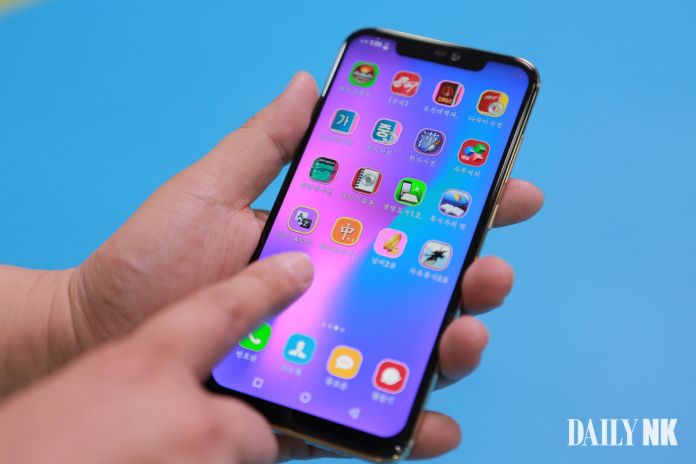
North Korean education officials in South Hamgyong province have launched a student tracking app for high schools. Students can now borrow library books and join after-school clubs on their own mobile phones. Since the September 2026 rollout, however, unstable networks and incompatible devices have caused widespread confusion.
A source in the province told Daily NK on Monday that the system took effect on Sept. 10. The education department of the provincial people’s committee introduced it at senior middle schools as part of a modernization push for the new term. People’s committees are North Korea’s regional administrative bodies and oversee local schools, housing and public services. Senior middle schools are the North Korean equivalent of high schools.
Once students install the app, they receive a QR code to scan at library terminals when borrowing or reserving books. The app also scraps the longstanding rule that limited each student to a single after-school club. Students can now register for up to three or four clubs in academic, arts, sports and technical fields. These clubs are a fixture of North Korean school life, where students build skills in areas from science to music.
The education department plans to log each student’s reading history and club activity on a provincial server in real time. It will then use that data in academic evaluations and future career placements. In North Korea, the state largely decides whether graduates head to university, military service or assigned workplaces. That gives these digital records real weight in shaping a young person’s future.
Student tracking app hit by network failures and device gaps
Problems surfaced even before launch, when city and county education departments ran simulated login tests across the province. Unreliable networks frequently prevented the app from syncing student data with the central server, according to the source.
“In some areas, the data synchronization failure rate topped 40%,” the source said. “The confusion comes from rushing a phone-based management system while network conditions remain unstable.”
Teachers complain that compatibility problems across different phone models have only added to their administrative workload. The rollout has also sparked a debate over fairness and equal access to school services. Students without phones, or with older handsets that cannot run current software, could be shut out of borrowing and club sign-ups entirely.
Mobile phone use has grown rapidly in North Korea over the past decade. Yet smartphone ownership remains uneven, and network coverage outside major cities is often unreliable.
A senior middle school teacher in Hamhung, the provincial capital, called the rollout “a textbook case of armchair administration.” The teacher said officials launched the system without first checking student phone ownership, school networks or the local power supply.
Schools also differ widely in their IT infrastructure, which has deepened the problem. Rural schools on the outskirts of Hamhung lack adequate network connections and equipment. Some of them suffered login delays and outages on club registration day, throwing the process into disarray.
Schools and parents must also cover part of the cost of the QR code scanners installed in libraries. That expense has prompted complaints from families already stretched by informal payments to their children’s schools. North Korean parents are routinely expected to contribute cash or goods toward school supplies, repairs and state projects.
“Authorities are introducing a new management system in the name of education modernization, but basic conditions like network coverage and phone distribution aren’t in place,” the source said. “Because access depends on each student’s and school’s IT environment, many worry the education gap will grow even wider.”
Reporting from inside North Korea
Daily NK operates networks of sources inside North Korea who document events in real-time and transmit information through secure channels. Unlike reporting based on state media, satellite imagery, or defector accounts from years past, our journalism comes directly from people currently living under the regime. We verify reports through multiple independent sources and cross-reference details before publication.
Our sources remain anonymous because contact with foreign media is treated as a capital offense in North Korea — discovery means imprisonment or execution. This network-based approach allows Daily NK to report on developments other outlets cannot access: market trends, policy implementation, public sentiment, and daily realities that never appear in official narratives.
Maintaining these secure communication channels and protecting source identities requires specialized protocols and constant vigilance. Daily NK serves as a bridge between North Koreans and the outside world, documenting what’s happening inside one of the world’s most closed societies.
Disclaimer : This story is auto aggregated by a computer programme and has not been created or edited by DOWNTHENEWS. Publisher: dailynk.com