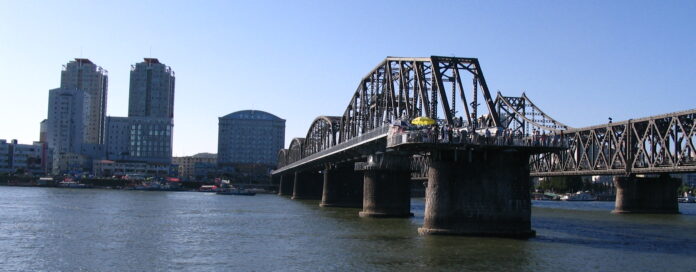
China and North Korea opened the New Yalu River Bridge on Oct. 15, 2026, a full 17 years after the two neighbors first agreed to build it. Strained North Korea-China relations explain only part of the delay. North Korea’s slow work on roads and customs facilities and international sanctions over its nuclear weapons program also kept the crossing closed.
The cable-stayed bridge spans the Yalu River between Dandong, in China’s Liaoning province, and Sinuiju, in North Pyongan province. It was built to ease pressure on the aging Sino-Korean Friendship Bridge, which has long carried most official trade between the two countries.
According to China’s Ministry of Foreign Affairs, the two sides agreed to pursue a new bridge during then-Chinese Premier Wen Jiabao’s visit to North Korea in October 2009, and they signed a formal agreement in February 2010. North Korean leader Kim Jong Il had suffered a stroke in August 2008 and was courting Beijing to stabilize his regime and ease economic hardship. Workers broke ground on the bridge in 2010 and completed its main structure in 2014.
In the intervening years, however, a series of events strained relations between Beijing and Pyongyang. Kim Jong Il died in December 2011, and his son Kim Jong Un inherited power. Xi Jinping, then China’s vice president, sent the young leader a personal letter urging him to avoid another nuclear test for the sake of stable ties, according to several sources familiar with North Korea-China relations. North Korea went ahead with its third nuclear test in February 2013.
In December 2013, North Korea executed Jang Song Thaek, Kim Jong Un’s uncle and a key architect of economic cooperation with China. Jang had served as vice chairman of the National Defense Commission, then North Korea’s top state body, which the State Affairs Commission replaced in 2016. He had also led the joint development of Hwanggumpyong and Wihwa, two Yalu River islands that the two countries designated as a special economic zone in 2011.
Relations between the two allies cooled quickly after Jang’s execution, and North Korea also fell behind on building its connecting roads and customs facilities. As a result, the bridge sat unused for years even though its main structure was complete.
Hopes for an opening rose at times, most notably during the thaw in North Korea-U.S. relations under the first Trump administration. In March 2018, shortly after U.S. President Donald Trump said he was willing to meet Kim, the North Korean leader held his first summit with Chinese President Xi Jinping. The two leaders went on to meet five times in all by June 2019.
That momentum faded when the second Kim-Trump summit, held in Hanoi in February 2019, ended without an agreement. When COVID-19 began spreading, North Korea sealed its borders in January 2020. In December of that year, it adopted the Reactionary Ideology and Culture Rejection Act to keep South Korean, American and other foreign culture away from the North Korean public. The law imposes harsh penalties, including death in serious cases, for bringing in, watching or distributing outside media. Amid this self-imposed isolation and border lockdown, the opening slipped yet again.
Why the New Yalu River Bridge finally opened
A shifting geopolitical landscape helped make this year’s opening possible. At their June 2024 summit, North Korea and Russia signed the Treaty on Comprehensive Strategic Partnership. The pact includes a pledge of mutual military assistance if either country comes under attack. Trump, who began his second term in January 2025, also signaled interest in renewed dialogue with North Korea.
China, for its part, moved actively to repair ties with Pyongyang. In high-level contacts, Beijing stopped putting denuclearization of the Korean Peninsula front and center, as it long had, and emphasized stability and cooperation in bilateral relations instead. That change in tone paved the way for Kim Jong Un’s visit to China and his summit with Xi in September 2025. Facing rising prices and a shortage of foreign currency, North Korea also needed to normalize its economic relationship with China.
Even with the bridge open, several issues in North Korea-China relations remain unresolved. According to Xinhua, China’s state news agency, the two countries agreed during Xi’s June 2026 visit to Pyongyang to expand exchanges across party, government and military channels. Yet as of October, North Korea still has not fully reopened to ordinary Chinese tourists. Pyongyang appears worried that foreign visitors could bring in outside culture or carry information about the country back home.
Sources also say China has signaled it could offer comprehensive economic support if North Korea moved toward reform and opening. Pyongyang, however, has shown little interest in taking Beijing up on the offer so far. Thomas Schaefer, a former German ambassador to North Korea, wrote in his book that hard-liners gained ground within the leadership after Kim Jong Il’s 2008 stroke. Those hard-liners favored a stronger military and more conservative economic policies, according to his analysis.
Seen in this light, the New Yalu River Bridge should help stabilize North Korea-China relations and expand cross-border economic cooperation. It appears unlikely, however, to push Kim Jong Un’s North Korea toward reform, opening or any fundamental change in policy.
The views expressed in this column are the author’s own and do not necessarily reflect those of Daily NK.
Disclaimer : This story is auto aggregated by a computer programme and has not been created or edited by DOWNTHENEWS. Publisher: dailynk.com