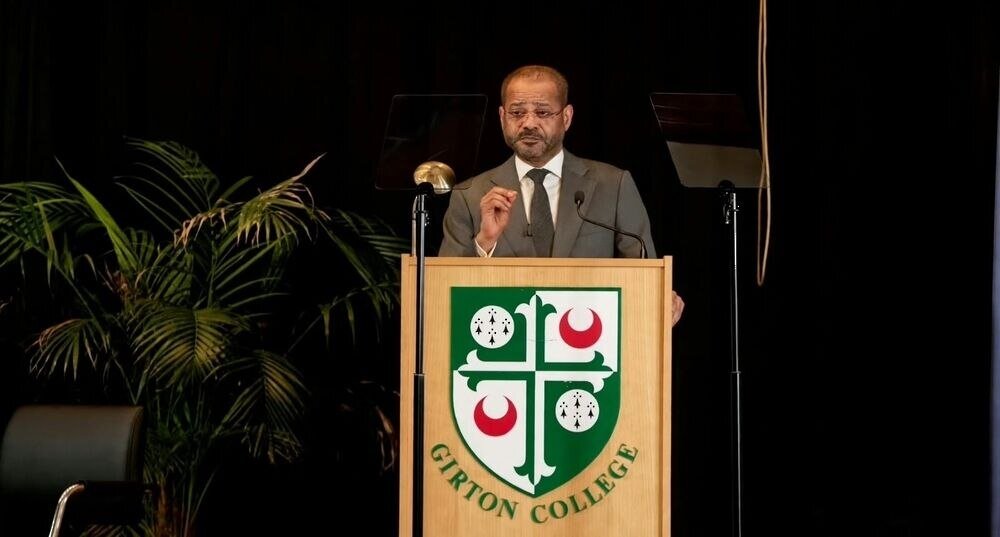
TEHRAN — Omani Foreign Minister Badr bin Hamad Al Busaidi has called for an inclusive regional security framework bringing together Iran, Iraq and the six member states of the Persian Gulf Cooperation Council (GCC), warning that any arrangement excluding Tehran would be inherently unstable and incapable of delivering lasting security.
Speaking at the University of Cambridge on Monday in a speech titled Inclusive Security in the Persian Gulf, Al Busaidi challenged approaches that portray Iran as a threat around which regional security arrangements should be built, arguing instead that stability depends on cooperation among the countries bordering the Persian Gulf.
He said existing security arrangements had been shaped by the mistaken assumption that Iran and the Arab states of the Persian Gulf were fundamentally hostile to one another, despite centuries of coexistence and shared regional interests.
With a population of approximately 93 million, a history spanning some 3,000 years and a coastline extending along roughly half of the Persian Gulf, Iran is an indispensable part of the region’s security equation, the Omani foreign minister argued.
Foreign military presence has carried political costs
Al Busaidi also questioned the long-term consequences of the Persian Gulf states’ reliance on foreign military powers, pointing to US military agreements, intelligence cooperation, naval deployments and air defense systems.
While stating that such arrangements had delivered certain benefits, he said their political costs over the longer term had been substantial.
His assessment reflects a broader debate over whether an enduring regional security order can be built through external military guarantees or whether it requires direct cooperation among the countries most affected by instability.
From this perspective, excluding Iran from regional security arrangements would leave a major regional power outside the very framework intended to address shared security concerns, undermining the prospects for a sustainable settlement.
Al Busaidi did not suggest that cooperation with international partners should end. Instead, he called for a shift away from military commitments toward investment, economic development and other forms of constructive engagement.
Iran-US negotiations and Strait of Hormuz security
The Omani foreign minister cited the Iranian nuclear issue and negotiations over maritime navigation through the Strait of Hormuz as examples of regional challenges that have been complicated by external involvement.
Oman has played a mediating role in indirect negotiations between Iran and the United States. According to Al Busaidi, Muscat facilitated five rounds of talks in April and May 2025 and three further rounds in February 2026.
He said substantial progress had been achieved, and an agreement had appeared within reach before the US-Israeli military aggression against Iran disrupted the diplomatic process.
Al Busaidi also reported progress in discussions between Oman and Iran on a preliminary framework for an interim maritime security agreement, while acknowledging that political obstacles remained.
The Strait of Hormuz is a vital international energy transit route, making security arrangements there a matter of importance not only for the Persian Gulf’s coastal states but also for global energy markets and maritime trade. The Omani position points to the importance of addressing navigation and maritime security through engagement with the countries directly concerned.
Reviving a regional security initiative
As a way forward, Al Busaidi proposed reviving a 1976 initiative for collective security among the eight states bordering the Persian Gulf: Iran, Iraq and the six GCC members.
He identified a non-aggression pact as a possible foundation for an inclusive regional arrangement, suggesting that a shared commitment to refrain from aggression could help establish the trust needed for broader cooperation.
Such a framework would place regional states at the center of decisions affecting their security and provide a platform for addressing disputes through dialogue rather than military confrontation.
Al Busaidi’s proposal also leaves room for continued international engagement but envisages a different role for external partners—one focused more on economic investment and development than on military deployments and security guarantees.
The central message of his speech was that lasting stability cannot be imposed on the Persian Gulf through arrangements that exclude one of its principal coastal states. Instead, he argued, security must be built through the participation of all regional countries and grounded in their shared responsibility for peace and stability.
The proposal reinforces the importance of regional diplomacy at a time when tensions involving Iran, the United States and Israel have heightened concerns over military escalation, maritime security and the wider consequences for energy supplies and regional stability.
Disclaimer : This story is auto aggregated by a computer programme and has not been created or edited by DOWNTHENEWS. Publisher: tehrantimes.com