Steve Toltz’s fourth novel dwells on some hefty subjects – AI, alienation, consciousness – but it all started with a joke.
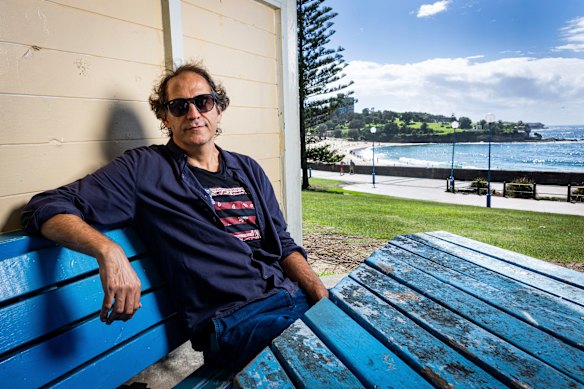
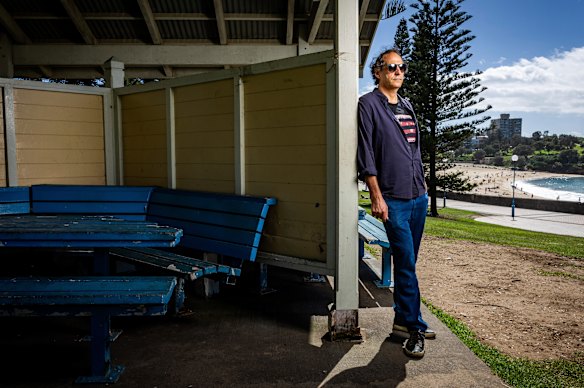
On sun-bleached days at Coogee Beach, in Sydney’s east, you’ll find the usual suspects: swimmers, joggers, and people in committed relationships with large water bottles. And then there’s Steve Toltz, 54, pen and notebook in hand, using a municipal-blue picnic table as a splintery desk. One of the funniest serious writers in Australian fiction, doing what he does best: making existential despair feel oddly like a good time.
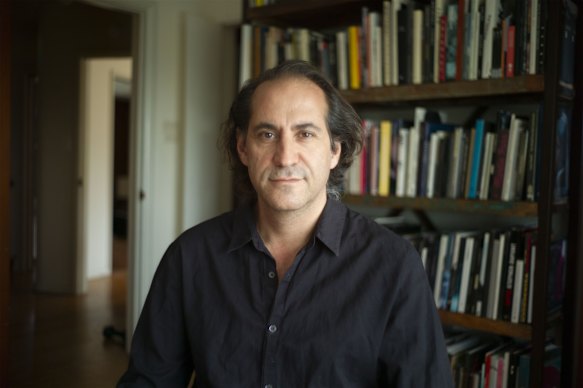
This is where I meet him. He spends a few hours here most days writing, including his new novel A Rising of the Lights. He looks exactly how you might expect the author of darkly comic fiction to look: slightly wild writer’s hair veering off in all directions, a casual graphic T-shirt, and a faintly cynical expression. Taken together, it gives the impression he’d be the good value guest you might hope to be seated next to at a dinner party.
That’s even if he does seem, at least at first, a little awkward, a little bemused – maybe shy – about being interviewed. Like a scene from his own novel, our conversation is briefly punctured by a man on a nearby bench letting out a spectacular, unignorable burp.
“That’s probably the luckiest thing that’s happened to me in my life is that I enjoy probably 98 per cent of the process,” he says of novel writing. “I enjoy dreaming it up, imagining how the ideas I have might become a book. I enjoy writing my bad first drafts. I enjoy the process of editing them and rewriting, so something bad becomes fairly good and then becomes publishable.
“I enjoy all of that process. When I submit it to an editor and then work with an editorial team, and they give me some notes. I enjoy the process of correcting mistakes and improving it. I enjoyed everything up until … like yesterday.”
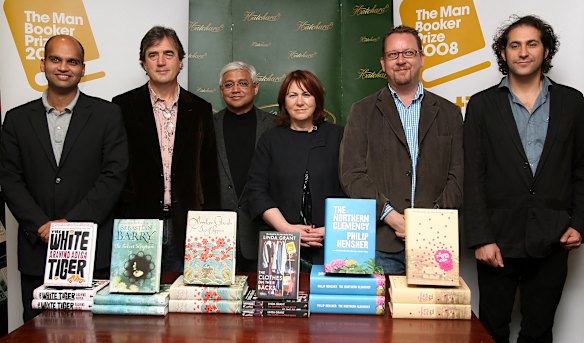
A pause, while I catch up to the joke. Oh, he means up until this interview, about his fourth novel. His first, A Fraction of the Whole, was something of a literary event in 2008 – a sprawling, chaotic father-and-son story that took close to a decade to write and arrived with a bang: a substantial advance, critical plaudits, and a spot on the shortlist for the Man Booker Prize and the Guardian First Book Award.
The son of two lawyers who lived on Sydney’s north shore, educated at Knox Grammar School and Killara High School, he studied video production at the University of Newcastle before drifting, geographically and professionally, through Vancouver, New York, Barcelona and Paris. He has one of the better author CVs you’re likely to come across: private detective, security guard, telemarketer, screenwriter, teacher – alongside intermittent work in film. Let’s linger there.
Toltz was an extra in George Lucas’ 2002 film Star Wars: Episode II – Attack of the Clones. Or at least, he’s fairly sure it was that one. Is he recognisable? “If you could identify my gait,” he says. He plays a stormtrooper, appearing briefly in a walking scene. Maybe better luck spotting him as a background actor in an episode of the Australian TV series Water Rats? “I feel like I had to pretend to snort a line of cocaine at a party.” And then there’s David Cronenberg’s 1996 classic Crash: “My job was to get there at five in the morning, put out orange cones, and make sure nobody parked there, and then when the film trucks came, I left. So, I saw none of the production.”
In 2004, while living in Paris, he suffered a spontaneous cervical spinal haemorrhage that left him temporarily paralysed; doctors weren’t sure he would walk again. He did, and the experience has fed into his work. After many years living in Los Angeles – working as a screenwriter on No Activity and Guilty Party – he returned to Sydney in 2023, and now lives within walking distance of this park bench with his 14-year-old son.
If A Fraction of the Whole was his rather loud introduction, the novels that have followed deepened a set of recurring obsessions about human identity. With Quicksand (2015) and Here Goes Nothing (2022), Toltz continued to circle questions of mortality, meaning and free will, forming what he has described as a “fear trilogy”, exploring fear of death, suffering, and the opinions of others.
It is the kind of writing that invites its own adjective, Toltzian: hyperactive prose; digressive philosophy; quick-fire dialogue, and smart, slightly doomed characters who can’t stop talking themselves into (and out of) trouble. His work shares DNA with the likes of Louis-Ferdinand Céline, Thomas Bernhard, Peter Carey and Knut Hamsun.
His latest novel opens with one of the sharpest first lines of the year: “It was the year my mother reported a suspicious character in the backyard: my father, as she well knew.” The story is told from the perspective of Russell Wilson, a former child psychotherapist whose job vetting potential hires at the NSW Department of Health has largely been taken over by AI, leaving him, as the character reflects, “an assistant to a robot in human resources”. To make matters worse, his wife has an affair with an Uber driver named Jed, and his parents declare they no longer want to see him.
Rusty moves through all this in a kind of mental fog: no ambition, high self-awareness, and the uneasy question of what is within his control, and what is a question of fate. “Have you purposefully cultivated an objectionable persona out of boredom?” his boss asks, a question that lands somewhere between insult and insight. Toltz is drawn to these figures: the ones we might call loveable losers, but who perhaps make more sense than the scripts they struggle to follow.
“I suppose in some ways they’re kind of like alter egos. I like characters that have the ability to self-question because I enjoy putting thoughts in their heads and writing characters that are constantly self-interrogating and are able to articulate their own weaknesses. And yeah, I have enough to draw on,” he says.
No one has any answers and that is the best place to write fiction from, from a place of mystery.
Toltz turns his focus in A Rising of the Lights to the elusive matter of consciousness: the limits of self-knowledge, the gap between inner narrative and external reality, as well as the uneasy dynamic between isolation and connection.
“It’s such an unanswered part of science. Science doesn’t really understand consciousness, or what it is. We don’t really even understand intelligence. But there are a lot of fun theories. You’ve got panpsychism and all these different theories of consciousness and now that AI is in the world, I feel like it’s just a very rich place to explore. No one has any answers and that is the best place to write fiction from, from a place of mystery,” he says.
The title Rising of the Lights works on several levels. It’s an old term for a pulmonary death – one of those accidentally poetic 19th-century phrases – but also gestures toward the slow dawning of self-awareness, the light clearing the fog. And, Toltz adds, when philosophers and neuroscientists debate whether a machine might be conscious, the shorthand question is always the same: are the lights on? “AI is self-correcting; very few people are. That’s where we let ourselves down,” Rusty reflects.
Toltz has experimented with Chatbots, but is wary of where things are heading. He ruminates on a future like that imagined in Aldous Huxley’s 1932 novel Brave New World, not overt oppression, but lives controlled by a complete dependence on technology.
“The other force that I think really controls us is our own appetite for convenience. We’re such lazy f—ers that the moment something becomes faster, easier, more frictionless, we’ll just take it on, and we will never, ever go back,” he says. “We’re not good at doing a cost-benefit analysis. We sort of vaguely understand the cost, but we’re very aware of the benefit. We’re at genuine risk of becoming, I guess, it’s oppression by dependence. It’s not a boot, it’s not a smile, it’s like a helping hand that will just help us do things until we can’t do them ourselves any more.”
For all that, the book didn’t begin especially seriously. It started with a joke that stuck. Rusty’s wife has an affair with an Uber driver, who later describes the connection with unexpected poetry: “She was in the back, and we just had this sustained eye contact via the rear-view mirror. I guess you could say it was a back-seat/front-seat romance.”
Toltz collects these fragments – jokes, situations, odd bits of dialogue – and holds on to them until they find a place. Some ideas in A Rising of the Lights, he says, have lingered for decades. His process remains stubbornly analogue: handwriting everything in notebooks, then transcribing it sooner rather than later. This was a habit reinforced after losing a notebook on a plane trip and, with it, a month’s work. Pen and paper were how he started writing, he says, and so he has continued. It also keeps him distraction-free.
If his earlier novels are truly maximalist – expansive and digressive – this one is more contained, unfolding over the course of a single year, from one New Year’s Eve to the next. He also wrote it more quickly than his previous books.
“I guess I just don’t want to take seven years to write a book. You know, I am in my 50s now, and there’s a limit. I have 20 books in my mind that I would love to write, and I don’t have 20 years. I don’t have 20 books’ worth of life ahead of me, so it’s a race against the clock now,” he says.
Toltz has already started the next one. Plans for a trilogy about consciousness have loosened, but the same underlying interests hold. The routine does too, including returns most days to the benches by the beach.
“Whenever life takes me out of the ability to be working on a novel, I’m always sort of slightly unhappy,” Toltz says. “Like something feels off, so I like to always be writing, and I can’t imagine a day in which I wouldn’t be.”
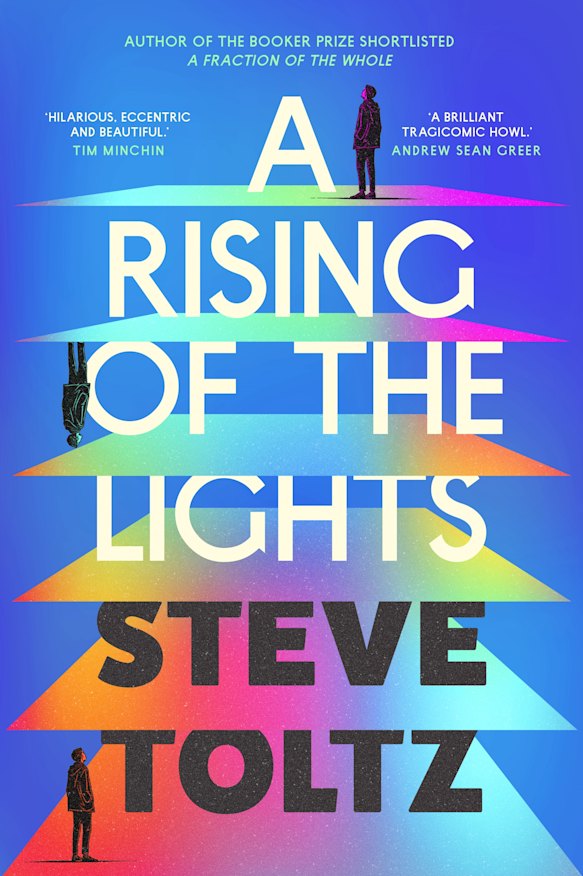
A Rising of the Lights is out now. Steve Toltz appears at Sydney Writers’ Festival (May 17-24).
Disclaimer : This story is auto aggregated by a computer programme and has not been created or edited by DOWNTHENEWS. Publisher: www.smh.com.au