
In a small village in Tamil Nadu, a man once found himself at the centre of ridicule for doing something most people refused to even speak about.
He was trying to make a sanitary pad.
Neighbours whispered about him. His wife left him for a period of time. At one point, he began testing his own prototypes by simulating menstruation on himself, determined to understand what women experienced every month.
To those around him, this was not innovation. It was seen as something deeply inappropriate.
That man, Arunachalam Muruganantham, is today among the nominees for the 2026 Nobel Peace Prize.
His journey from social isolation to global recognition is often told as a story of resilience. But the more important question now is this. How far has his mission to end period poverty actually come?
Where it began
The answer begins with a moment inside his own home.
In the late 1990s, shortly after his marriage, Muruganantham discovered that his wife was using old cloth and newspapers during her periods because sanitary pads were too expensive. A packet of branded pads was a luxury their household could not justify.
When he began asking questions, he realised that this was not an isolated case. Across rural India, millions of women were forced to choose between affordability and hygiene.
What he had stumbled upon was not just a gap in the market. It was a deeply entrenched public health and social issue, wrapped in silence and stigma.
With no formal training and limited resources, he set out to create an affordable alternative. The early years were marked by repeated failures and growing alienation. Yet, through persistence, he arrived at a solution that would prove to be far more transformative than the product itself.
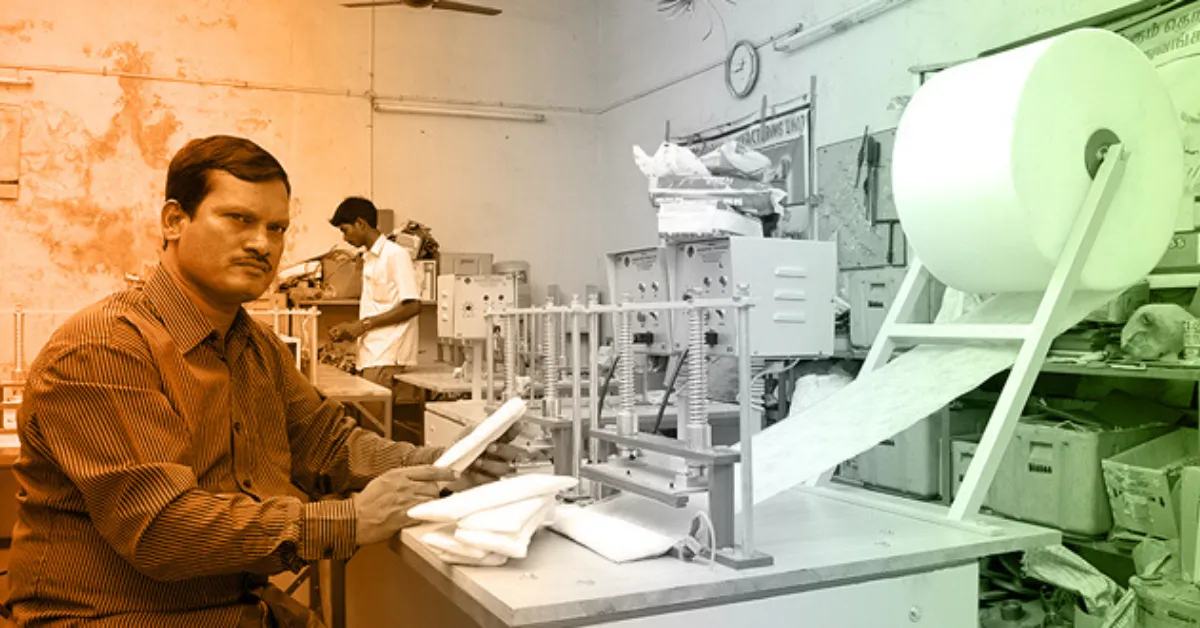
Instead of simply manufacturing low-cost sanitary pads, Muruganantham designed a compact, low-cost machine that could produce them locally. The idea was to decentralise production and place it in the hands of women.
From invention to ecosystem
Nearly two decades later, the scale of that idea can be measured across geographies. His machines, typically priced between Rs 65,000 and Rs 1.5 lakh depending on capacity, have been installed across 27 states in India and expanded to more than 100 countries, including regions in Africa, Southeast Asia, and Latin America. Each unit can produce between 1,000 and 3,000 pads a day and is designed to be operated by semi-skilled rural women.
This shift from centralised manufacturing to community-led production has created thousands of micro-units, many of them run by self-help groups.
The pads produced through these units are sold at prices ranging from Rs 2 to Rs 5 per piece, making them significantly more affordable than commercial brands. Importantly, they are not distributed for free.
The low-cost model ensures sustainability while also enabling women to take ownership of both production and distribution.
/filters:format(webp)/english-betterindia/media/media_files/2026/05/06/3-2026-05-06-12-59-00.png)
The impact of this ecosystem extends beyond access to menstrual products. Each unit typically employs five to ten women, which translates into tens of thousands of women earning a steady income.
In many communities, this has led to the emergence of small but stable local economies built around menstrual hygiene products. At the same time, improved access has helped millions of women and adolescent girls move away from unsafe alternatives.
There is also a visible shift in education outcomes. Several grassroots studies and reports from non-profit organisations indicate that access to affordable sanitary products has contributed to a reduction in school absenteeism among girls, particularly in rural areas where menstruation once meant missing several days of school every month.
Why a Nobel Peace Prize nomination
Muruganantham’s nomination for the 2026 Nobel Peace Prize reflects a broader understanding of what peace entails. His work addresses a form of inequality that has long remained invisible. Period poverty is not just a matter of hygiene. It affects education, restricts mobility, and reinforces gender disparities.
By making menstrual products accessible and by enabling women to become producers and entrepreneurs, his model contributes to more equitable communities.
/filters:format(webp)/english-betterindia/media/media_files/2026/05/06/4-2026-05-06-12-59-56.png)
It restores dignity, improves health outcomes, and opens up economic opportunities at the grassroots level. These are all critical components of what is often described as positive peace, where the focus is on building conditions that allow individuals and communities to thrive.
The work continues
Muruganantham continues to lead this effort through his social enterprise, Jayashree Industries. His work today focuses on expanding the reach of these machines, training women to operate and manage production units, and building partnerships with governments and organisations to replicate the model in other regions.
He is also actively involved in menstrual health awareness programmes, working to challenge the stigma that still surrounds the subject.
Despite the progress, the gaps remain significant. A large number of women in India still lack consistent access to safe and affordable menstrual hygiene products, particularly in remote and marginalised communities. Cultural barriers and lack of awareness continue to limit reach.
What has changed, however, is the baseline.
Before Muruganantham began his work, menstrual hygiene was rarely discussed in public. Today, it is recognised as an important issue within public health and education. His work has helped shift the conversation, making space for policy interventions, grassroots initiatives, and broader social acceptance.
In building a system that combines affordability, local production, and women’s economic participation, Arunachalam Muruganantham has shown how a simple idea can evolve into a large-scale social intervention.
His journey is a reminder that meaningful change often begins with questioning what society has chosen to ignore, and then refusing to look away.
Sources:
‘My nomination for Nobel Peace Prize accepted, says India’s Padman’: by The Times of India, Published on 4 May 2026
‘Padman Arunachalam Muruganantham listed as nominee for 2026 Nobel Peace Prize’: by The Times of India (ANI), Published on 3 May 2026
‘Real PadMan Arunachalam Muruganantham listed as 2026 Nobel Peace Prize nominee’: by Hindustan Times, Published on 3 May 2026
Disclaimer : This story is auto aggregated by a computer programme and has not been created or edited by DOWNTHENEWS. Publisher: thebetterindia.com



