
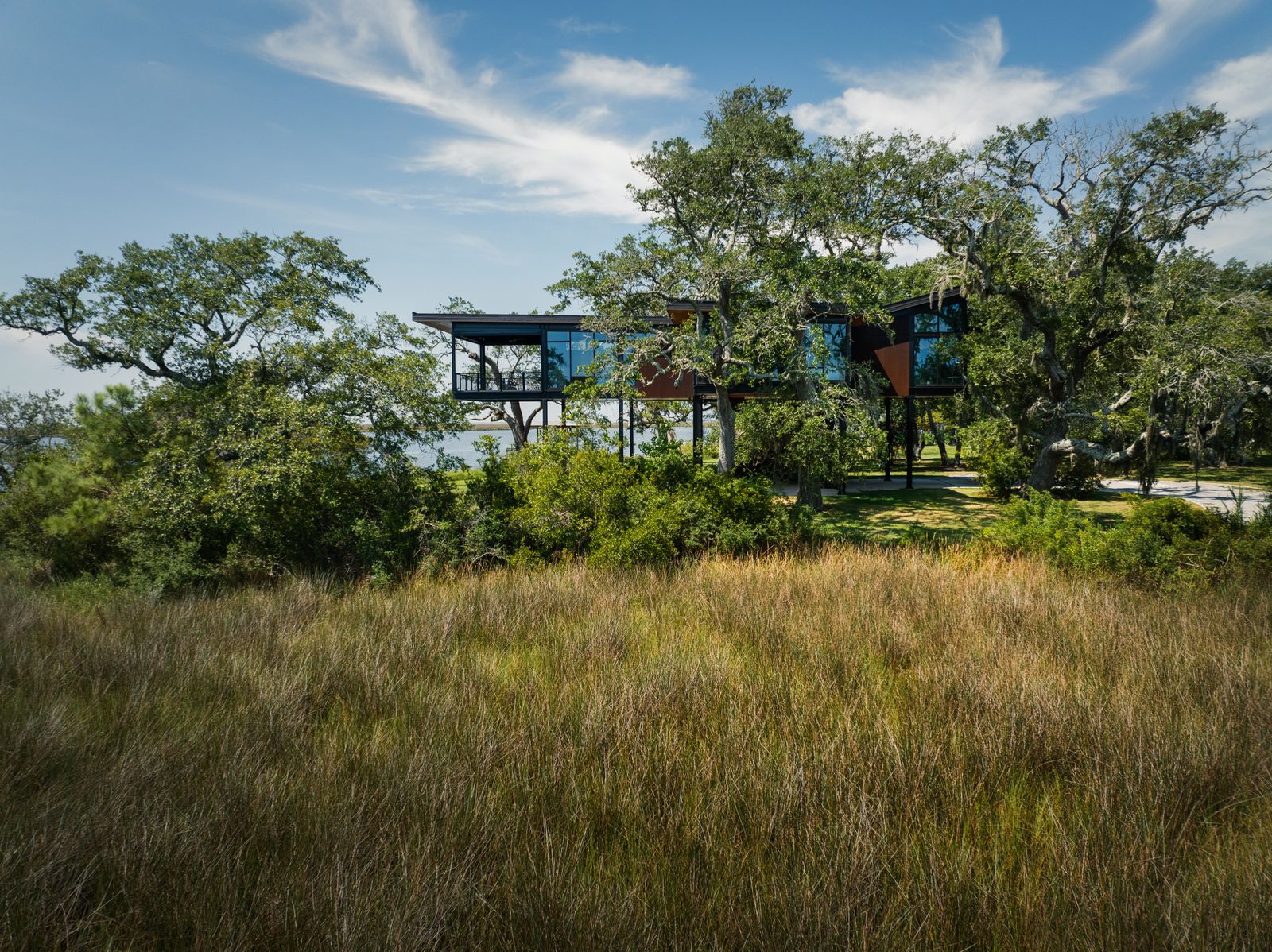
Tom Kundig absorbed lessons in resilience before he even knew the word. As a child, he saw many of the industrial and agricultural buildings of the rural Pacific Northwest abandoned but still standing, the harsh winter conditions no match for their steel columns. That background came in handy when he was asked to design a house for a young family on a coastal Mississippi site susceptible to severe flooding. The clients, Joel and Jill Kavanaugh, had fallen in love with a plot bordering the Gulf Islands National Seashore in Ocean Springs, Mississippi. The one-acre parcel looked out onto the Davis Bayou, with the Gulf of Mexico visible in the distance. That was the background; in the foreground were about a dozen ancient live-oak trees dripping with Spanish moss. As Joel puts it, he and Jill owned the painting; now they wanted the frame. And they wanted that frame to be the work of Tom Kundig, whose rugged houses they had been admiring in magazines for years.
Kundig accepted the job and flew to Mississippi to get to know the property, which at its highest points rises just five feet above sea level. Common sense and government regulations told Kundig to raise the house 23 feet off the ground, “above even the mosquitoes,” he jokes. Kundig being Kundig, he would lift the house not onto flimsy wooden posts but onto substantial steel columns. “We wanted to embrace the site’s unique conditions, not camouflage them,” he says.

The house itself would be covered in sheets of Corten steel, pre-weathered by their Kansas City fabricator. The roof and other exposed surfaces would also be metal. And the windows would be strong enough to withstand sustained 140-mile-per-hour winds, with gusts up to 200 miles per hour, a requirement in “high velocity hurricane zones” unless the glass can be shielded by exterior shutters. But despite Kundig’s reliance on industrial materials, the house would have a soft, domestic mien. Its most distinctive features are a switchback stairway with a landing that serves as a viewing platform and a screened porch large enough for the Kavanaughs to spend much of their time in. Wooden ceilings, which are visible from the ground, complement the reddish Corten sheathing.

Kundig is one of many architects designing houses to withstand extreme weather events—as well as fires—which have become especially severe during this period of climate change. And he is one of many architects proving that resilient houses need not look like bunkers. Kundig, who cofounded Olson Kundig Architects in 1986, says, “People come to us for houses that require little maintenance, but that they hope will last for generations.” As it turns out, he adds, “The same houses tend to be resistant to the larger forces of nature.”
For that reason, Kundig says, “just about all” of his houses can be considered resilient. They occupy dramatic (and challenging) sites in Europe, Asia, Africa and North and South America. He has not yet planted his flag on Antarctica. “Talk about resiliency,” he muses. “That would be a fascinating place to build.” And what about the moon or Mars? Those don’t grab him the same way: “I think we have enough challenges here on Earth,” says Kundig.

Disclaimer : This story is auto aggregated by a computer programme and has not been created or edited by DOWNTHENEWS. Publisher: wired.com






