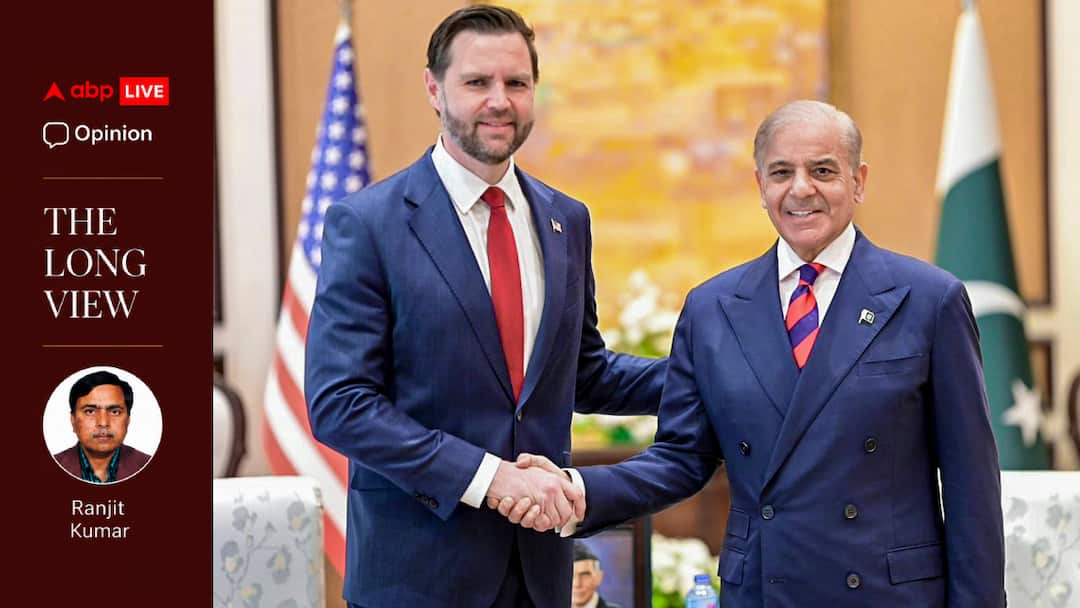
- US officials praised Pakistan’s role, elevating its diplomatic status.
- India rejects Pakistan’s mediator claim; US senators criticize.
- Pakistan seeks economic benefits, rebrands as peace facilitator.
- India faces pressure amidst Pakistan’s changing regional role.
The recent diplomatic engagements involving Iranian President Masoud Pezekshian’s visit to Islamabad, coupled with US Vice President JD Vance’s commendation of Pakistani Field Marshal Asim Munir, have significantly elevated Pakistan’s status as a crucial ally in the geopolitical landscape of the West Asia and beyond. Vance’s acknowledgment of Munir as a skilled diplomat and statesman, with whom he has had extensive interactions over the past three months, underscores the growing importance of Pakistan in facilitating dialogue between the United States and Iran.
This newfound recognition is likely to embolden Pakistan, prompting it to leverage its enhanced diplomatic standing to secure economic and strategic advantages, as suggested by an editorial in the Pakistani daily The Nation, which emphasizes the country’s intent to convert its diplomatic influence into concrete gains.
Jaishankar Rejects Pakistan’s ‘Mediator’ Narrative
In contrast, Indian External Affairs Minister S. Jaishankar has sought to downplay Pakistan’s role in mediating between the US and Iran, asserting that India does not engage in the same broker-like activities as Pakistan. His remarks highlight a long-standing narrative that positions Pakistan as a nation historically utilized by the United States for its strategic interests, particularly since the 1980s.
While it is true that Pakistan has served as a frontline state in the US-led efforts to expel Soviet forces from Afghanistan, the subsequent abandonment by the US following the 9/11 attacks has left a complex legacy. The allegations of Pakistan’s involvement in facilitating terrorism, particularly in relation to the attacks on New York and Washington, have further complicated its international standing and relationships.
ALSO READ: OPINION | Golden Dome And Sudarshan Chakra: Survival Kits In A New World Order
US-Pakistan Ties: A History Of Trust And Mistrust
It is essential for US officials, including Vice President JD Vance and President Trump, to reflect on the historical context of their statements regarding Pakistan. Trump’s famous tweet from January 1, 2018, which criticized Pakistan for receiving substantial financial aid (USD 33 billion)while providing sanctuary to terrorists, encapsulates the contentious nature of US-Pakistan relations. This sentiment of betrayal and mistrust has persisted over the years, complicating any potential for a renewed partnership. As Pakistan navigates its role in the current geopolitical climate, it must balance its aspirations for greater influence with the historical grievances that continue to shape its interactions with both the United States and its regional neighbours.
Interestingly, Trump’s fellow Republican senators have not overlooked Pakistan’s involvement in the ongoing war against terrorism, a sentiment echoed by several prominent members. Senator Rick Scott has publicly criticized the accolades bestowed upon Field Marshal Asim Munir, emphasizing Pakistan’s historical role in harbouring terrorists and providing refuge to notorious figures such as Osama Bin Laden. He pointed out that both Pakistan and Qatar have a troubling legacy of supporting terrorism, suggesting that their current focus appears to be more on bolstering Iran’s long-standing terror initiatives rather than pursuing genuine peace efforts. Additionally, Senator Tim Sheehy lamented Pakistan’s decade-long concealment of Bin Laden and its financial support to the Iranian Ayatollah, facilitated through the Inter-Services Intelligence (ISI), further underscoring the skepticism surrounding Pakistan’s intentions.
Pakistan Eyes Economic Gains From Diplomatic Success
Yet, Pakistan seems to be capitalizing on its newfound prominence, particularly following the conclusion of the U.S.-Iran deal, which has garnered praise from both the United States and Iran. This diplomatic achievement comes after a protracted period marked by exchanges of missiles and drones between the two nations.
As Pakistan seeks to leverage this moment to address its rapidly declining economy, exacerbated by the ongoing conflicts in West Asia, it is likely to appeal to both Iran and the United States for assistance. The de facto leader of Pakistan, who has recently elevated himself to the rank of Field Marshal following a controversial portrayal of military success against India in May 2025, appears to have demonstrated to U.S. officials how to transform a perceived defeat into a narrative of victory, particularly in the context of US negotiating agricultural trade with Iran.
The U.S.-Iran agreement, framed as a business-oriented arrangement, has been met with enthusiasm from President Donald Trump, who expressed optimism about the economic implications for American farmers. In this complex geopolitical landscape, Pakistan has positioned itself as a mediator, effectively catering to the interests of both the United States and Iran. The ongoing conflict in West Asia has presented Islamabad with what it perceives as a divinely ordained opportunity to facilitate dialogue, offering its territory as a neutral ground for negotiations. This role not only allows Pakistan to gain favour with the U.S. but also provides Iran with a convenient intermediary, thereby enhancing its own diplomatic standing. Pakistani leaders are likely envisioning substantial economic benefits stemming from the U.S.-Iran agreement, as they seek assistance from both the oil-rich Iranian economy and the world’s largest economy to mitigate the adverse effects of regional conflicts on Pakistan’s economy.
ALSO READ: OPINION | India Will Pay Heavy Price For Rafale Delay
Can Pakistan Rebrand Itself As A Peace Facilitator?
As a result of this newfound diplomatic role, Pakistan may transition from being perceived as a promoter of terrorism to a facilitator of peace, thereby elevating its profile in the Western world. This shift could compel India to navigate a transformed relationship with Pakistan, as the narrative of Pakistan as a terror-supporting nation may lose its credibility. Consequently, India might face increased pressure from Western nations to address its longstanding issues with Pakistan, particularly given that both countries possess nuclear capabilities, which heightens the stakes of their ongoing tensions. Recent reports from the Stockholm International Peace Research Institute (SIPRI) have raised concerns regarding India’s nuclear arsenal, indicating that it has deployed twelve nuclear bombs and surpassed Pakistan’s stockpile of 170 by an additional twenty. This situation is further complicated by the rapid expansion of China’s nuclear capabilities, which remains largely unaddressed in the discourse surrounding South Asian security dynamics.
The ongoing discourse surrounding Iran’s nuclear program has raised significant concerns globally, yet it is perplexing that the Western nations remain relatively silent regarding Pakistan’s nuclear capabilities, especially given the potential threats posed by extremist groups within the country. This apparent discrepancy may stem from a strategic perspective, where the West perceives Pakistan’s nuclear arsenal as a necessary counterbalance to India’s expanding nuclear deterrent. Such a viewpoint could inadvertently contribute to a precarious security environment in South Asia, where the balance of power is increasingly influenced by the nuclear ambitions of both nations, alongside the volatile political landscape that includes the risk of extremist factions gaining control.
India’s Diplomatic Challenge In A Changing Regional Order
In this context, Indian diplomacy faces a formidable challenge in countering the narrative propagated by Pakistan, which positions India as the instigator of heightened military tensions, particularly concerning the rights of the people in Jammu and Kashmir and the equitable distribution of water resources that are vital for the livelihoods of millions. As international scrutiny intensifies, India may encounter mounting pressure to engage in bilateral discussions with Pakistan; failure to do so could result in India being labelled as an aggressor in the region. Consequently, it is imperative for India to reassess and recalibrate its policies towards Pakistan and, more broadly, its approach to South Asia, in order to establish itself as a credible leader and advocate for stability and cooperation within the region.
(Ranjit Kumar is a senior journalist and strategic affairs analyst)
Before You Go
Ketan Agrawal Case: Pune Police Recreates Crime Scene at Lohagad Fort, Fresh Revelations Emerge
Disclaimer : This story is auto aggregated by a computer programme and has not been created or edited by DOWNTHENEWS. Publisher: abplive.com