A war-induced oil shock is bad, but a supercharged version of a familiar climate pattern could add to the misery.
Samir Wanmali, the Thai-based director of the United Nations World Food Program for Asia and the Pacific, a man who speaks in long, careful and precise sentences, is having trouble sleeping.
Ask him what keeps him up at night and he rattles off a series of numbers. The UN, says Wanmali, is currently tracking 318 million people at risk of acute hunger. Of those, 69 million fall into his region of responsibility. But there’s more to it than that.
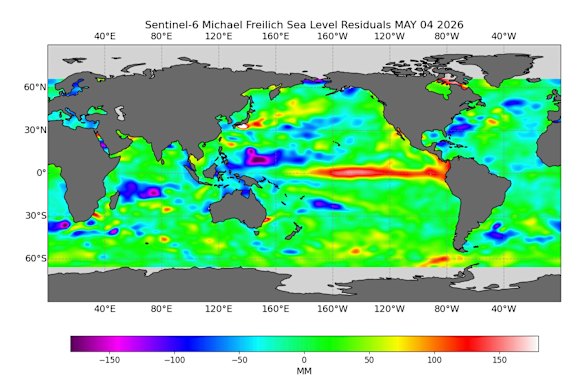
In January, a string of undersea buoys strung across the Pacific, and a brace of satellites orbiting above, began blinking in further warnings to observers. They detected what is known as a Kelvin wave, a mass of warm water, gathering on the eastern Pacific around Ecuador and releasing a heated plume to the west towards Australia.
Then, on February 28, a wave of bombs and missiles unleashed by the United States and Israel slammed into targets across Iran, beginning the war that has seen the Strait of Hormuz closed to sea traffic ever since.
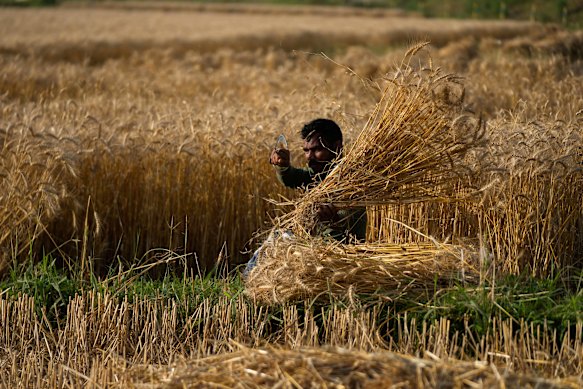
The Kelvin wave is typically plotted on maps of the Pacific as a red plume extending along the equator like a spear. It suggests that an El Niño is rapidly developing, a weather pattern that typically causes floods in parts of the Americas and droughts, heat and fire in parts of Australia and Asia, cutting crucial crop yields.
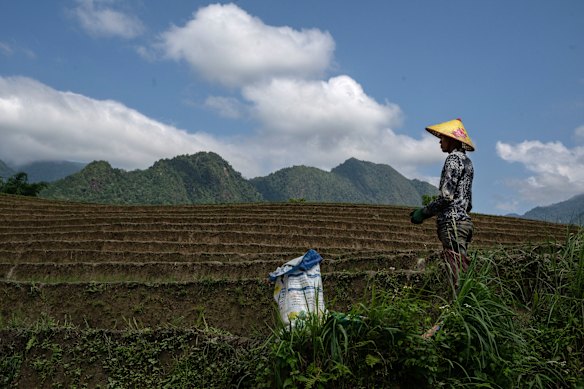
The closure of the Strait of Hormuz has not only crippled global oil supplies, but also supplies of gas, used to make urea, which in turn is a key ingredient of fertiliser. The UN’s analysts, says Wanmali, fear that these two crises woven together – what is already being referred to by some observers as an omnicrisis – could drive up the number of people who will face acute food shortages over the coming months.
And here the figures come tumbling out again. The UN fears a further 45 million people face intense hunger across the world – of those, 9 million are in the Asia Pacific region – due to the combination of disrupted weather and shortages of fuel and fertiliser.
“What we’re looking at is a series of intersecting and compounding crises that start with the existing prevalence of food insecurity and malnutrition in the region,” says Wanmali.
But it gets worse still, at least from a climate perspective.
The readings being gathered by the buoys and satellites that track the plume of heat in the Pacific have not been normal even by the standards of El Niño conditions. One key measure, known as the Niño-3.4 index, revealed warming of 1 degree between March and May. The Australian Bureau of Meteorology noted that 0.3 degrees of that increase occurred in a single fortnight. This is an exceptionally fast and furious increase in ocean temperature.
This has prompted some observers to warn that the most intense El Niño in recorded history could be brewing. Some have described it as an impending super El Niño.
Is There Such a Thing as a Super El Niño?
When this masthead first reported that international observers were describing the warming in these terms, one of Australia’s leading climate scientists warned against the use of such language.
“The phrase ‘Super El Niño’ makes climate scientists like me roll our eyes,” wrote Kimberley Reid, a postdoctoral research fellow in atmospheric sciences at the University of Melbourne, in an article for The Conversation.
“When ocean temperatures are 0.8 degrees warmer than usual in that region, and the trade winds have sufficiently weakened, the Bureau of Meteorology can declare an El Niño has arrived. (The United States uses 0.5 degrees as the figure).
“A ‘Super El Niño’ is when the region’s ocean temperatures rise 2 degrees, roughly two standard deviations above normal (about a 2.5 per cent chance of happening),” she wrote. “While scientists first coined the term, the evocative phrase has become a favourite of media commentators.
“But Australian forecasters don’t use these terms, as it doesn’t matter that much for our weather if the index goes over 2 degrees. What matters much more is whether an El Niño is present or not.”
In simple terms, she explained to this masthead in a later interview, it was not yet certain that the El Niño signalled by ocean and atmospheric temperatures on that long red spear across the Pacific would eventuate. Further, even if it did, the intensity of an El Niño does not correlate to unusually intense outcomes for Australia, though it will cause hotter and drier conditions.
That might be of some comfort to Australian farmers, but it is of little comfort to Wanmali, whose responsibility extends to the region and the world, where an extreme El Niño does correlate to extreme conditions. Besides, just as Australians are suffering from increased energy prices, even though we export energy, Australians will face price increases for foodstuffs when the global supply of rice and grains shrinks. Everything connects.
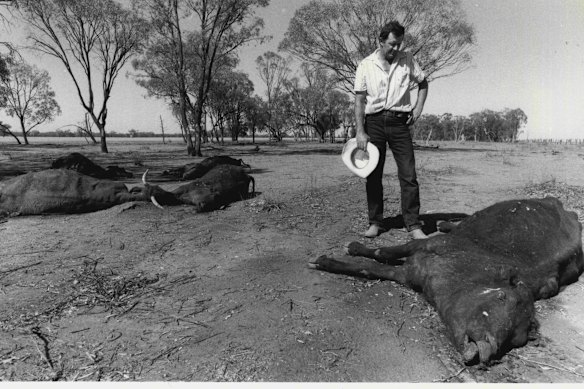
“It would be a globally catastrophic event if it’s a super El Niño because we know that those super El Niños can bring horrendous flooding rains to Latin America, severe drought and bushfire to Australia, Indonesia, and parts of Asia, and it even teleconnects to Antarctica … and can lead to more rapid rates of ice shelf melt,” UNSW Scientia Professor Matthew England, a climate scientist specialising in oceanic modelling, told this masthead last month.
“It’s a global phenomenon, it’s extreme in magnitude in terms of how far it reaches, and the amount it changes our climate patterns, and it costs us deeply because there are disruptions to what we do, everything from fisheries to heat extremes to flooding, rains and drought.”
Dr James Hansen who, as director of the NASA Goddard Institute for Space Studies, became famous when he warned US Congress of the potential impact of global warming in 1988, also pushed back against Reid in recent weeks.
“Media attention to the possibility of an upcoming ‘Super El Nino’ irritates some scientists, given inherent uncertainty in forecasts,” he wrote in April in a piece alongside three other climate scientists. “We push back gently against that irritation. Predictions in the face of uncertainty are a valuable approach, with the potential to increase our understanding.”
Further, he argued, measurements of water temperatures 300 metres beneath the ocean surface were a more reliable indicator of the phenomenon. “The 300-metre temperature already assures that we will have an El Niño in 2026-27,” Hansen and his colleagues wrote. “The March average of the 300-metre temperature anomaly exceeds plus 1 degrees. At that point, it is consistent with either a Super El Niño or an ordinary El Niño. However, in the first week of April, the 300-metre anomaly reaches plus 1.6 degrees.”
So far this year, the European Centre for Medium-Range Weather Forecasts models give a 98 per cent chance of at least a moderate El Niño, an 80 per cent chance of a strong El Niño and a 20-25 per cent chance of a super El Niño.
Worse still, as global temperatures rise due to climate change, even moderate El Niños are hotter than those that occurred before warming began, as each spike of heat builds off a higher baseline temperature. Since 1980, there have been three super El Niños. The 2015-2016 El Niño was the biggest yet, with the sea surface temperature anomaly peaking at 3 degrees in November 2015. The previous record was a 2.8 degree anomaly in January 1983. On each occasion, the year that followed the onset of the super El Niño – 1983, 1998 and 2016 – smashed the record for the world’s hottest year in recorded history.
The current hottest year in history is 2024, which followed a moderate to strong El Niño year, and the past 11 years are the 11 hottest on record.
The Cascade
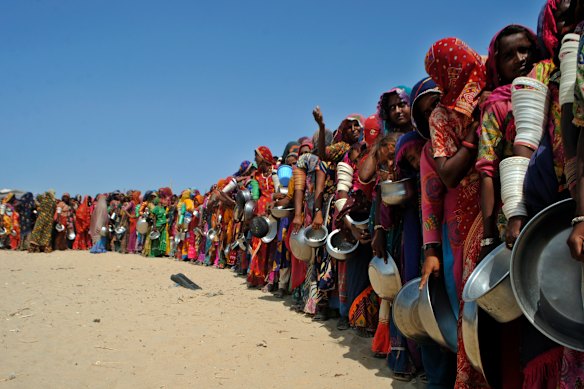
More heat in the atmosphere lends more energy to the storms that already batter the world. Wanmali explains that in the last five years, “the frequency of natural disasters are on the rise”. In Pakistan, he says, major flooding used to occur every four to five years. Now, flooding comes with every monsoon. Last year, floods left around 3 million people displaced and in need of immediate humanitarian assistance.
As the monsoon season approaches alongside an El Niño, he is fearful for populations left all the more precarious by the war that has restricted not just fertiliser, but fuel, which is needed to ship and truck grains and to run pumps and irrigation systems.
Indeed, complications are already rippling through long and complex supply chains. In March, S&P Global reported that Asian rice exports were being hampered by a shortage of the plastic raffia that is used to make sacks to carry and ship the grain, which in turn is made from oil exported from the Gulf. “Deals booked in February are also stuck, and so far, no new vessel has been able to transit,” one buyer of the material in India told S&P.
While it is unclear what impact the looming omnicrisis will have on the region, by sheer dint of its wealth, Australia is likely to do better than neighbouring nations the WFP is preparing to assist. “Bangladesh is a country that imports 30 per cent of its electricity generation as oil,” said John Grimes, the outgoing chief executive of the Smart Energy Council, during that organisation’s annual conference earlier this month.
“They are massively exposed to the oil crisis that’s playing out around the world. It’s not just about financial market confidence, it’s about the physical systems that drive the economy. When you don’t have electricity, then you don’t have the way to transport diesel, you don’t have the way to transport food.
“Your food system starts to break down. You don’t have electricity to run water treatment plants. All of a sudden, you’re subject to disease outbreaks. You don’t have the electricity to run your hospital, your critical systems to keep medications cold.
“Countries like Australia … will be able to secure the diesel that we need, the oil that we need for our industry. But remember, not every country is in that position, and there are many countries around the world that will disproportionately feel the pain of this cascading effect.”
Dr Timothy Neal, Scientia senior lecturer in the UNSW’s School of Economics and also at the Institute for Climate Risk & Response, says the combination of a likely El Niño and fuel and fertiliser shortages is a “perfect” storm for Australian agriculture. He argues that to estimate its impact we should look at the recent past. According to his research, “the real price of food today … is roughly where it was in the 1960s”, which he finds “staggering” given huge productivity gains. His unpublished research suggests that climate change and more extreme weather have eroded those gains by hitting yields, so the potential dividend from improved production has been largely cancelled out.
Last month, the UN’s Food and Agricultural Organisation reported prices had already begun to increase. “The FAO Food Price Index, which tracks monthly changes in the international prices of a basket of globally traded food commodities, averaged 128.5 points in March, up 2.4 per cent from February and 1.0 per cent above its level a year ago,” it reported.
“The FAO Cereal Price Index increased by 1.5 per cent from the previous month, driven primarily by higher world wheat prices, which rose 4.3 per cent due to drought-related deterioration of crop prospects in the United States of America, and expectations of reduced plantings in Australia due to higher fertiliser costs. Global maize quotations edged up slightly, as ample global availability offset concerns over fertiliser affordability and indirect support from greater ethanol demand prospects, linked to the rising energy prices.”
ReliefWeb, an online news service for global humanitarian organisations, subsequently warned the looming El Niño is “associated with rainfall deficits, higher temperatures, and extended dry spells across Caribbean states, including Belize, Guyana, Suriname, and parts of Jamaica, and Trinidad and Tobago”. It said Belize had already activated “drought-related anticipatory action mechanisms” and warned that much of the world had not yet recovered from consecutive shocks, including the COVID pandemic and the invasion of Ukraine.
Writing for CarbonBrief, climate scientist Zeke Huasfather said a strong El Niño was likely, and would probably peak between November and January. He added that recent history showed the year following an El Niño to be hotter still. This could make 2027 the hottest year in recorded history.
Hansen projects the average global temperature could hit 1.7 degrees above the historical mean next year, a temperature the UN predicted in 2025 the world would not see until the early 2040s.
Get to the heart of what’s happening with climate change and the environment. Sign up for our fortnightly Environment newsletter.
Disclaimer : This story is auto aggregated by a computer programme and has not been created or edited by DOWNTHENEWS. Publisher: www.smh.com.au