
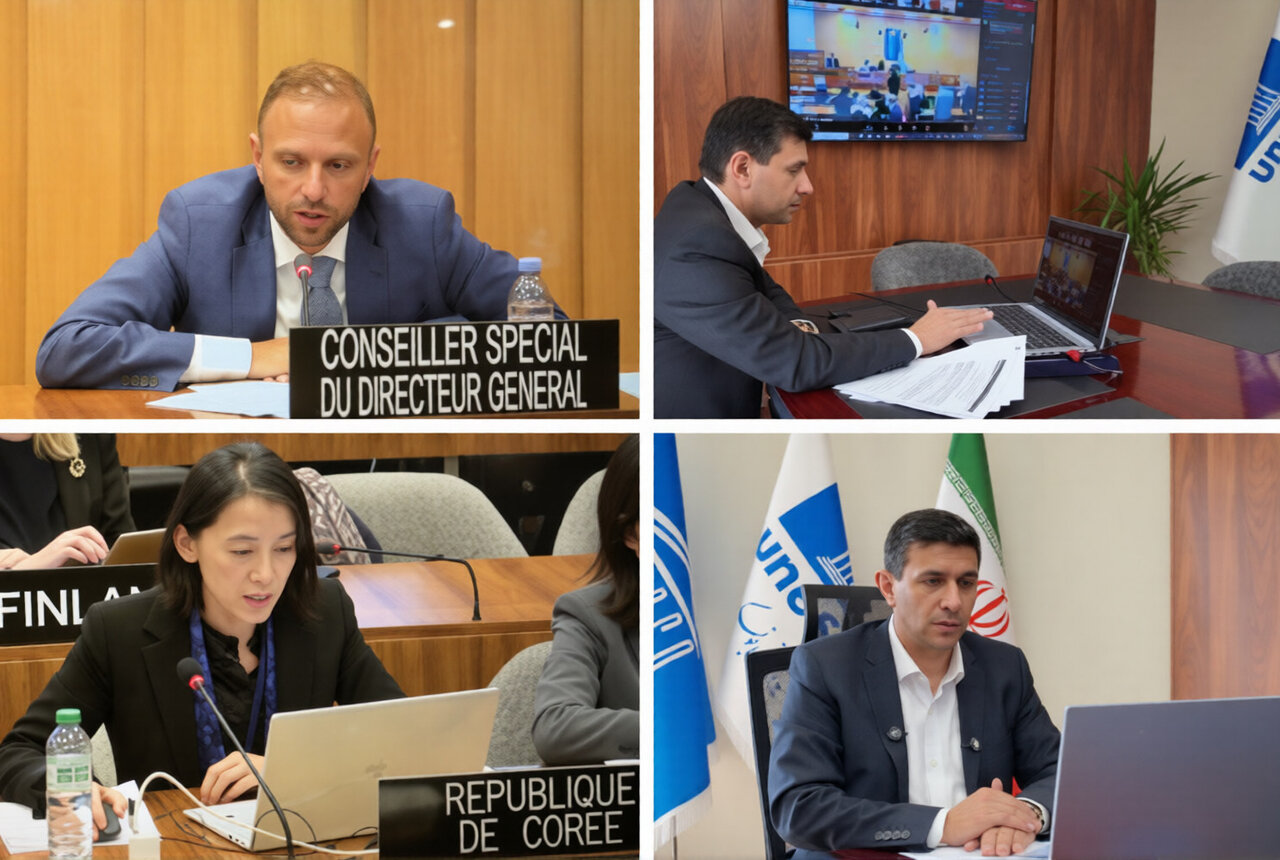
TEHRAN –Secretary-General of Iran’s National Commission for UNESCO Hassan Fartousi has underlined the importance of preserving peace at the heart of UNESCO’s mission, and urged National Commissions for UNESCO to play a more active and responsible role in sustaining lasting regional and global peace while delivering a talk at the Traditional Meeting of UNESCO National Commissions.
The meeting took place on October 8 and 9, at UNESCO Headquarters in Paris, France, on the sidelines of the 225th Session of the Executive Board. Fartousi addressed the meeting online, IRNA reported.
Referring to the devastating impacts of war in Iran, the official said that wars affect education, scientific cooperation, and common heritage of humanity. He also highlighted that UNESCO’s fundamental vision is to build lasting peace in the minds of women and men through education, culture, science, communication, and dialogue.
Hence, UNESCO and its national commissions bear a great responsibility for fostering regional peace, Fartousi noted.
Underscoring the unparalleled role of national commissions in aligning UNESCO’s global priorities with national realities and capacities, the official said strengthening national cooperation with UNESCO and its National Commissions is among the top priorities of the Iranian National Commission.
The Traditional Meeting of UNESCO National Commissions was opened by UNESCO Director-General Khaled El-Enany and Assistant Director-General for Africa Priority and External Relations Lidia Brito.
The discussions centered on reaffirming the role of National Commissions as a bridge between UNESCO and Member States, enhancing intersectoral cooperation, and increasing field office synergy.
Iran urges UNESCO to help restore scientific infrastructure damaged in war
On October 1, the head of the National Committee for Management of Social Transformations (MOST) called for UNESCO to play an effective role in safeguarding knowledge, ensuring uninterrupted access to learning, and rebuilding academic centers damaged during the US-Israeli imposed war against the country.
Highlighting the destructive impact of conflicts on educational institutions and human capacities, Seyyed Ziae Hashemi said the international community needs to pay close attention to these outcomes, IRNA reported.
The official made the remarks while addressing the extraordinary session of the Intergovernmental Council of MOST Program, which took place at UNESCO headquarters on October 1 in Paris; the official and the Secretary General of Iran’s National Commission for UNESCO attended the session online.
Referring to the impacts of the US-Israeli war against Iran, and the damage inflicted on certain educational and scientific institutions, cultural heritage and civilian infrastructures, he called for UNESCO to utilize its capacities for rebuilding scientific and educational capacities, strengthening international cooperation, and supporting sustainable development.
“International responses must be tailored to the specific circumstances of each crisis, while simultaneously placing the fundamental principles of protecting human lives, safeguarding knowledge, and ensuring the continuity of learning at the heart of these efforts,” he added.
“The catastrophic dimensions of war in Gaza have inflicted irreparable damage on civilians, educational centers, cultural and scientific activities; the international bodies have to make it clear what they can do within the frameworks of BRIDGES and MOST to protect knowledge, sustain education and research,” he added.
The restoration of the right to education for Afghan girls and women was another issue raised by the official.
Fartousi, for his part, emphasized that science is not merely a driver of industry or technology, but an essential part of human life and a factor that enhances our understanding of the world. Access to knowledge, equal learning opportunities, and universal participation in research are fundamental rights in human society.
Referring to UNESCO’s approach to open science, he called for the establishment of specific mechanisms that prevent the monopolization of knowledge, ensure the free flow of knowledge, and strike a balance between supporting researchers and universal access to science.
Highlighting the challenges faced by researchers due to unilateral and coercive measures, the official noted that BRIDGES frame work needs to propose practical solutions to remove barriers to scientific cooperation, prevent concentration of knowledge and power, and consolidate the concept of knowledge as a shared heritage and asset of humanity.
The Intergovernmental Council (IGC) of the MOST Program was established by UNESCO Member States in 1994. It is composed of 35 Member States elected by the General Conference, whose representatives meet every two years to guide and oversee the planning and implementation of the MOST Program. The IGC defines the MOST Program’s broad priorities, reviews its activities and achievements, and helps strengthen the link between social and human sciences research and public policy.
Through its work, the IGC provides a platform for Member States to exchange on contemporary social transformations and to promote more inclusive, evidence-based policies aligned with national priorities.
MT/MG
Disclaimer : This story is auto aggregated by a computer programme and has not been created or edited by DOWNTHENEWS. Publisher: tehrantimes.com




