If the US defence secretary, Pete Hegseth, goes ahead with plans to livestream the execution of a soldier radicalised to extremist Islam who killed 13 people at a military base in Texas, his country will join a motley assembly of lesser powers and rogue actors who have conducted public executions in recent years.
Only two countries currently systematically carry out capital sentences in public: Iran and Afghanistan. In 2025, the Taliban authorities carried out six such killings and the regime in Tehran 11, according to Amnesty International.
In April last year, the Taliban executed four men accused of murder in three different cities. All were shot dead in crowded public sports stadiums. Such events were common when the hardline Islamist militia movement were in power in the late 1990s. Then as now, the Taliban claimed a due court process had been followed.
In July, two young men accused of killing policemen were hanged by Iranian authorities in the central square of Isfahan. Human rights monitors have reported about 30 public executions in Iran in the last five years, with an intensification in recent months after massive popular unrest earlier this year and the war with the US and Israel. Historically, many hangings have been carried out using a crane as a makeshift gallows.
Saudi Arabia appears to have ended the practice after decades of beheading convicted criminals in a square in the capital, Riyadh, and sometimes publicly in provincial cities.
Legal experts and historians argue that public executions perform different functions. If the rule of law is shaky or there is doubt about the efficacy of the criminal justice system, they offer authorities seeking to win support a way of convincing the community that criminals will be punished. Such public spectacles can also be a way of cowing a population through terror.
Armed militant groups have frequently resorted to public executions – often in a bid to assert their authority.
Islamic State, which ruled a swath of Iraq and Syria between 2014 and 2019, conducted thousands of executions for alleged offences ranging from homosexuality to theft. Many of the executions took place in public or were videoed. A large number were deliberately choreographed to provide a spectacle for broadcast to terrorise enemies and potential dissidents as well as to radicalise IS supporters and attract new ones.
In October 2025, as Hamas sought to reassert its control over the population of Gaza, it carried out a public execution of six men apparently accused of collaborating with Israel. Almost a decade earlier, in 2017, the group had executed three men accused of the same crime, partly livestreaming the event on Facebook.
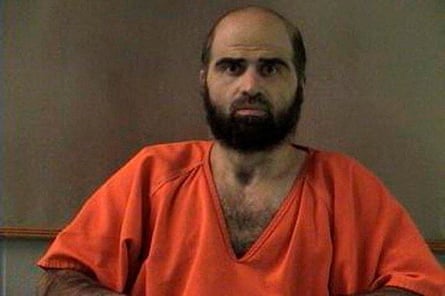
The execution of Maj Nidal Hasan, a former army psychiatrist who opened fire at Fort Hood in Texas in 2009, would be the first public execution in the US in many decades.
In the US, the practice of public executions was largely stopped in the 1930s, though in 2001, some survivors and victims’ relatives were allowed to watch the execution by lethal injection of Timothy McVeigh, convicted of the 1995 bombing of a government office in Oklahoma City.
Hasan’s execution has been scheduled for 3 December. Hegseth, who has the authority to decide the conduct of the killing, has said that “of course” it would take place at the same time and in the same place as Hasan’s attack 17 years ago and would use firearms, as Hasan did.
Hasan can launch appeals within the civilian federal court system that could delay the execution for many years.
In 2025, Amnesty International recorded 2,707 executions, the highest total globally since 1981, and an increase of two-thirds on the previous year. The sharp rise was mainly due to more than 2,100 executions by Iran, its highest number of executions in decades.
Amnesty said authorities had placed the death penalty “at the centre of flawed public security and ‘tough on crime’ narratives to assert control, project state power and score political points”.
“This trend was strongest in countries where the authorities have tightened their grip on power by restricting civic space, silencing dissent and displaying disregard for protections established under international human rights law and standards,” the campaign group reported.
Disclaimer : This story is auto aggregated by a computer programme and has not been created or edited by DOWNTHENEWS. Publisher: theguardian.com