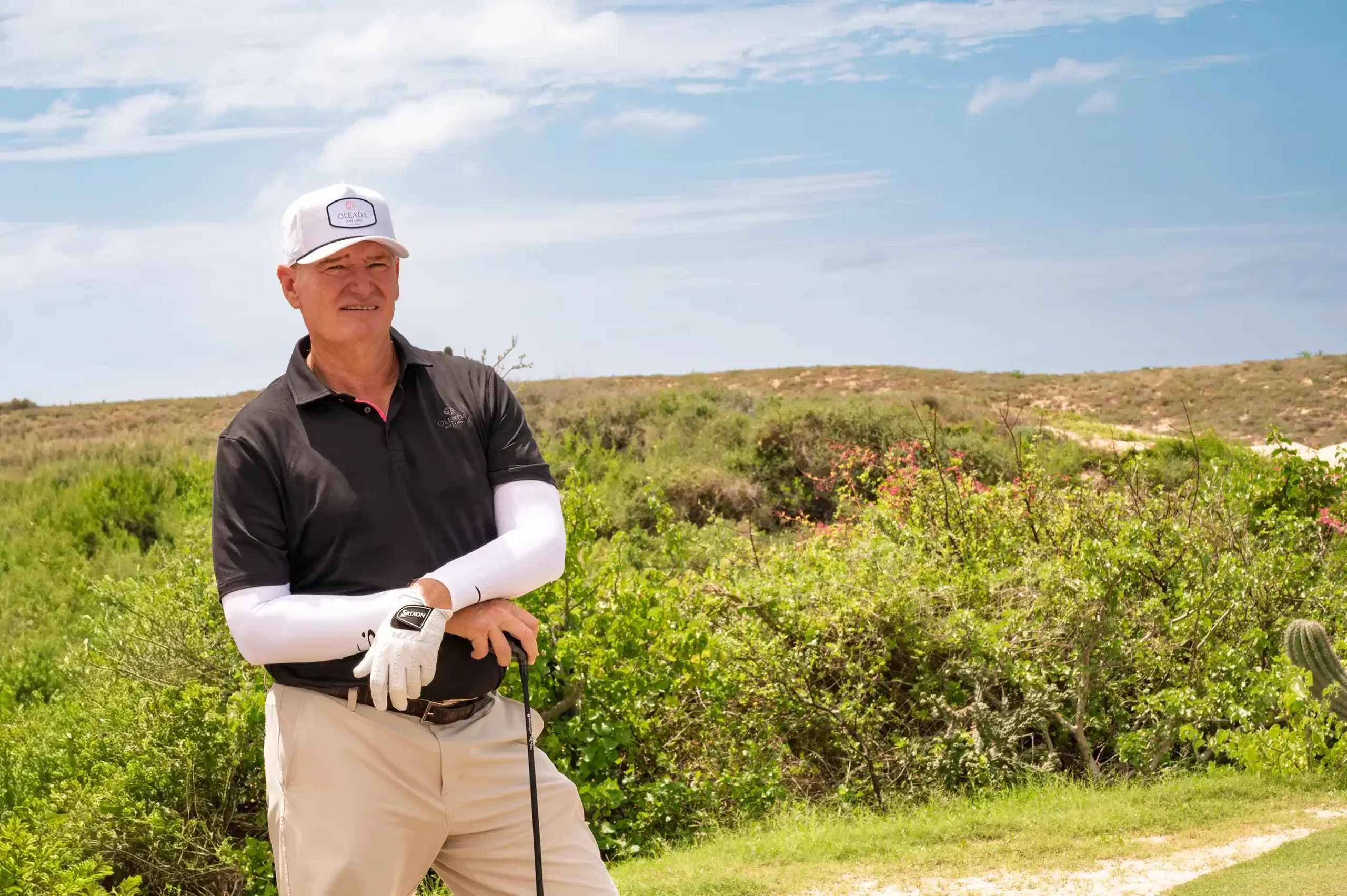
“That’s how we get ready for St. Andrews,” Ernie Els said, rifling a long iron low into the breeze.
It was the type of shot Els often hits in preparation for the Open Championship, but this was no typical practice session.
For one thing, the next Open, to be held at the Old Course in St. Andrews, was still eight months away. For another, Els wasn’t on a wind-blown links in Scotland.
He was swinging in the sunshine in Cabo San Lucas.
The occasion was the opening of Oleada Golf Links, the latest addition to Cabo’s booming golf scene and Els’ first course design in Mexico.
“That was on a good line, but I didn’t quite catch it,” Els said. His stinger on the downhill par-5 10th had hopped and scurried before coming to a stop just shy of the green.
Els looked around. Cardón cacti flanked the fairway. In the near-distance, tawny desert gave way to blue Pacific, where humpbacks spouted just offshore. The setting was less Scottish than the style of play.
“We wanted to give you some room so you can work the ball a bit, get creative, hit the bump-and-run,” Els said. “Believe me, you’re going to need those shots because it can blow out here.”
Oleada isn’t technically a links, but it borrows liberally from the links playbook. From its starting point on high ground in a cactus forest, the course plunges toward the water and a swath of dunes that would have made Old Tom Morris proud. Here, Els and his design partner, Greg Letsche, found a welcome canvas for 14 of their holes, nesting greens in natural saddles, threading fairways through heaving camelbacks of sand and scrub. The result allows for aerial assaults, but towering approaches aren’t always the best option. There are few forced carries. Most greens are open-fronted. Oleada wasn’t dreamed up as a dartboard. A billiard table is a better comp. Shots aren’t meant to stick but scoot.
Courses of this kind weren’t in fashion when Els’ lead man, Letsche, first worked in Cabo in the early 1990s. He was then an associate with Nicklaus Design, assisting in the build of Palmilla and Cabo del Sol, target-golf showpieces that helped define the region for a generation. If design tastes have changed since, so has the golf landscape in Cabo itself. Development has exploded, and a destination that was once a sleepy fishing village now looks and feels, in many places, like a southern annex of Rancho Santa Fe. Newer courses in the area skew private, while some older resort courses have morphed into members-only enclaves.
Oleada is starting on a different tack. It is allowing limited outside play for now, and will eventually open its tee sheet to guests of two planned hotels as well as homeowners and their guests in a planned low-density residential community.
The man behind the design has taken on most every kind of course there is, in nearly every corner of the world where the game is played. Introduced to golf on the wind-scoured layouts of his native South Africa, Els has won 80 titles across five continents and designed courses on four, though never until now in Latin America.
Oleada is a first in another way: the first course in Mexico to provide a base for the Els for Autism Foundation, which he and his wife, Liezl, started after their son, Ben, was diagnosed with the condition. Among other initiatives, the foundation teaches golf fundamentals to people with autism, with the aim of building communication, motor and social-emotional skills, and self-esteem.
For Oleada’s ribbon cutting, Els began the day not on the course but at a clinic for children with autism and other special needs. Before the ceremonial opening round, he moved about the practice range, bending low to adjust a grip or steady a backswing, helping each child make contact with a plastic club on a tennis ball. Partway through, Els was demonstrating proper hand position to a boy when he realized the boy couldn’t see — a moment that left him blinking back tears.
“Golf is an amazing game like that,” Els said later. “You can meet kings and presidents. You can also help kids with autism.”
He kept thinking about the boy. “Just the sweetest, gentlest human being you could imagine,” he said.
A four-time major champion and a member of the World Golf Hall of Fame, Els appears to carry his achievements lightly, or at least with the humility of a man who knows how fortunate he is.
Perspective helps in life. And course design.
Until this week, Els’ take on Oleada had come through multiple site visits, during which he’d hit balls in the dirt while hashing out the details of the layout with Letsche. Now, at last, he was playing it turfed.
On a property so young, conditions weren’t as firm and fast as they will be when the grass fully matures and the superintendent can really do his thing. So it goes. Courses evolve. Architects also tweak them. On the 12th, a dramatic par-4 whose fairway splits around a dune then plays to a green where a sandy ridge encroaches from the right, Els wondered aloud whether the approach might be too daunting for the average resort guest.
“Maybe we should take out that ridge, eh, Greggy?” Els mused.
He and Letsche batted the idea around before deciding to let it be, though Els closed the conversation with another thought: maybe they should cover the sandy ridge in turf.
Els, of course, is not the average guest. At 57, with a design firm and other global business interests to run, he still competes on the PGA Tour Champions (his two Open wins exempt him into that championship until he’s 60), and thanks to advances in equipment, he’s as long as ever.
“I’m averaging 294 out there, which is what I was in my heyday,” he said, then grinned. “Problem is the kids are now hitting it 330.”
Oleada is plenty long, too, tipping out at more than 7,300 yards, with four other sets of tees for the ordinary players who represent its target market.
Few are apt to play the par-3 13th the way Els did: 178 yards, into the wind. Els pulled 8-iron. His ball never wavered from the pin, landing a few hops short and peeking in the cup on the way past, a whisker from an ace.
“Gosh, why didn’t that go in,” Els said. “That would have been something.”
Asked how many holes-in-one he’d made, he could only guess. “Twenty-four or 25, I think,” he said.
Better, maybe, to save the next one for St. Andrews.
Disclaimer : This story is auto aggregated by a computer programme and has not been created or edited by DOWNTHENEWS. Publisher: golf.com