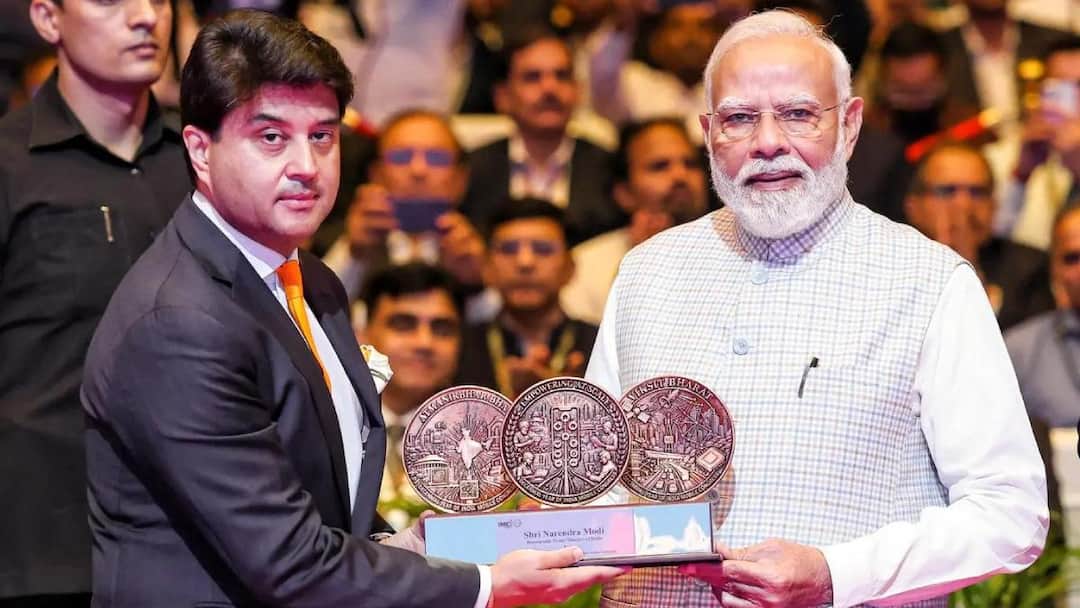
- Prime Minister Modi outlines India’s 6G, AI, and cybersecurity roadmap.
- India achieved widespread 5G; mobile phones enable digital services.
- Cybersecurity and global cooperation become crucial for digital safety.
India’s telecom story is moving beyond the rapid expansion of 5G, with Prime Minister Narendra Modi using the India Mobile Congress 2026 platform to outline a broader technology roadmap centred on 6G, artificial intelligence, semiconductors, cybersecurity and advanced digital infrastructure.
Speaking at the inauguration of the 10th India Mobile Congress at Yashobhoomi in New Delhi on Thursday, October 8, Modi said India’s digital transformation has fundamentally changed the role of the mobile phone. What began primarily as a communication device, he said, has evolved into an important platform for governance, payments, content creation and access to digital services.
The Prime Minister also pointed to the dramatic changes in India’s mobile ecosystem over the last decade, including substantially higher data consumption and significantly lower costs for users.
Prime Minister @narendramodi addresses the India Mobile Congress (IMC) at Yashobhoomi in New Delhi. PM Modi says, “Today is October 8. This is a special day for India. We celebrate this day as Air Force Day. I salute all our brave air warriors and extend my greetings to the country on Air Force Day…” #IMC2026 #IndiaMobileCongress #Technology #Innovation @DoT_India @PIB_India
— All India Radio News (@airnewsalerts) October 8, 2026
From 5G Expansion To The 6G Era
India’s 5G network has now expanded to every district, according to Modi, with more than 5.5 lakh 5G base stations deployed across the country.
The Prime Minister also said mobile internet speeds have increased tenfold since 2022, when India began its 5G rollout. The India Mobile Congress itself played a role in that journey, with the technology being launched from the event’s platform.
Looking back at the expansion of the network, Modi said, “In 2023, I spoke about India’s transition from 5G rollout to 5G reach-out.”
The focus is now shifting towards the technologies expected to define the next stage of connectivity. Alongside 6G, the government is placing artificial intelligence, semiconductor production and emerging technologies at the heart of India’s digital growth ambitions.
The emphasis also extends to domestic manufacturing, with India seeking to strengthen its position in the production of mobile phones, telecom equipment and other electronics.
Mobile Phones Become A Digital India Building Block
The scale of India’s digital transformation, Modi said, can be understood through the changing importance of mobile phones in everyday life.
Rather than remaining limited to voice calls and messaging, smartphones have become gateways to government services, financial transactions, digital content and other online services.
“Through the Digital India initiative, we resolved to change this situation, with the mobile phone at the centre of this transformation. This has been a major effort towards the democratisation of technology,” PM Modi said.
He added that telecom infrastructure and policy reforms have helped accelerate this shift.
“Over the past 10-12 years, the mobile phone has emerged not only as a means of modern communication, but also as an important tool for good governance. It has remained at the core of our Digital India vision,” PM Modi said.
The comments underline the government’s effort to position connectivity not merely as a communications service, but as foundational infrastructure for India’s wider digital economy.
Cyber Fraud Emerges As A Major Digital Challenge
Greater connectivity also brings a larger security challenge. As smartphones increasingly handle financial transactions, personal information and communications, Modi stressed that digital expansion must be accompanied by stronger safeguards.
“Phone and network security are our top priorities,” he said. “An average citizen does not think in the language of technical protocols. When they receive a call, they should know who is calling. When they make a digital payment, they must feel assured that their money is safe and their personal data is secure.”
The Prime Minister also argued that tackling cybercrime requires countries to work together because attacks can cross multiple jurisdictions.
“Cybercriminals do not recognise borders. A person sitting in one country can commit a crime in a third country, using resources from a second country. To tackle this, it is absolutely essential that we work together to establish a global framework for cybersecurity,” he urged.
The remarks place cybersecurity and consumer trust alongside connectivity and innovation as key components of India’s digital agenda.
IMC 2026 Broadens Its Technology Portfolio
The scale of this year’s India Mobile Congress also reflects the expanding definition of the telecom and technology sectors.
IMC 2026 has been organised around four broad themes: Srishti: Building the Future; Samvardhan: Fueling Growth; Sashakt: Expanding Opportunities; and Suraksha: Strengthening Trust.
The exhibition and conference programme covers areas including 5G and 6G, AI-driven networks, semiconductors, non-terrestrial networks, cybersecurity and quantum communication. Enterprise transformation, electronics manufacturing, circular economy and ESG are also part of the event’s established technology focus.
Four additional areas have been introduced this year: smart mobility, stadium experiences, industrial robotics and transport technology.
Together, these segments point to a technology ecosystem that is increasingly moving beyond conventional telecom infrastructure. Connectivity, AI, automation, electronics manufacturing and digital security are becoming interconnected parts of India’s next phase of technological development.
Disclaimer : This story is auto aggregated by a computer programme and has not been created or edited by DOWNTHENEWS. Publisher: abplive.com