There may be more market angst ahead this week as investors realize just how fragile the ceasefire between the U.S. and Iran could prove to be.
The United Arab Emirates said an unidentified drone strike had caused a fire near the Barakah Nuclear Power Plant on Sunday.
Officials are still investigating the source of the strike, according to reports, but the potential reescalation of tension in the Middle East is precisely the opposite of Wall Street’s hopes.
As the Iran conflict hit 80 days this morning, Deutsche Bank’s Jim Reid highlighted the truce and ceasefire period of 41 days has now outlasted the 39-day kinetic phase.
“While an end to the ceasefire clearly cannot be ruled out, the fact this stalemate has persisted for so long suggests the U.S. would prefer to avoid that route, given the political and economic consequences—particularly the political ones in an election year,” he added in a note seen by Fortune.
ONE BIG THING
Trump on interest rates, Iran, and inflation
Fortune’s Editor-In-Chief Alyson Shontell sat down with President Donald Trump in the Oval Office ahead of his trip to Beijing last week.
In the wide-ranging interview, President Trump discusses tariff repayments (“Can you imagine—to people who hate us, to countries that ripped us off for years, I’ve got to give them back $149 billion”), his view on the base rate (“You can’t really look at the figures until the war is over”), and his regrets over the Intel deal (“I should have asked for more”).
President Trump has always hung his hat on his dealmaking skills—be it with trade allies, military rivals, or American businesses—but whether the next White House occupant will be able to keep the pipeline flowing remains to be seen.
“Can’t answer that question,” Trump says. “I don’t know. I mean, it’s not going to happen again.”
With the midterms approaching, potential frontrunners for the next presidential election may soon come into focus, but the president avoided any name drops: “Whoever gets this [job] is going to be very important. And if you get the wrong person: disaster.”
CHINA
Xi’s ‘grand bargain’ to President Trump
Briefings following the U.S.-China summit have diverged in content. The White House has focused on the bigger picture: Reopening the Strait of Hormuz, and near-term trade. China has emphasised that Taiwan is of the utmost importance and mishandling the situation could have dire consequences.
Goldman Sachs’s Andrew Tilton and Hui Shan wrote in a note seen by Fortune this morning that Xi may be implicitly offering Trump a “grand bargain” of sorts: if the U.S. reduces rhetorical support for Taiwan, then the White House can expect to see bigger headline purchases by Beijing.
The duo went on: “This might explain the remaining uncertainties on items such as China’s purchases of U.S. goods – they are implicitly conditioned on Trump’s actions in coming months with respect to Taiwan. But Trump may have a similar view, and want to see deliverables from China up front before he considers further delays or even downsizing of any military sales.”
MORE FROM FORTUNE
While Detroit blinked on EVs, the Iran war has handed Chinese automakers the opportunity of a lifetime – by Marco Quiroz-Gutierrez
World Economic Forum: women’s health gets only 20% of R&D funding. We must seize this $1 trillion opportunity – by Shyam Bishen
The top foreign holders of U.S. debt may soon dump Treasury bonds and bring their money back home, potentially spiking borrowing costs – by Jason Ma
Wall Street is keeping a close eye on Kevin Warsh at the Fed. These are the red (and green) flags they’re watching for – by Eleanor Pringle
CHART OF THE DAY
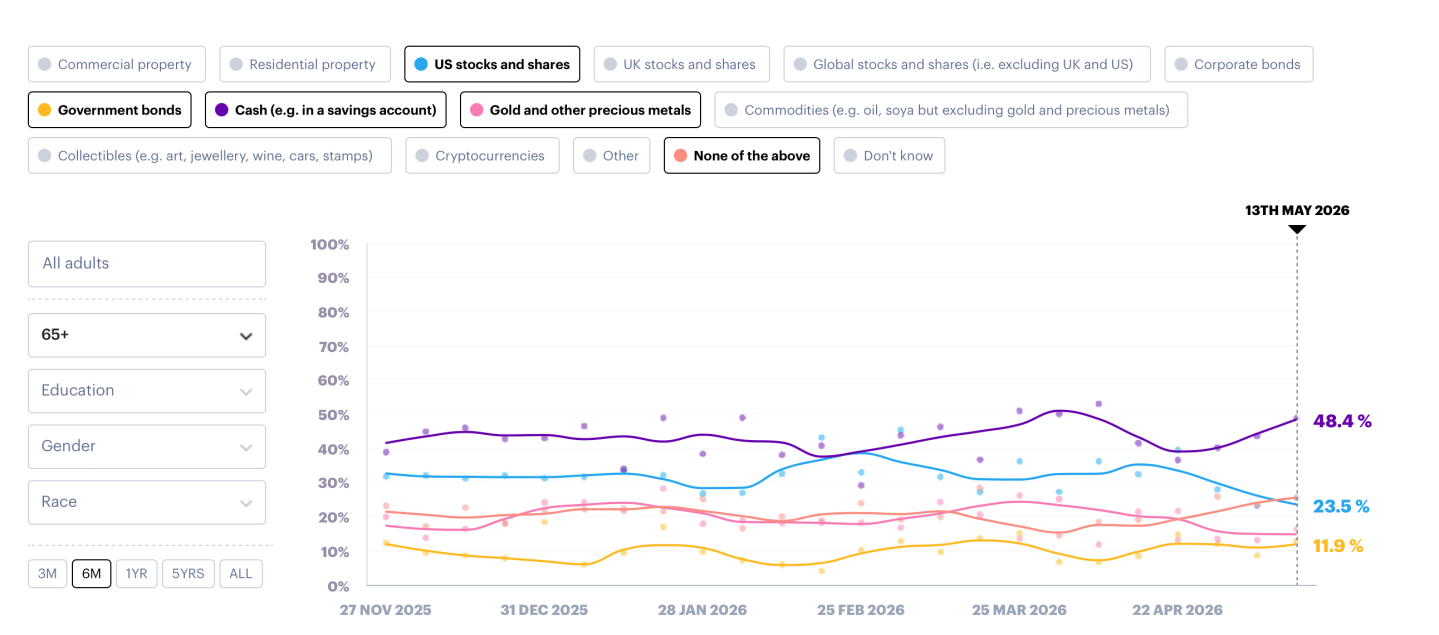
Boomers’ safe haven is savings
Cash is king for Boomers. A running YouGov poll shows that confidence in cash assets such as savings account has grown in May. Since the end of April, preference for U.S. stocks and shares has declined, and overall sentiment toward all asset classes (bonds, gold and precious metal) has declined, with more people voting for ‘none’ when asked which investments would become more appealing.
NUMBER OF THE DAY
59%
Pew Research asked more than 4,000 Americans whether the country’s best years were ahead or lay in the rear-view. Six in 10 adults said the best years of the U.S. have passed. Of note, the majority of adults earning lower and middle incomes said the golden years have gone by (61%), while upper-income adults were evenly split: Half say the nation’s best years are behind us, and half say its best years are still to come.
THE FRONT PAGES TODAY
Ukraine’s deadly drone strikes in Moscow ‘entirely justified’, says Zelenskyy – FT
Trump advisers fear China may target Taiwan in next 5 years – Axios
Ryanair has plans for ‘armageddon’ scenario as CFO warns weaker European carriers may not survive jet fuel crunch – CNBC
The Iran War Is Crippling One of the World’s Wealthiest Nations – NYT
ONE MORE THING
Financial stress is easing
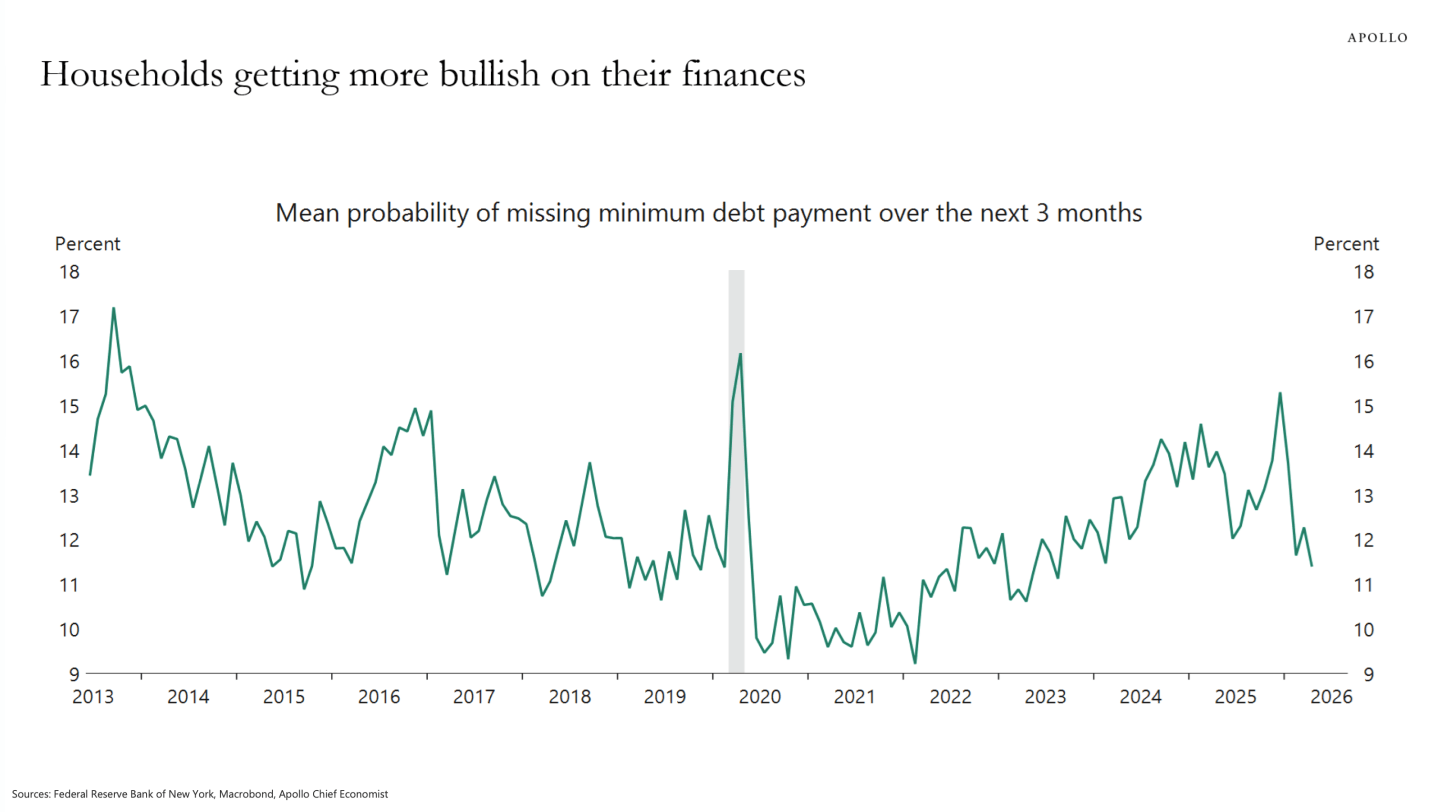
Financial stress is easing for households, writes Torsten Slok at Apollo. Slok points to the share of consumers who expect to miss a minimum debt payment in the next three months, with the figure hitting a record low for the past several years. This is a “quiet but meaningful sign” that financial stress is easing, he wrote.
Disclaimer : This story is auto aggregated by a computer programme and has not been created or edited by DOWNTHENEWS. Publisher: fortune.com