
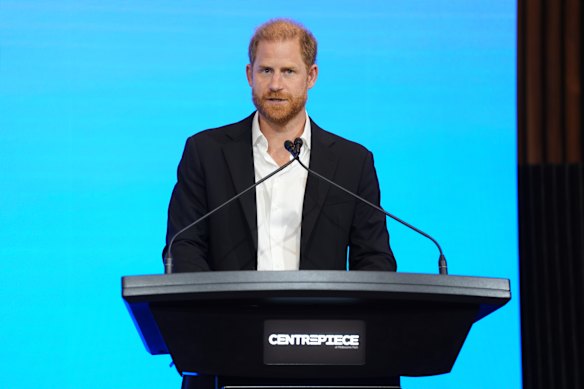

Prince Harry, the Duke of Sussex, has attacked social media companies for failing to protect children from harm, and for deliberately designing their platforms to draw in young people, knowing they are not safe.
The prince, speaking at the InterEdge Pyschological Safety Summit in Melbourne on Thursday, congratulated Australia for adopting new laws aimed at locking children out of social media.
This was “what leadership looks like in practice, stepping in to protect young people where platforms failed to act despite knowing full well of the dangers,” he said.
But the laws should not have been necessary, he added.
“Too many of these platforms are not designed with safety in mind. They’re designed for engagement, to draw people in, to keep them there, to shape behaviour.
“And we know these companies have the capability to understand who their users are.
“They can target young people with extraordinary precision, but when it comes to protecting those same young people, we are told that it’s too difficult, too complex, that it can’t be done,” the duke said.
“That contradiction should concern all of us because if a platform is capable of targeting a child, it is surely capable of protecting them, and if it is not doing so that is not a failure of technology. It is a failure of responsibility.”
Prince Harry’s address made clear he was on a mission to prove he was not simply another aimless royal in exile, but a man with a serious message about mental health.
He presented a deeply personal view of his own mental health challenges, stretching back to childhood when he was plunged into grief following the death of his mother, Princess Diana, in a car crash in 1997.
He startled some members of the audience when he confessed that when he was invited to speak at the summit, “I wasn’t sure whether I was expected to speak as someone who, despite everything, has their shit together, or as someone who, despite what it may look like, actually doesn’t have his shit together.”
But he said he was struck by something quite simple: that while his experiences may be unusual, most people weren’t sure how to deal with the feelings that everyone experiences – loss, love, failure, success, birth, death and disappointment.
Ignoring abnormal experiences, he said, did not make anyone stronger. Rather it just delayed the crash, and something that could have been addressed early became something much bigger and much harder.
“While I’m being so open with you, there have been many times when I felt overwhelmed. Times when I felt lost, betrayed or completely powerless, times when the pressure externally and internally felt constant, and times when, despite everything going on, I started short, pretending everything was OK so as not to get anyone down,” he told the audience.
“For me, one of the biggest shifts came when I realised that asking for help isn’t a weakness, it’s very much a form of strength.”
He likened the support needed by individuals suffering mental distress with the preparations that Australia undertakes to deal with bushfires.
“Each year, tens of thousands of wildfires are fought across this land, and what stands out is not just the scale of those challenges, but the preparation behind it: training, readiness, support systems and understanding that resilience is not just built in a moment of crisis,” he said. “It’s built long before. Mental fitness works the same way.”
The prince’s Australian tour of public appearances and speeches promoting mental health for ex-military personnel, for better fatherhood and now psycho-social safety, is a much more proactive approach to post-royal life than other royals in exile, past and present.
His grand-uncle, Edward VIII, abdicated the throne because he was thwarted in his desire to marry Wallis Simpson, an American who had divorced her first husband and was seeking a divorce from her second.
Edward and Wallis lived the high, indolent life of wealthy socialites for many years in Paris, where Edward sulked and waited in vain to be invited back to England. Apart from infamously mixing with Nazis, serving for a short period as governor of the Bahamas, hosting movie stars at their Paris villa and being feted as fashion plates, they offered little of lasting worth to the world.
The currently disgraced royal outcast, Harry’s uncle Andrew Mountbatten-Windsor – previously Prince Andrew, Duke of York, until his past with the late Jeffrey Epstein caught up with him – currently lives in exile on the Sandringham estate of his brother, King Charles III.
Harry and Meghan, the Duke and Duchess of Sussex, are presenting themselves as in another class altogether, despite their slightly awkward status after walking away from royal life in 2022, and thus having to present their trip to Australia as “not a royal tour”.
Some in the British media sniffily describe their visit as a back-door royal tour combined with money-making deals.
But the one-time leader of the federal opposition, Brendan Nelson, wasn’t having any of that when he effusively introduced Harry to the summit audience as “a father, humanitarian, mental health advocate, environmentalist [who] dedicates his adult life to the causes about which he feels passionate, to make a permanent difference to people and places”.
“Harry, I also say to you, as an Australian, we’re bloody proud now,” said Nelson.
Get the day’s breaking news, entertainment ideas and a long read to enjoy. Sign up to receive our Evening Edition newsletter.
 Tony Wright is an associate editor and special writer for The Age and The Sydney Morning Herald.Connect via email.
From our partners
Disclaimer : This story is auto aggregated by a computer programme and has not been created or edited by DOWNTHENEWS. Publisher: www.smh.com.au


