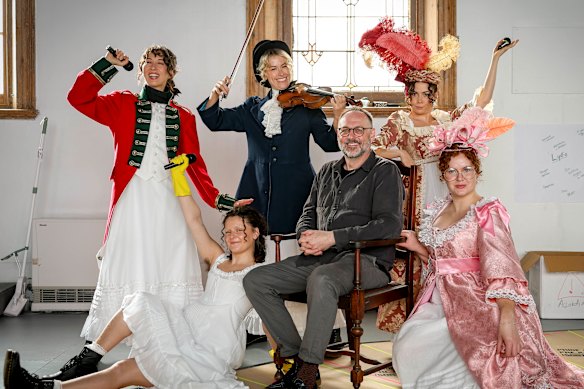
Jane Austen’s classic is re-imagined as a musical, including disco hits and ’80s ballads, from the perspectives of the novel’s ‘forgotten’ characters.
Minutes into a rehearsal for Pride and Prejudice* (*sort of) Mrs Bennet seems, alarmingly, about to headbutt anyone getting too close. Instead, she pulls her disappointing daughter Mary into an embrace and coos soothing words. Poor Mary. The monstrous mother’s manic moods have hardly improved over the past two centuries.
A new musical version of Jane Austen’s classic is electrified by the physicality of a very fast and funny ensemble. As Mrs Bennet, the wiry Zoe Ioannou is a bruiser: part street thug and part dictator. Her muscular strut is sure to become iconic in its own way when the show opens this month.
Austen’s famous novel is such a beloved story of wit and romance that it’s been the subject of endless adaptations, parodies and tributes. Last year, Austen-mania reached new heights during the 250th anniversary of the author’s birth.
Recently, Melbourne hosted yet another take on Pride and Prejudice with theatre company Bloomshed perching the cast on top of a giant wedding cake – a hulking symbol of what once deemed women’s sole destiny. Nadine Garner has presented a solo adaptation; and a 2026 television series, The Other Bennet Sister, follows unmarried Mary as her sisters rattle off in carriages to matrimony.
“She wanted to tell it from the point of view of the maids, the forgotten people in the novels.”Director Simon Harvey on playwright Isobel McArthur
Naturally, the gender and class relations of a novel written in 1796 in Regency England are ripe for lampooning in 2026. Director Simon Harvey has worked on several previous productions and in the rehearsal’s early scenes, he’s enjoying watching Ioannou dominate the stage and her daughters. Despite Mrs Bennet’s historic reputation as vulgar and embarrassing, he takes a kinder view.
“The challenge with that role is you want her to be mean because that’s what people are expecting, but the drive for her is actually desperation. She’s desperate to keep the house because she hasn’t got sons, and the inheritance law (favouring male heirs) is one of the tricky things for a modern audience. It’s so ridiculous and archaic. I think if she’s driven by desperation, you do kind of buy her behaviour. Although we do enjoy her being mean to Mary!”
Thanks to actor Colin Firth’s alluring wet shirt in the well-known Pride and Prejudice BBC television series, and any number of classy British re-makes, few would not know the storyline – but here’s a quick primer.

The five Bennet sisters live more or less innocently with their nervy mother and distracted father, but a patriarchal threat looms. Due to the era’s laws, once their father dies, a male heir – his cousin – will inherit their house and turf out the unmarried girls and their mother. Hence their mother must get them down the aisle to avoid penury.
Austen biographer Claire Tomalin notes “the notion of marriage as a form of prostitution” – particularly in the character of Charlotte, the girls’ neighbour, who marries the repellent Mr Collins to secure her own future. This sinister example shadows them all.
Yet Austen’s tone is light, often satirical and her humour shrewd. Indeed, few literary lines have been flogged as hard as the opening to Pride and Prejudice. Countless reviews and analyses begin with Austen’s “a truth universally acknowledged” to the point of cliche – so this piece firmly avoids it.
Isobel McArthur isn’t alone in believing Austen’s classic can handle a refresh. A spirited Scot, McArthur wrote, co-directed and performed in Pride and Prejudice* (*sort of) in a small Glasgow theatre in 2018. It went on to charm Scotland and England, win an Olivier award and tour internationally.
After opening in Melbourne, this first Australian production will tour Sydney, Canberra, Wollongong and Brisbane.
McArthur begins her musical with the servants of the Bennet household acting out the time-honoured story. A sparky bunch, the maids narrate the romance in their own way, peppering the events with below-stairs karaoke. Five performers play 18 characters, including all the men “in want of a wife”.
Pretensions are savaged with songs that lean towards corny, and the inspired clowning and slapstick make this reboot so fresh. Harvey insists both Austen devotees and rookies will enjoy a rollicking night at the theatre.
“I think it’s all to do with its Glaswegian roots,” he says. “They wanted it to be a good night out. So Isobel delved into her ’90s music repertoire and hit upon this idea of having a chintzy karaoke kind of vibe to it. As she was working through the character of Lady Catherine de Bourgh, it was Chris de Burgh’s The Lady in Red that was too good to miss. And [Carly Simon’s] You’re So Vain for Darcy.” (It also features Candi Staton’s disco hit Young Hearts Run Free and The Shirelles’ Will You Love Me Tomorrow, among other pop classics.)
“She wanted to tell it through the songs and also tell it from the point of view of the maids, the forgotten people in the novels, because Austen is all about the middle and upper classes. So it’s not Mr Darcy, it’s a maid playing Mr. Darcy. It’s the maids’ version, and they’re kind of stuck and telling the story over and over for the last 200 years. But it’s their favourite story so they love playing it.”
The local cast is a mix of well known and less experienced performers: Amy Lehpamer has Dusty and & Juliet among her credits, Zoe Ioannou is a Grease alumnus, and they’re joined by Kaori Maeda-Judge, Ruby Shannon and Teo Vergara.
In the novel, Austen is justly celebrated for depicting each Bennet sister with great charm – from the studious to the sweet natured, the spirited to the strumpet. In this production, the actors relish the familiar character types: naughty Lydia grabbing the drinks tray at the ball and tone-deaf Mary desperate to sing.
Lizzie Bennet is our moral compass. Bound by convention, she’s also striving to marry for love and to chart her own course. The “will they or won’t they” of Lizzie and Mr Darcy has quickened hearts for generations.
Harvey believes that, despite the irreverence, McArthur still captures the essence of the story.
“In some productions, it’s like you can’t touch Austen’s humour,” he says. “What Isobel has done really cleverly as an adaptation is she’s faithful to the story, so we follow all the events, even though it’s ridiculous with karaoke and there are Pringles tubes and Wagon Wheel biscuits. With the maids narrating, we’re playing it as for the first time. So it plays very well to teenagers, for example, who might not have read the book.”
Then there’s the pain that somehow we don’t expect. Even in rehearsal, humiliation still stings. When Darcy insults Lizzie, the room goes silent as they absorb the slight.
“Darcy says, ‘You’d have me paired with the plainest woman in the room just to entertain her idiotic family,’” Harvey says. “That’s why Lizzie dislikes him. It’s the first romcom in a way. They meet, they kind of find each other attractive and then a misunderstanding sends them off in different directions.
“The other maids are willing them to get together. They love influencing it. Also, I think they’re the audience as well. It’s why we love watching romcoms. We want them to get together; we’re willing it.”
Pride and Prejudice* (*sort of) opens in Melbourne at the Athenaeum Theatre on June 18 and Sydney at the Sydney Opera House on July 16. Seasons in Wollongong, Canberra and Brisbane follow.
Tickets: prideandprejudicesortof.com.au
Want more musical theatre?
The Booklist is a weekly newsletter for book lovers from Jason Steger. Get it delivered every Friday.
Disclaimer : This story is auto aggregated by a computer programme and has not been created or edited by DOWNTHENEWS. Publisher: www.smh.com.au