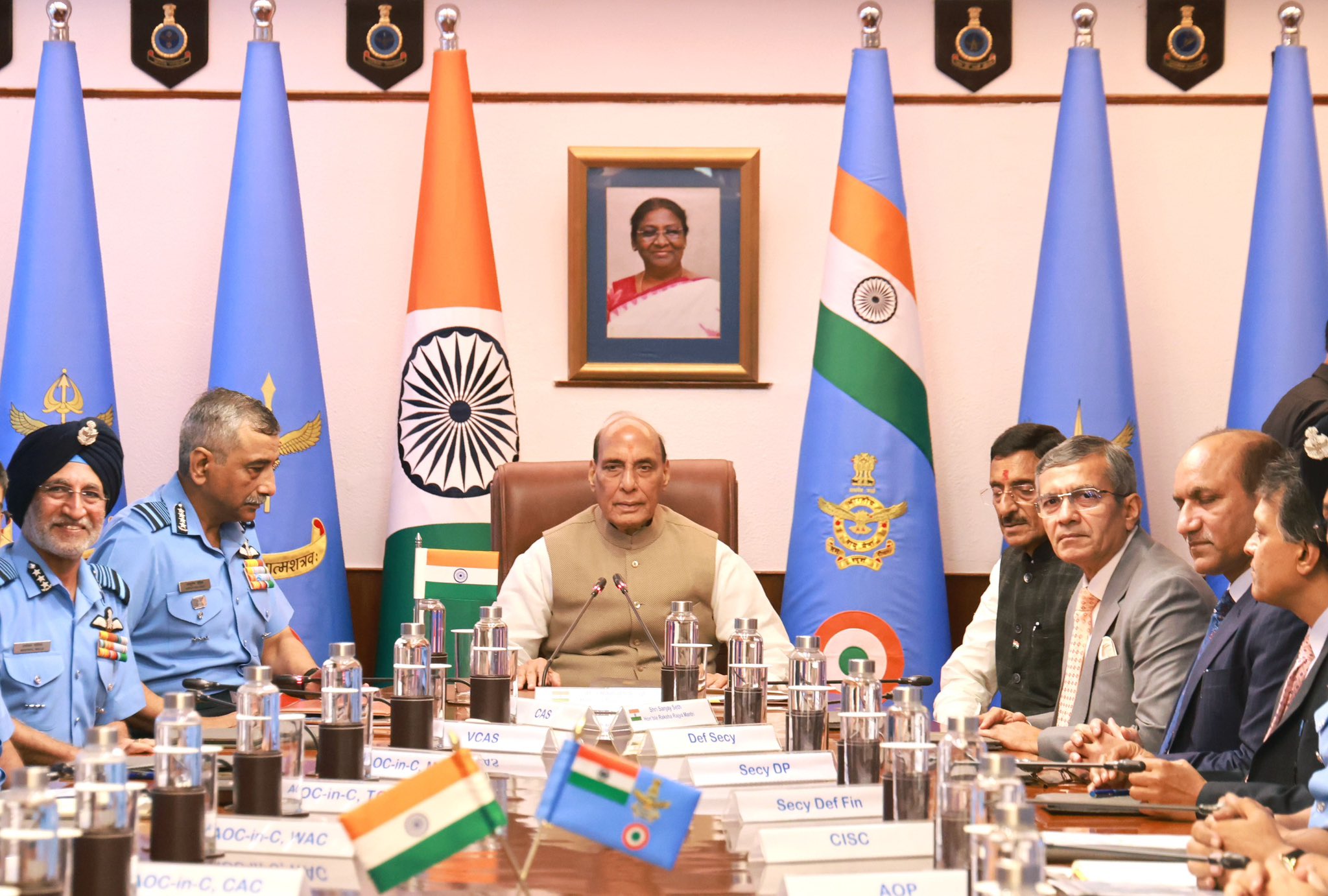
New Delhi:Defence Minister Rajnath Singh on Thursday called upon the Indian Air Force (IAF) to strengthen its capacity to surprise adversaries, sharpen intelligence and surveillance capabilities and develop technological superiority to counter emerging security threats.
Addressing the Air Force Commanders’ Conference, Singh said the changing nature of warfare demanded stronger offensive and defensive capabilities, greater integration among systems and improved preparedness against conventional and unconventional threats.
“Our Defence Forces must develop capabilities and methods that leave the adversary with no time to react or recover, while simultaneously ensuring that we are never caught off guard by an unexpected move from the enemy,” he said.
Singh said surprise could take several forms, including conventional and electronic operations. Intelligence and surveillance mechanisms must be strengthened to identify threats before they materialise, he added.
Referring to the Russia-Ukraine and Israel-Hamas conflicts, the minister said missiles, drones and advanced weapon systems had emerged as critical components of contemporary warfare.
He asked the commanders to prepare for challenges involving kamikaze drones, surveillance systems and counter-drone operations.
Singh also stressed the need to develop dedicated doctrines and operational architectures for electronic, cyber and space warfare.
“Victory in future conflicts would depend not merely on the number of aircraft, but also on technological sophistication, speed of response and precision of preparations,” he said.
The minister said emerging technologies must become an integral part of the IAF’s institutional thinking, operational planning and training programmes.
Highlighting ongoing defence reforms, Singh said the armed forces were undergoing a transformation involving organisational restructuring, jointness, integration and changes in operational concepts.
He commended the IAF for its performance during and after Operation Sindoor, particularly its professionalism, restraint and operational judgement.
The minister said lessons learnt during the operation had influenced the IAF’s evolving operational procedures, including greater emphasis on drones and air defence systems.
He also highlighted the coordinated contributions of the Army, Navy and Air Force during the operation, saying jointness and integration must continue to guide military planning.
Singh urged the commanders to train personnel in emerging technologies and draw upon the technical expertise of young recruits to improve decision-making and operational effectiveness.
Referring to the Second Tour of Duty initiative for Agniveers, he said the decision had been taken following feedback from the armed forces and reflected the government’s commitment to incorporating their suggestions into policy.
During the conference, Singh launched a suite of artificial intelligence applications developed by the IAF’s AI Centre of Excellence under the Unit for Digitisation, Automation, Artificial Intelligence and Application Networking (UDAAN).
The applications, deployed on the IAF’s secure network, are intended to automate and accelerate tasks relating to operations, administration and aerospace safety.
Disclaimer : This story is auto aggregated by a computer programme and has not been created or edited by DOWNTHENEWS. Publisher: deccanchronicle.com