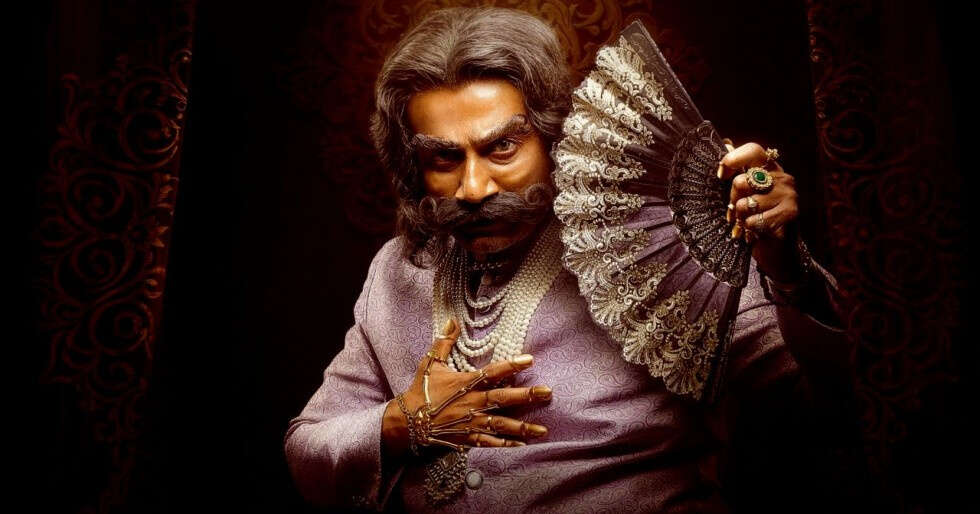
Quick Take: Rao Bahadur boasts a rich premise, but it is weighed down by a sluggish pace, stagey dialogue and oversimplified psychology.
A terminally ill man’s existential reckoning, filtered through lineage and pride, this story is told as a psychological thriller laced with dark comedy. The titular character, Ramappa Rao Bahadur (Satyadev Kancharana), is an enigma in the first half. What does love mean to him? What does his wife, Renuka (Deepa Thomas), really think of him? Why does one of his sons appear torn between his love for his father and his desire to free himself from the emotional trap he feels he is in? How much damage can Ramappa’s phobias, delusions and hallucinations inflict? Questions like these abound, and the answers unfold gradually. At 169 minutes, this is very much a slow-burn.
Writer-director Venkatesh Maha, whose debut feature C/o Kancharapalem married raw emotion with understated storytelling, returns not to deliver shocking twists but to interrogate society’s obsession with bloodline. In one conversation with his doctor friend Achari (Vikas Muppala), Ramappa questions the external symbols of royalty and the caste markers that divide people. Despite belonging to an aristocratic family, the protagonist often comes across as surprisingly grounded. He believes he is entitled to an enviable family life, yet he does not hesitate to fall in love with a woman from a modest economic background. While the film’s promotional material portrays him as an eccentric man consumed by absurd rituals within the confines of his palatial residence, Bhuvanalayam, the character proves to be far more layered.
The conversations are deliberately paced, and moments of genuine insight are relatively sparse. Yet when they land, they leave a lasting impression. Themes of inherited privilege, ancestral ego and class entitlement resonate throughout the film. In one witty exchange, Ramappa dismisses the importance of the longevity line on a person’s palm. At the same time, he finds himself trapped by the expectations imposed by both the living and the dead. Like many privileged men, he assigns immense value to possessions, yet he also speaks with the idealism of a socialist, imagining one of India’s most powerful figures standing before him. The narrative unfolds across two timelines, the 1960s and the early 1990s.
Satyadev makes the audience feel Ramappa’s anguish through monologue-heavy emotional breakdowns. Given how unconventional the character is by contemporary mainstream cinema standards, the performance demands total commitment, and he delivers.
One of the film’s strengths is that it avoids reducing its ideas to a broad commentary on “Indian tradition.” Without becoming excessively heavy-handed, it allows its structure to carry much of the thematic weight. At times, viewers are left wondering whether Ramappa’s paranoia is real, imagined or deliberately performed.
However, while the film avoids over-explaining itself, it isn’t quite the drushya kavyam that its promotional campaign, voiced by Superstar Mahesh Babu, had promised. Contemporary audiences, thanks largely to OTT platforms, have embraced slow-burn, atmosphere-driven storytelling. But for a theatrical experience, Rao Bahadur needed stronger narrative momentum at regular intervals.
The film gradually becomes verbose and increasingly resembles a stage play, particularly during the song sequence involving Ramappa’s ancestors. It also oversimplifies learned behaviour. Not every form of tribalism stems solely from childhood conditioning; many human behaviours have neurological and biological roots that deserve more nuanced exploration. The final reveal further undercuts the emotional impact by introducing an unexpectedly flippant tone. Several conversations feel rooted in old-school dramedy, while many supporting characters exist either as one-note observers or as comic relief.
Rao Bahadur features a fascinating central character, brought to life by an excellent Satyadev, and offers thoughtful commentary on class privilege and ancestral pride. However, its sluggish pacing, theatrical dialogue, oversimplified psychological lens and tonally uneven climax prevent it from fully realising its rich potential. It remains worth watching for its performances and its ambitious central idea.
Also Read: SS Rajamouli Honoured at France’s Mur Des Cinéastes Alongside Martin Scorsese, Quentin Tarantino
Disclaimer : This story is auto aggregated by a computer programme and has not been created or edited by DOWNTHENEWS. Publisher: filmfare.com