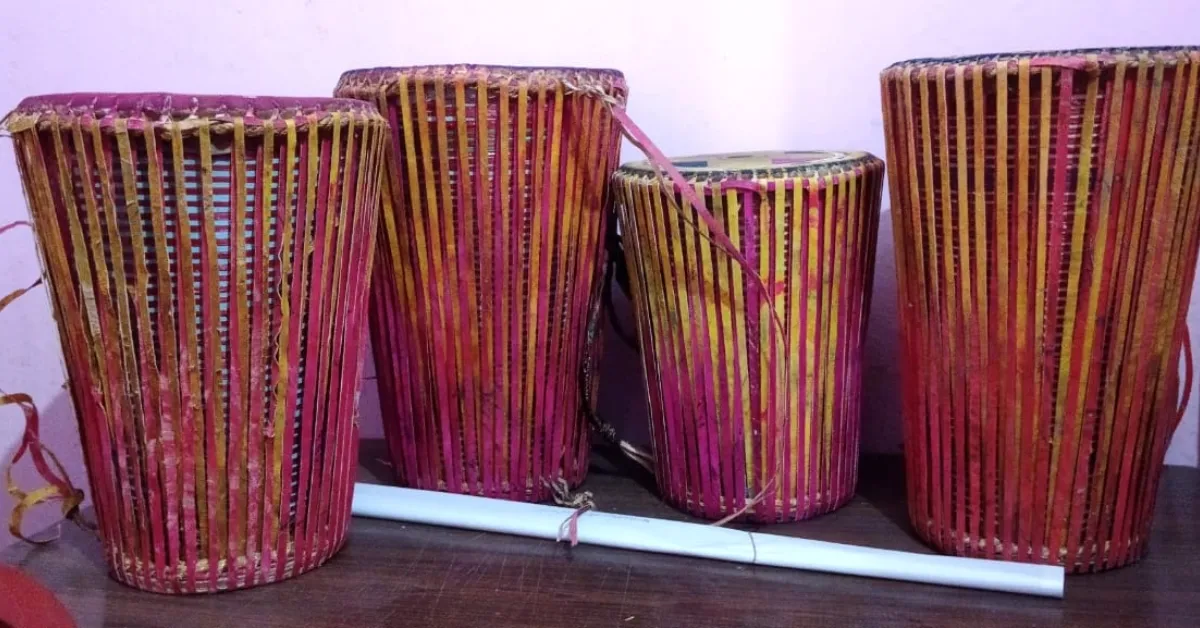
At a wedding, festival or village celebration in Jharkhand, you are likely to hear the Mandar. Its beats fill the air as people gather to sing and dance, often with the drum hanging from a musician’s shoulder.
But long before the Mandar reaches a celebration, someone has to make it.
In villages like Jarjatta in Jharkhand’s Gumla district, artisans have been doing exactly that for generations. Using red clay from the region, leather and traditional techniques passed down through their families, they make the drums that have become such a familiar part of the state’s celebrations.
And now, this centuries-old craft has received some well-deserved recognition.
The Mandar of Jharkhand has been granted a Geographical Indication (GI) tag, recognising the instrument’s connection to the state, the materials used to make it and the skills of the artisans behind it.
For the families who have kept this tradition alive, the recognition could help their work reach people far beyond Jharkhand.
𝐉𝐡𝐚𝐫𝐤𝐡𝐚𝐧𝐝’𝐬 𝐌𝐚𝐧𝐝𝐚𝐫 𝐠𝐞𝐭𝐬 𝐆𝐈 𝐓𝐚𝐠✨ The traditional musical instrument Mandar, deeply rooted in folk culture and tribal life of Jharkhand, has received official recognition with a Geographical Indication tag. Mandar Samrat Manpuran Nayak described Mandar as an integral part of Jharkhand’s cultural heritage. He said that the GI recognition is a tribute to the ancestors and the soil of Jharkhand. #Mandar #Jharkhand
— All India Radio News (@airnewsalerts) September 29, 2026
What goes into making a Mandar?
If you have seen a dhol or dholak, you may think the Mandar looks quite similar. But the way it is made sets it apart.
While many traditional drums have wooden bodies, the Mandar is made using locally sourced red clay.
Artisans shape the clay into a hollow, slightly rounded body. They then cover both ends with leather, keeping one opening smaller than the other, and secure the coverings with braided cords.
There’s another small detail that makes a difference.
A special coating called Kiran is applied to the smaller opening. It helps produce the Mandar’s distinctive sound, the one people across Jharkhand have grown up hearing at festivals, folk performances and community gatherings.
Making the instrument requires knowledge of the materials and techniques involved. These are skills that artisans have learnt over years of practice, often from older members of their families.
And that is what makes the GI recognition important. It acknowledges the local materials and traditional methods that give Jharkhand’s Mandar its identity.
How a village in Gumla helped the Mandar get recognised
The effort to secure the GI tag was led by Raidih Mandar Producer Company Limited, associated with artisans from Jarjatta village in Gumla’s Raidih block.
The organisation applied for GI recognition in September 2021, bringing attention to the traditional process of making the Mandar and its connection to Jharkhand.
But what does a GI tag actually mean?
Think of Darjeeling tea. Its name tells you something about where it comes from and what makes it special.
A GI tag works on similar lines. It recognises products whose reputation, qualities or characteristics are closely linked to a particular place.
For the Mandar, that means recognising Jharkhand as the home of this traditional craft and protecting its geographical identity.
And for the artisans who make it, that recognition could have a practical value.
Could this help Gumla’s artisans earn more from their craft?
For someone who buys a Mandar, it may simply be a musical instrument. For the artisan making it, it is also a skill, a livelihood and something they may have learnt from their parents or grandparents.
Yet making a traditional product does not always mean finding enough buyers or earning a good income from it.
This is where the GI tag could make a difference.
It can help customers identify authentic Mandars associated with Jharkhand’s traditional craftsmanship, while protecting the registered geographical name from unauthorised use.
It could also help artisans reach buyers in other parts of India and potentially abroad.
Of course, a GI tag alone cannot guarantee more orders or better earnings. Artisans will still need support in marketing their products and reaching customers.
But it gives their work a recognised identity, and that is an important starting point.
For generations, people across Jharkhand have danced to the sound of the Mandar. Now, as the instrument receives recognition beyond the state, there is an opportunity for more people to learn about the artisans who make that music possible.
And perhaps, the next time someone picks up a Mandar to play, they will think about the hands that shaped it, too.
Sources:
‘GI tag for Mandar puts Jharkhand’s folk instrument on record’: By Statesman News Service, Published on 29 September 2026
‘Dalma, drums and determination: Jharkhand welcomes South Asian athletes’: By Statesman News Service, Published on 17 October 2025
‘Jharkhand’s traditional musical instrument ‘Mandar’ may get GI tag, final hearing on Dec 20’: By India New England, Published on 17 December 2024
Disclaimer : This story is auto aggregated by a computer programme and has not been created or edited by DOWNTHENEWS. Publisher: thebetterindia.com