
SRINAGAR: Security restrictions and a partial lockdown imposed on Srinagar’s Khawaja Bazaar and its neighbourhood late Sunday continued into Monday, with Jammu and Kashmir Police—supported by Central Armed Police Forces (CAPFs)—sealing all routes leading to the Mazar‑e‑Shuhada, the historic martyrs’ cemetery. The measures were aimed at preventing public gatherings on Kashmir Martyrs’ Day, an annual observance deeply embedded in the region’s political identity and collective memory.
Authorities appeared determined to maintain the clampdown for a second day, seemingly influenced by events of July 14 last year, when Chief Minister Omar Abdullah defied police restrictions, scaled the wrought‑iron fence of the Mazar‑e‑Shuhada, and paid homage to the martyrs of July 13, 1931. As J&K is a Union Territory, policing and law‑and‑order fall under the purview of the Centre-appointed Lieutenant Governor.
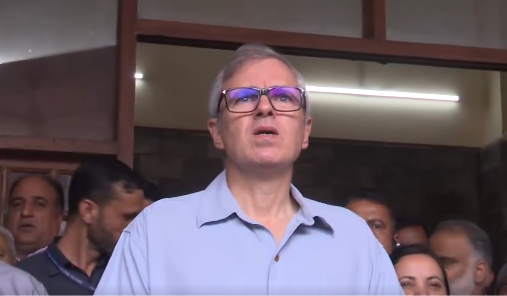
Accompanied by National Conference (NC) ministers and legislators—and later joined by his father, party president Farooq Abdullah—the Chief Minister quietly drove to Khawaja Bazaar to recite Fatiha, the Islamic prayer for mercy and forgiveness, and offer floral tributes. Before he reached the cemetery, police attempted to block his entry. Videos showing officers physically restraining him, and Abdullah pushing past them, quickly went viral.
Abdullah himself posted one such video on X, stating that he was manhandled but “made of sterner stuff” and determined to reach the graveyard. “I was doing nothing unlawful or illegal,” he wrote, demanding that the “protectors of the law” explain under which legal provision they tried to stop him from offering Fatiha.
Despite the long‑standing tradition of political leaders—both mainstream and separatist—visiting the cemetery beside the revered Naqshband Sahib shrine, entry was once again barred this year. Heavy deployment, barbed‑wire barricades, and locked gates ensured even pre‑dawn attempts were thwarted. Denied access, senior NC leaders—including Farooq Abdullah and Omar Abdullah—assembled at the party headquarters, Nawa‑e‑Subha, on Monday to offer prayers and tributes.
NC leader and minister Sakina Itoo said she and colleague Sabiya Qadri tried to reach the site at 4:30 a.m. on Monday “to pay my humble tributes,” but were stopped by security personnel. On X, she wrote that physical barriers “cannot prevent us from honouring the supreme sacrifices of our martyrs,” insisting their legacy endures beyond restrictions.
Other mainstream parties, including the People’s Democratic Party (PDP), had planned commemorative gatherings at the cemetery. PDP’s Iltija Mufti said she was placed under house arrest, sharing a video of herself arguing with police at her locked gate and questioning official claims of “normalcy.” She alleged selective use of police powers to suppress dissent. Her mother, PDP president Mehbooba Mufti, later paid tributes at the party headquarters here.
Martyrs’ Day commemorates July 13, 1931, when 22 Kashmiri Muslims were shot dead by forces of Dogra Maharaja Hari Singh outside Srinagar Central Jail. They had gathered during the secret trial of Abdul Qadeer Khan, a non‑local cook serving a British traveller accused of sedition for fiery speeches against the Maharaja’s rule. His call to dismantle the Palace “brick by brick” became a rallying cry for political rights and resistance. Since then, July 13 has been observed as Martyrs’ Day on both sides of the Line of Control.
For decades, the head of the J&K government would visit the cemetery, lay wreaths, and oversee ceremonial honours by a police contingent. But since 2020, no official ceremony has been held, and residents have been barred from entering the premises.
The shift began in January 2020, months after the abrogation of Article 370 and the bifurcation of the state, when the administration cancelled the July 13 public holiday. The decision drew widespread criticism from regional parties and many Kashmiri Muslims, who viewed it as an attempt to erase a foundational moment in their political consciousness. In 2021, the Lt. Governor’s administration—responding to demands from political and ethnic groups in Jammu and the BJP—declared September 23, Maharaja Hari Singh’s birthday, a public holiday, reflecting competing regional narratives.
These narratives remain sharply divided. For the NC, PDP, and other regional parties, July 13 marks the birth of Kashmiri political awakening—a struggle for democratic rights and resistance against autocratic Dogra rule. They argue the uprising stemmed from socio‑economic and political grievances under systemic oppression. Separatist leaders frame the day as symbolic of Kashmir’s quest for complete freedom from domination. Kashmir’s chief Muslim cleric Mirwaiz Muhammad Umar Farooq said on Monday that he was again placed under house arrest to prevent him from leading a procession from Jama Masjid to the cemetery. He issued an emotional tribute describing the martyrs as the foundation of “the people’s struggle for justice, dignity and human rights.” He lamented that people were being prevented “by force” from offering prayers, adding that even if graveyards are sealed and roads blocked, “the martyrs live in our hearts and our collective memory.”
In stark contrast, the BJP, allied groups, and Kashmiri Pandit organisations such as Panun Kashmir and Kashmir Vahini argue that July 13 marks the beginning of Hindu persecution in the Valley. They view Dogra rule as a “golden period” and maintain that Maharaja Hari Singh was a legitimate ruler. For them, the 1931 uprising was an illegitimate rebellion. During the PDP‑BJP coalition government (2015–2018), BJP ministers routinely skipped the official wreath‑laying ceremony, stating openly that “they are not our martyrs.”
Disclaimer : This story is auto aggregated by a computer programme and has not been created or edited by DOWNTHENEWS. Publisher: deccanchronicle.com




