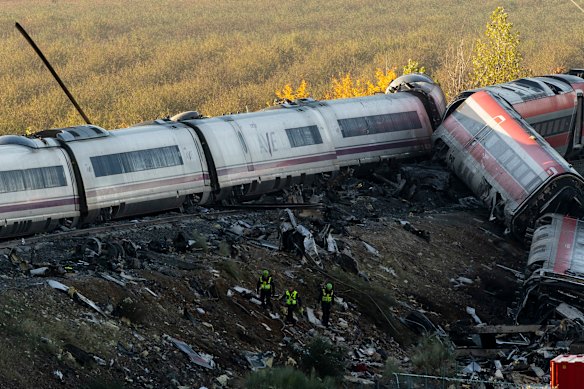

London: Leaked recordings from a Spanish train controller have shed new light on the horrific train crash that killed at least 69 people, while raising key questions about the ultimate blame for the disaster.
The recordings reveal the final messages between the rail control centre in Madrid and the two train drivers operating on the same line south of the Spanish capital, moments before one train smashed into the rear of the other.
Spanish media outlets report that a controller in Madrid told the driver of a Renfe AVE high-speed train to “resume normal operations” after being stopped due to a signalling malfunction.
The instruction in Spanish, according to national newspaper El País, was la marcha normal – a message that led the driver to accelerate rapidly without knowing another train was stationary on the line ahead.
But the disclosures are fiercely contested, with union leaders angry about the leaks, and the Spanish people are yet to learn the full facts about the catastrophic errors that led to the tragedy.
Five questions stand out in the search for answers about the crash on Wednesday (Thursday AEDT). Finding the facts will take time, however, because Spain goes to a national election on November 29. Political arguments are clouding the debate about who bears the blame for the tragedy.
The first question is about the failure of the signalling and control system on the high-speed line from Madrid to Seville early on Wednesday morning (Spain time).
The control centre in Madrid experienced a disruption to the system called LZB, which is also used in Germany and Austria to monitor train speeds and relay traffic instructions.
The failure of the automated system brought eight trains to a halt along the line, a standard safety precaution. Operations then reverted to manual control.
One expert, transport professor Carlos Gutiérrez Hita, has expressed concern about a series of LZB outages in the weeks before the crash. Why did the safety system fail on Wednesday morning?
The second question is about the instructions from the control centre to the Renfe AVE train – – run by Spain’s state-owned railway company – after the halt.
The leaked recordings obtained by Spanish media outlets suggest the controller in Madrid told the Renfe AVE driver to “resume normal operations”.
The driver asked: “Normal operations?” The controller replied: “Yes.” (Bear in mind, this is sourced from leaks to the media, not official testimony.)
The definition of “normal operations” includes speeds of up to 200 kilometres per hour rather than the more cautious 40km/h during a signal outage. Why did the controller allow a speed so fast without being sure that other trains were also moving?
The third question: What did the control centre tell the other train involved in the crash, run by private operator Iryo?
The leaks suggest the instruction was to resume normal operations, but it is not clear if the Iryo driver knew that the Renfe AVE had begun accelerating at 8.36am and was only about 25 kilometres behind on the same line. Was anything done to make this known?
The fourth question is the most crucial. What happened in the final minutes before the crash? The driver of the Iryo train told the control centre of a problem: the system restart had failed and the Iryo remained stationary.
The leaked recordings give her actual words. “I have had a loss of transmission and I am stopped at the Urda entrance signal,” she said, according to the transcript published by Spanish state broadcaster RTVE. This was at 8.41am. The control centre told the driver to keep trying to resume normal operation.
Minutes later, the two sides spoke again. “The train is not allowing me to restart the LZB system,” the Iryo driver said. “And that is why I am still stopped before the entrance signal.“
The response from the controller was to ask her to begin moving as soon as she could. “And if you have a problem, call us,” the controller said. The driver replied: “OK, perfect. I’ll let you know.”
This was at 8.48am, according to Spanish newspaper El País. The speeding train smashed into the stationary train at 8.53am.
If the leaked recordings are accurate, it is already clear that human errors led to tragic deaths.
The rail unions, however, have reacted angrily to the idea that one of their own will bear the blame for the disaster. “Human errors occur when you don’t have the equipment you need to do your job,” one union leader told El País.
Getting straight answers will be challenging during an election campaign. Union leaders are calling on Transport Minister Óscar Puente to resign because they believe he should be held responsible. This pits the Socialist Party government against its union support base.
Prime Minister Pedro Sánchez is promising a full investigation and a solution, given the death of 46 people in a derailment at Adamuz in January in and the death of at least 69 in the Urda crash on Wednesday.
“If we need to further strengthen safety in order to rebuild confidence in our high-speed rail system, we will do so, because what is unacceptable for a country like Spain is to suffer two high-speed rail accidents in the same year,” he said on Wednesday.
The contender to replace Sánchez at the election, People’s Party chief Alberto Núñez Feijóo, has suspended his campaign during the three-day mourning period for the dead, but he is pointed about the onus on the government. “Spain has the right to know what is happening with its infrastructure,” he said.
And that leads to the fifth question. Did the national government put lives at risk by running down the high-speed train system?
About 25 million passengers used the country’s high-speed services last year, according to a Reuters analysis. Spain has spent billions of dollars on a network that is one of the largest in the world – but has the investment kept up with the demand?
When the election campaign began a few weeks ago, the dominant issue was housing. Sanchez led in the polls.
The tragedy at Urda now shapes a debate about whether the Spanish people can rely on their essential services. And that, in turn, may determine who runs the country.
Get a note directly from our foreign correspondents on what’s making headlines around the world. Sign up for our weekly What in the World newsletter.
 David Crowe is Europe correspondent for The Sydney Morning Herald and The Age.Connect via X or email.
From our partners
Disclaimer : This story is auto aggregated by a computer programme and has not been created or edited by DOWNTHENEWS. Publisher: www.smh.com.au