In an audio interview in “Avedon,” the Ron Howard-directed documentary, which premiered at this year’s Cannes Film Festival and streams on Netflix, beginning Nov. 11, Richard Avedon is asked why he took up photography. “I still can’t type,” he answers. “I can’t read my own handwriting. I don’t think consecutively. I’m anecdotal. I’m instinctual. But I can see like a son of a bitch.”
The movie chronicles the famed photographer’s life and 60-year career shooting not just icons of the fashion and film worlds but also mental institutions, the civil rights movement and the Vietnam War. Avedon also focused extensively on the American West, which served as the setting for his 1985 portrait series of coal miners, oil field workers, ranchers, drifters and ordinary people that he considered his masterwork.
Howard’s documentary features interviews with fellow photographers, models, magazine editors, writers, former assistants and art dealers, including Larry Gagosian, who reminisces about meeting Avedon for the first time in New York in the mid-1970s. Gagosian later brought one of Avedon’s exhibitions to the ArtCenter College of Design in 1976 and to Broxton Gallery, his first space in Westwood. He opened Gagosian a few years later, leading to a decades-long relationship with the photographer and more than a dozen shows at the gallery in the last 15 years.
Gagosian’s newest exhibition, opening Wednesday, is titled “Richard Avedon: Hollywood.” But the more than 120 featured images, spanning from 1947 to the year Avedon died in 2004, embrace all kinds of celebrities who represent Hollywood, not just as a place and an industry, but as a “global concept” and an “aspirational notion,” said curator (and Avedon’s daughter-in-law) Laura Avedon.
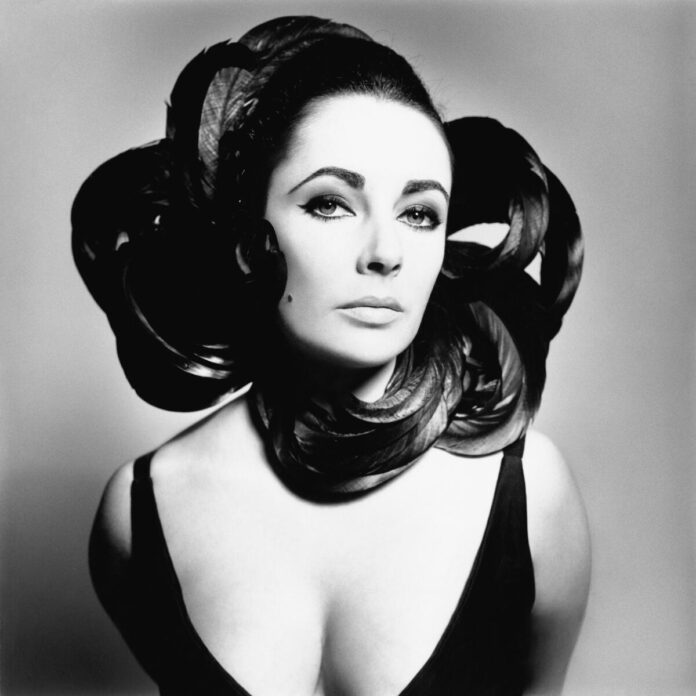
Elizabeth Taylor, cock feathers by Anello of Emme, in New York on July 1, 1964.
(Richard Avedon / Richard Avedon Foundation)
“If you look at each individual portrait in the exhibition, every single one of them can be connected back to Hollywood in some way,” said Laura Avedon, who is also one of the movie’s executive producers. “I’m not just looking at Hollywood as film people. That would be a very narrow view from my perspective. I’m looking at Hollywood as an idea, a particularly American idea that encompasses so much of America, fame, money, creativity, talent and vision.”
Laura Avedon conceived of the show while Howard’s Imagine Entertainment scoured the Richard Avedon Foundation’s archive of approximately 500,000 images for use in the film.
Laura Avedon said that working with a Hollywood production company presented a unique opportunity., “I became very interested in what sort of Hollywood threads and connections could be discovered. So I started following the threads to see where they lead. I wanted to see whose stories are worth telling and who drives the actual narrative content of Hollywood.”

Steven Spielberg, Los Angeles, February 1994.
(Richard Avedon / Richard Avedon Foundation)
Born in New York in 1923, Richard Avedon first became interested in fashion thanks to his father, who owned a women’s clothing store on Fifth Avenue, which carried the latest fashion magazines. After serving in the Merchant Marine and working as a staff photographer, he was hired by Harper’s Bazaar to cover the couture shows and models in post-World War II Paris. He incorporated movement and dance into a still medium, and shot his figures against stark white backgrounds, his signature style.
He served as a visual consultant on Stanley Donen’s 1957 film “Funny Face,” which starred Fred Astaire as a photographer who turns bookish Audrey Hepburn into a glamorous model. The movie, loosely based on Avedon’s life, catapulted him into the spotlight.
The exhibition’s first section is filled with familiar images of early Avedon muses and subjects, mostly from the 1950s and ‘60s, including Suzy Parker, Lauren Hutton, Marlene Dietrich, Elizabeth Taylor, Katharine Hepburn, Judy Garland and Brigitte Bardot, as well as his first wife, model Doe Avedon. He captured Marilyn Monroe wearing a halter dress in a rare melancholic moment, and Charlie Chaplin holding his fingers up like devil’s horns.

Marilyn Monroe, actress, dress by Norell, New York, May 1957.
(Richard Avedon / Richard Avedon Foundation)
Avedon’s 1955 photograph of model Dovima posing in a black Dior gown while standing in between two circus elephants is among the most iconic pictures in fashion history — though the one of Nastassja Kinski with a snake wrapped around her nude body from 1981 is right up there, too.
“That’s one of the things that Dick loved about working with performers,” says Laura Avedon. “How their range of emotions were so vast and that they could tap into that range of human emotion and therefore the human experience. He had a depth of curiosity about people. He understood that all people are connected while photographing them in very simple and straightforward ways.“
Richard Avedon shot Hepburn dancing with Astaire on the set of “Funny Face,” and Marlon Brando and Frank Sinatra filming “Guys and Dolls” in 1955. He followed Truman Capote around Kansas while the author was researching for his 1966 novel, “In Cold Blood.” Avedon even photographed Perry Smith and Richard Hickock, the two men who committed the murders of the Clutter family, chronicled in the book.

Ronald Reagan, Orlando, Fla., March 4, 1976.
(Richard Avedon / Richard Avedon Foundation)
The exhibition’s second section moves beyond models, actors and performers to focus on the people who influenced and wielded power behind the scenes in Hollywood. Directors like Steven Spielberg, Billy Wilder, John Huston, Alfred Hitchcock and Orson Welles. Writers such as Dorothy Parker, Tennessee Williams, Susan Sontag and William F. Buckley Jr. Former Presidents Ronald Reagan and Dwight D. Eisenhower; the latter’s presidency was the first to benefit from the support of Hollywood celebrities. A goofy Harvey Weinstein mugging for the camera. And a 2001 pre-presidential Donald Trump photographed against a black frame with a look of menace on his face.
“I want people to come away with a sense of how interconnected Hollywood is,” Laura Avedon said of the show. “How powerful those connections are and that they even involve presidential power. And the fact that all of these elements come together and form this system of American influence.”
Finally, she said, “I hope they see that over the course of Avedon’s long career that he kept interacting with Hollywood because Hollywood is an unavoidable American phenomenon.”
‘Richard Avedon: Hollywood’
Where: Gagosian, 456 N. Camden Dr., Beverly Hills
When: Nov. 4 to Dec. 19, see website for times
Cost: free
Info: gagosian.com
More to Read
Disclaimer : This story is auto aggregated by a computer programme and has not been created or edited by DOWNTHENEWS. Publisher: latimes.com