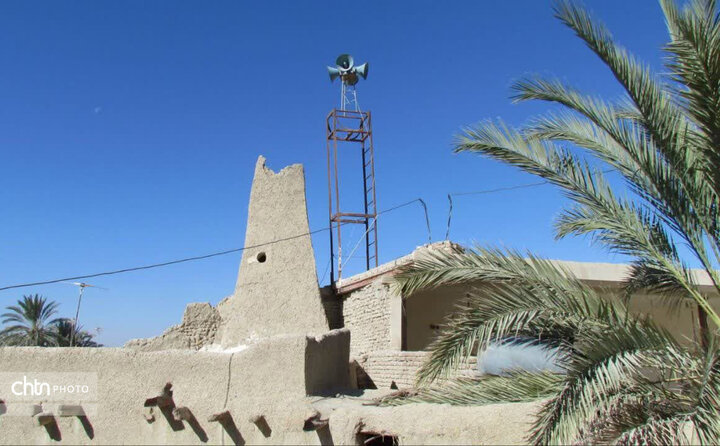
TEHRAN – Saravan’s historic minarets offer travelers a distinctive way to explore the evolution of religious architecture in Iran’s southeastern Sistan-Baluchestan province, where mud-brick construction, local craftsmanship and centuries-old religious traditions have shaped the landscape.
Unlike the tall, mostly symbolic minarets seen at many modern mosques, the older structures of Saravan preserve evidence of a time when a minaret was a working part of daily religious life. Before loudspeakers transformed the way the call to prayer was delivered, muezzins climbed stairs, ladders or raised platforms to reach elevated points from which their voices could travel across surrounding settlements.
This architectural evolution can still be traced in and around Saravan. At some historic mosques, the place for the call to prayer was little more than a raised platform reached by a spiral staircase. Elsewhere, mud-brick stairways were built beside the mosque or covered to protect those using them from the harsh local climate.
The remains therefore tell more than a story of religious practice. They reflect how local builders adapted architecture to the region’s environment, available materials and community needs.
Among the most notable surviving examples is the minaret at Aspich Mosque, regarded by local researchers as the only completely circular historic minaret still standing in Saravan. Built of sun-dried mud bricks and mud, the structure rises about 10 meters and contains a narrow internal spiral staircase of around 20 steps.
Visitors approaching the minaret can still see the simple logic of its design: the staircase leads upward through the compact structure to the point where the muezzin once stood to deliver the call to prayer. Local accounts also suggest that the elevated structure could have served as a lookout in times of emergency, although its principal purpose was religious.
The survival of the Aspich minaret is itself part of the story. Local residents and religious figures have helped preserve the structure over the years, and it underwent restoration and mud-plastering in 2021. Its continued presence offers a rare glimpse into the construction techniques and religious architecture of earlier generations.
Another important example stands at the historic mosque in Zangian. About eight meters high, the mud-brick and mud structure has a distinctive architectural form: its exterior is broadly square, while its interior is circular. An internal staircase once allowed the muezzin to reach the upper section. Two openings at the top and the minaret’s visibility from a distance were practical features of a structure designed primarily for the call to prayer.
The Zangian complex also preserves a different layer of the region’s heritage. Beside the minaret is a small chamber traditionally known in Baluchi as a sonia, or retreat, which was associated with worship, spiritual discipline and seclusion by religious figures. Together, the minaret and the chamber demonstrate how tangible architecture and intangible religious traditions could exist within the same historic setting.
Other old mosques around Saravan preserve earlier stages of this architectural development. In some cases, the muezzin reached the roof through an uncovered mud-brick staircase; in others, access was provided by a covered stairway or a raised platform. Some historic minarets, however, have disappeared during mosque renovations and rebuilding.
For travelers interested in architecture and cultural heritage, this variety makes Saravan particularly rewarding. The historic minarets are not monumental structures in the conventional sense. Their appeal lies instead in their modest scale, local materials and the way they preserve traces of everyday life.
They also illustrate a broader transition in Islamic architecture. As loudspeakers and modern sound systems replaced the need for the muezzin to climb a tower, the practical role of the minaret gradually diminished. In many contemporary mosques, it survives primarily as a visual and symbolic element.
In Saravan, however, surviving mud-brick minarets remain tangible reminders of the earlier relationship between architecture, faith and community. Preserving them is therefore not simply a matter of protecting old buildings. For visitors, they offer an opportunity to read the history of southeastern Iran through structures shaped by local hands, local materials and the needs of generations who lived around them.
AM
Disclaimer : This story is auto aggregated by a computer programme and has not been created or edited by DOWNTHENEWS. Publisher: tehrantimes.com