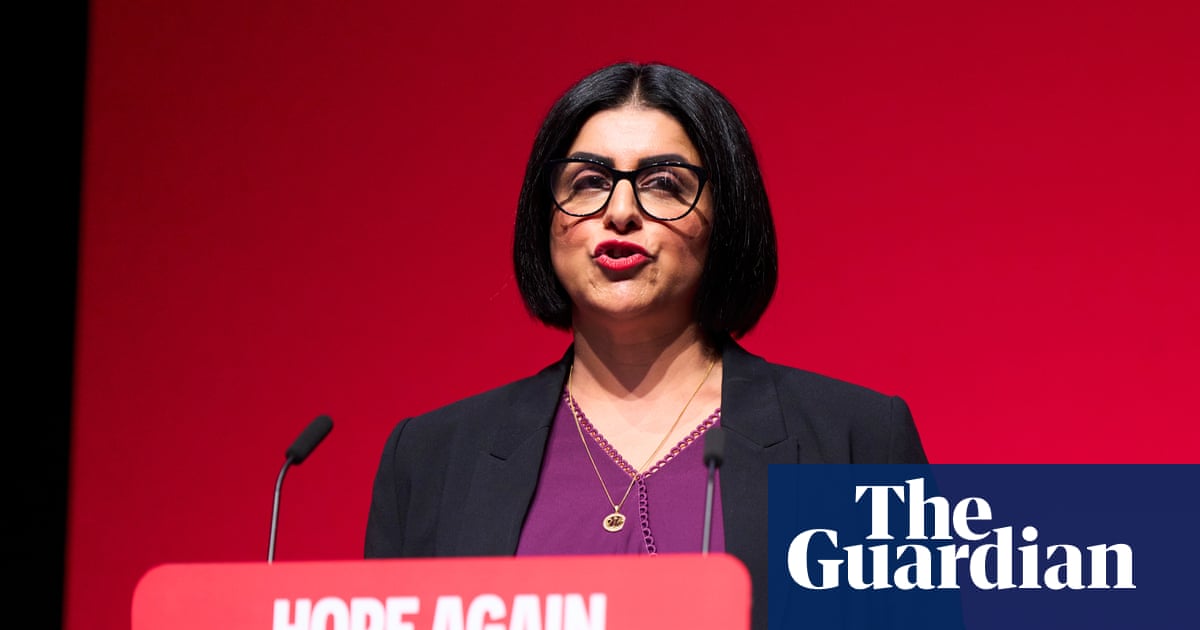
Shabana Mahmood has signalled she is considering watering down her plans to make it harder for foreign workers to claim permanent residence in the UK amid growing demands for a U-turn from cabinet colleagues and unions.
In a speech to Labour conference, the home secretary said the government would “come to a position that balances fairness for those who came here legally and fairness to British citizens across this country”, after acknowledging that “some have said elements of these reforms are not fair”.
Her comments follow demands from Angela Rayner and Unison’s general secretary, Andrea Egan, to drop changes to indefinite leave to remain that would penalise overseas care workers looking after the UK’s older citizens.
Mahmood told conference in Liverpool: “As we restore control and fairness to our asylum system, we must do the same for legal migration too. Fair to those who seek a new and better life here, like my parents did, and fair to those already here, including British workers, and especially the young.
“That same principle underpins my reforms to the right to live here indefinitely, ensuring settled status is earned, by those who have shown a consistent commitment to this country.
“I know that, throughout our consultation process, some have said elements of these reforms are not fair. To that, let me say this: we will come to a position that balances fairness for those who came here legally, and fairness to British citizens across this country.”
Last year the government changed visa laws to end the recruitment of care workers from abroad in an attempt to curb net migration. It also banned care workers from bringing family dependants with them.
Mahmood’s plans would increase the timeline for permanent residence from five to 15 years for social care workers who arrived on health and care visas. The changes would apply retrospectively to migrants who had arrived since 2021.
Rayner, the housing, communities and local government secretary, said over the weekend that Mahmood’s plans would hit foreign care workers who had “moved their lives here to look after our loved ones”.
A protest will be held outside Labour’s annual conference on Monday by a leading trade union calling for migrant workers not to be made scapegoats for the failure to invest in public services.
Egan said: “People who came to this country to help look after our loved ones are forced to work on restricted visas under harsh rules which make them second class citizens. Now the promise of being able to settle in the country after five years is not only being broken but replaced with the threat of 15 years of insecurity and exploitation.
“Moving the goalposts at this stage in the game is wrong and unfair.”
Sources close to Mahmood said no decision had been made on the indefinite leave to remain proposals, adding that the speech set out the principles underpinning those decisions.
In a further development, Mahmood said that from next month, the government would begin accepting applications from charities and nonprofit organisations to sponsor refugees through new safe and legal routes. “This will start with a community sponsorship route, allowing local communities to host refugees, and a student sponsorship route, allowing universities to do the same. Applications will open in October, with the first arrivals in autumn of next year,” she said.
She confirmed the government would reopen the UK resettlement route in partnership with the United Nations. “We will take vulnerable refugees from across the world, and give them the chance of a new and better life here in Britain, with the first arrivals beginning this year. I am proud to say that around a quarter will be Afghan women and girls, fleeing persecution under the Taliban, and Palestinians who have fled the horrors of Gaza,” she said.
Immigration experts and refugee charities have welcomed the plans but said the numbers who would be eligible for the schemes were too small to deter asylum seekers crossing the Channel in small boats.
In a personal section of the speech, Mahmood s said her parents came to Britain from rural Kashmir “because they knew they would get a fair shot at a better life here; a fairer shot than they could ever expect back home, where past was precedent, and your birth dictated your future.
“They were, largely, welcomed to this country, because most Brits thought it was right to welcome people who come here legally, [to] build a life, and contribute to our nation. There were exceptions to that welcome, of course. This was the 1970s. But they were exceptions, not the rule,” she said.
“Fairness is what unites us in this country. And a fair society unlocks the very best of us. When fairness isn’t present, the opposite is true. When this country feels unfair, people turn inwards. A Britain that is unfair is one that is smaller and colder for those who look like me.”
Disclaimer : This story is auto aggregated by a computer programme and has not been created or edited by DOWNTHENEWS. Publisher: theguardian.com