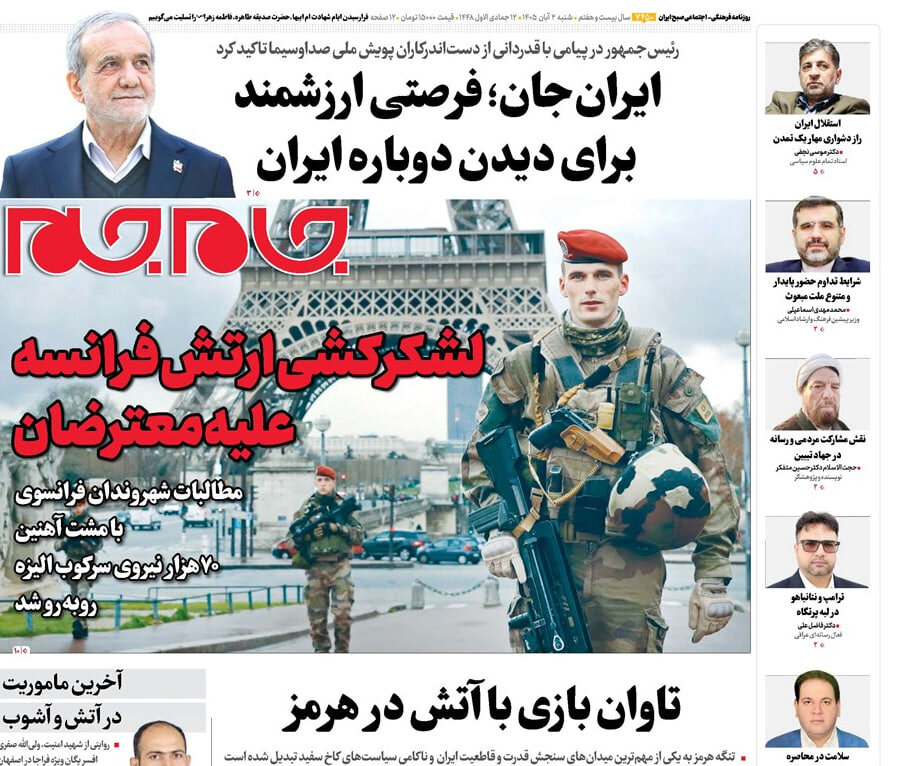
Jam-e-Jam criticized the International Atomic Energy Agency (IAEA) for its response to attacks on Iranian nuclear facilities. The article argued that military strikes carried out by the United States and Israel against Iran’s nuclear sites in 2025 and 2026 constituted serious violations of international law and the prohibition on aggression.
According to the paper, both the governing bodies and the Secretariat of the IAEA failed to issue even a statement condemning these actions, a situation unprecedented in the agency’s history. The newspaper claimed this failure exposed a major institutional weakness and raised concerns about the consistent application of principles that the agency is supposed to uphold. It argued that the IAEA cannot credibly defend the integrity of safeguards while treating attacks on safeguarded facilities as a secondary concern. Therefore, the agency should clearly reaffirm that attacks on peaceful nuclear facilities are unlawful, unacceptable, and should never be tolerated under any circumstances.
Donya-e-Eqtesad: Decoding an Emirati flight to Tehran
Donya-e-Eqtesad examined the repeated landing of an Emirati aircraft in Tehran. These flights sparked speculation about possible contacts between the UAE and Iran ahead of a potential new phase of regional tensions. The visits occurred at a time of intensified diplomatic activity across the region. The newspaper also noted that Trump’s support for Netanyahu before Israel’s national elections increased concerns about possible new attacks against Iran. Since the UAE aligned itself with the United States and Israel after the outbreak of conflict and was reportedly targeted by Iranian retaliatory actions, the return of a government-linked Emirati aircraft to Tehran attracted attention. Combined with earlier reports regarding possible arrangements related to frozen Iranian assets, the flights fueled speculation about behind-the-scenes communication between the two countries. Nevertheless, the true purpose of the flights remains unclear, leaving open the question of whether they were intended to ease tensions or serve another mission.
Ettelaat: E3’s proposal for mediation amid tensions
Ettelaat discussed the announcement by Germany, France, and the United Kingdom (known as European trio) that they are prepared to act as mediators between Tehran and Washington over the Iran nuclear issue. According to the newspaper, these three countries possess extensive experience in talks concerning Iran’s nuclear program and have long participated in diplomatic efforts aimed at ensuring its peaceful nature. The European initiative remains focused on preventing Iran from obtaining nuclear weapons, a goal that Berlin, Paris, and London continue to regard as essential for reducing regional tensions. European governments are therefore seeking to keep the door open for negotiations while responding to the rapidly evolving security situation in the Middle East. At the same time, Iran’s response to the proposal remains uncertain. Since the European troika has largely been sidelined in recent phases of the nuclear dispute, it remains to be seen whether Iran and the United States will once again bring these countries back into the negotiating process.
Etemad: Washington’s messages not genuine diplomatic initiatives
Etemad interviewed former Iranian parliamentarian Heshmatollah
Falahatpisheh about the likelihood of war versus successful negotiations. While diplomatic efforts to reduce regional tensions continue, assessments of potential Iran-US talks remain cautious. Falahatpisheh argued that Washington’s recent messages are not genuine diplomatic initiatives but rather ultimatums containing strict demands. He believes the United States seeks to restrict significant parts of Iran’s nuclear and military capabilities, and that its proposals appear closer to demands for surrender than a basis for agreement. At the same time, he noted that Iran is trying to highlight the costs and vulnerabilities of any military confrontation, taking into account both US electoral considerations and Iran’s military posture. In his view, this strategy can strengthen deterrence while keeping diplomatic channels open.
Javan: No violations in the Strait of Hormuz
In an article, Javan addressed developments in the Strait of Hormuz. Contrary to misleading narratives from Trump and CENTCOM, field reports indicate that vessels involved in oil smuggling or other violations have reduced or halted their activities. The newspaper suggested that military measures and restrictions may be influencing maritime calculations in this strategic waterway. Meanwhile, rising oil prices, with crude exceeding $117 per barrel, demonstrated that developments in the Strait of Hormuz are not merely military issues but also have immediate consequences for global energy markets and the international economy. In this context, warnings from the IRGC Navy about expanding responses to US actions, alongside statements from the speaker of Parliament regarding the costs of conflict with Iran, reflected two complementary messages: Iran’s ability to affect one of the world’s most important energy corridors and a warning about the broader economic and strategic consequences of escalating tensions.
Disclaimer : This story is auto aggregated by a computer programme and has not been created or edited by DOWNTHENEWS. Publisher: tehrantimes.com