
How sad that Zoya Patel avoids speaking to anyone on her phone (“I don’t make phone calls. Not even if it’s an emergency”, May 27). Conversations are a big part of what make us human, but now it seems they’re becoming a lost art, a “waste of precious time” when communication can be reduced to the purely transactional. My Apple Watch provides me with a range of responses to received texts, but I consider it quite insulting and dismissive to use these except for the most basic requests. Nothing can replace the joy of hearing a loved one’s voice, sharing the day’s events and having a laugh or a cry together. I have friends who’ve kept voicemail messages left by their late partner just to hear their voice again. Many of my older friends live alone and love to talk on the phone. Our phone call may be the only time they hear and speak with another human being all day. My school reports often commented that I liked to chat a bit too much in class, but this has become a useful and enjoyable skill, a warm means of reaching out to friends and family. Merona Martin, Meroo Meadow
I was speechless after reading Zoya Patel’s piece on the “phone anxiety” that seems to haunt her and her peers. Talking, whether face to face or on the phone, can convey more than any text or WhatsApp. Speaking live focuses the conscious and allows one to occupy the moment. As eminent scientist Stephen Hawking so rightly said, the only thing that separates us from the animals is that we learnt to talk: “All we need to do [to survive] … is make sure we keep talking.” His words even made it onto a Pink Floyd album, The Division Bell, even though he could only communicate via a speech-generating machine operated by a single cheek muscle because his body was ravaged by motor neurone disease. So come on Zoya and friends, use it or lose it! John Elder, Brisbane (Qld)
Zoya Patel makes some good points about the efficiency of telecommunications. Of course, there will be exceptions, like video calling my nearly centenarian aunt in Melbourne, and two-hour long chats with friends. I can understand phone call phobia in younger communicators, but I lament their missed chance at a good chat in pyjamas with a cup of tea and a biscuit. Beverley Fine, Pagewood
Text messages and other non-verbal means of communication may be more efficient, but there are subtle tones and inflections that can only be conveyed by the spoken word. Let’s not throw out the baby with the bathwater. Andrew Macintosh, Cromer
Take charge of AI
Kylie Moore-Gilbert is sceptical about universities’ response to the increased use of artificial intelligence among students (“AI has destroyed the value of a degree”, May 27). Yes, students cheat. They always have. Crib notes, essay mills, ghostwriters – academic dishonesty predates ChatGPT by centuries, and universities have adapted every time. This is no different. This is a management problem, not an existential crisis. The call to drag universities back to exclusively in-person assessment treats a scalpel problem with a sledgehammer. Flexible, online learning serves mature-age students, carers, regional learners and those with disabilities – real people who earned nothing fraudulently. Punishing them to catch a cohort of cheats we could identify through smarter means is neither fair nor necessary. Detection tools are improving. Targeted oral components can verify understanding where it matters most. Assessment design that asks students to apply thinking rather than reproduce information is both AI-resistant and pedagogically superior. None of this requires burning the system down. The author is right that we shouldn’t outsource our intellect to AI, but panic is not a strategy. The universities that will thrive are those that adapt intelligently. Manage the problem, don’t torch the institution. Raj Kamath, Castle Hill

Kylie Moore-Gilbert correctly identifies the enormous challenges that the higher education sector must meet in the age of AI. The potential impact of this technology on authentic, deep learning demands universities uphold the highest academic standards, while still preparing graduates for a dramatically different world. She is right that there is zero cause for complacency, but it is not true that universities are doing nothing in response. Her extraordinary claim that “all of Australia’s universities are committing widespread, industrial-scale fraud” is a disservice to her colleagues across the sector, who are working hard to adapt courses to ensure effective learning and assessment. But worse, the implication is grossly unfair to the current generation of students, whose curiosity, initiative and impressive intellectual strength I have the privilege of seeing up close every day. Universities are rightly the subject of public attention and concern, but catastrophising generalisations about the sector, and the capabilities of current students, aren’t a serious contribution to a serious topic. Professor Andrew Lynch, dean of law, UNSW
Kylie Moore-Gilbert is spot-on. The social utility of universities should be akin to what has become known in the corporate world as the “triple bottom line” – profit, people and planet. Universities are systems whose outputs should cater to the environmental, social and economic needs of the societies they serve. And that means producing well-rounded “thinkers”, people trained in critical analysis, people who elevate the intellectual stock of Australia. Unfortunately, AI (and the pernicious use of algorithms) has refashioned the triple bottom line to be merely spin from corporations and educational institutions wishing to be viewed as “good corporate citizens”, but whose underlying motives nevertheless remain solely the maximisation of return on investment. Adrian Lipscomb, Urunga
ISIS bride debacle
I, for one, am disgusted by the response of some MPs about the return of the ISIS brides (“‘ISIS bride’ barred from returning to Australia”, May 27). The prime minister, running scared about the Taylor team’s predictably malevolent attitude, has said he has “nothing but contempt” for a group of women and their children who have just arrived. While some of those women might have chosen to support an ideology anathema to this nation’s interests, and thereby warrant prosecution, some would have been coerced into joining their husbands. Moreover, their children, innocents in the first place, perhaps scarred by indoctrination, and with long lives ahead of them, will need rehabilitation so that, hopefully, they can make positive contributions to our democratic society. It costs MPs nothing to let the law take its course, to be mindful of not stoking public fears and to refrain from being so gratuitously vicious. Ron Sinclair, Windradyne
I’m annoyed and confused about the ISIS brides debacle, particularly the government’s response and the sensationalist commentary from Angus Taylor and parts of the media. Not to mention the irresponsible reporting of their flight arrival details. The PM seems to have openly withdrawn from the politically contentious issue of “bringing people home”, pledging no support or assistance. Consequently, I have no real idea of the security risks these people actually pose. The unmanaged way this has been conducted doesn’t make any sense. Leaving the whole situation to the law, rather than comprehensive repatriation by the government, means the line between policy and criminal justice is opaque. Bob Konig, Shell Cove
Are we not entitled to know why one of the ISIS brides and her child were forced to stay in Syria? What is different about her, her background, activities etc that make her ineligible? I have seen no explanation of why she and her child should be treated differently from the others. Gara Baldwin, Randwick
Sorry situation
Cathy Wilcox’s National Sorry Day cartoon is scathing, brilliant and heartbreaking (Letters, May 27). How tragic that while certain groups earn our compassion and funding, strangely little empathy and acknowledgment goes to the most disadvantaged – the original inhabitants of this land. It is still shameful to remember the No vote and the misinformation disseminated and not properly corrected. The Voice could have made a tangible difference, but we did not have it in us as a country. Thank you, Cathy, for acknowledging a day that went virtually unnoticed across most of the mainstream media. Alison Stewart, Riverview
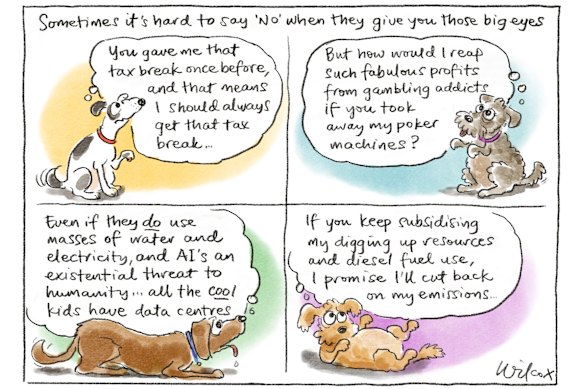
Each to their own
It’s disgraceful that Jeremy Stowe-Lindner had to suffer the antisemitism he outlined (“More abuse followed my royal commission testimony”, May 22). He is entitled, and indeed obliged, to advocate for any actions regarding Israel that he believes will make a better world. I understand that he believes that Israel is central to his identity as a Jew, and that Israel is the promised land. But I insist that I am able to disagree with him without being antisemitic. I refuse to accept that God chose the Israelites and gave them land of Israel. Stowe-Lindner can tell us what he believes, but I am entitled to believe, and say, that Israel is a failed experiment. The “God-given” right to Israel is no more proven than my God-given right to a small piece of land south of Gympie. Believing it does not make it so. Reg Lawler, Dagun (Qld)
Low-down cash grab
Charging a fee for care residents to enjoy entertainment provided free by volunteers would have to be at the top of a list of low acts (“Aged care home’s ‘fee’ to see musicians play”, May 27). It is monetising the kindness of others and exposes a mindset that questions just why these institutions are operating in the community. Until the economic scapegoat generation, aka Baby Boomers, pass from view (now there’s another euphemism for falling off the twig), such services will be increasingly needed. Any activity that fosters connection among residents in such communities should be encouraged, instead of driving a wedge between those who can afford such apparent trimmings and those who cannot. Bradley Wynne, Croydon
Broken promise
The “Big Australian” lumbers into the disjointed discussion on Australian values (“BHP talked green. Then the money got in the way”, May 27). Formally and publicly confirming a meaningful commitment to emissions reduction in their home country, they proceed to do very little, with leaked evidence indicating they knew exactly what they were doing. Their operation in Chile, however, captured in an environment where governmental action is more robust, has managed to show what can be achieved when you try. Brian Jones, Leura

Honest truth
Given that the Liberals and Nationals are struggling to find a way forward, or anywhere for that matter, the long-gone US comedian George Burns may have the answer for them: “The key to success is sincerity. If you can fake that, you’ve got it made.” Or as another (anonymous) wit put it: “Remember the First Law of Holes: if you find yourself in one, stop digging.” Anthony Curry, Toowoomba (Qld)
Climate folly
One big reason that wind farms and solar are stalling is the difficulty of getting them and the accompanying transmission lines through the approval process (“Investors desert Australia’s renewable rollout at ‘critical juncture‘“, May 26). Otherwise sensible townspeople and farmers are continually up in arms over any project, something which would never have occurred when coal holes, generators and lines were put across the land many years ago. These naysayers are jockeyed along by out-of-town anti-renewable people, as well as a whole barrage of unscientific rot directed at them on the internet. One suspects that the whole lot are being subtly manoeuvred by a shadowy third tier. Whatever happens, Rome and earth are burning, Europe is suffering heat waves, the seas are rising in Indonesia, while these smug fools delay and sometimes stop future clean energy projects. Donald Hawes, Peel
Vital function
In the face of falling digital skills among students, Barker College principal Phillip Heath is creating a specialist research team to study how students use AI and how literacy can best be taught (“Children’s digital skills at a 20-year low”, May 27). I can only hope the team is led by the person who is best qualified to teach digital literacy skills – the school’s teacher librarian. Yes, that’s right, the teacher librarian, a dually qualified professional whose skills specialise in digital/information literacy. When your students are struggling to determine if information is “real” you’re in trouble.
Not just private schools either. This is a nationwide problem affecting all schools, which continue to erode the specialist position of a teacher librarian. As a result, students have lost the knowledge required to recognise reliable, authoritative information. Sharon McGuinness, Thirroul
Keep it local
Chris Minns’s call for suggestions for an appropriate name for the proposed new Bays West suburb on Glebe Island offers the opportunity to restore the island’s original name, as used by the original inhabitants. That name is not found in modern records, but it might have been recorded by the early settlers in diaries or maps held in archives somewhere. I propose a challenge: find the original name and use that to honour the first Australians. Matthew Stevens, Thornleigh
Sign on the line
Not content on failing alone, Donald Trump has to coerce the oil-rich kingdoms into going down with him – sign the Abraham Accords or else (“US strikes a ‘gross violation’ of ceasefire: Iran”, May 27). The accords were not signed previously for failing to recognise Palestine. Talk about going around in circles. Surely, now is the time to let oil go. Moving away from polluting, war-prone oil to renewable energy has got to be more attractive than this bomb/oil tit-for-tat we are currently being strangled with. The faster we get there the better. Claudia Drevikovsky, Croydon

The White House is being obscured by a structure on the south lawn, not to conceal the ballroom works but to provide an arena for cage fighting. This, it seems, forms the high culture event that is part of birthday celebrations for President Trump’s imminent 80th. I shouldn’t be too snooty, though. Closer to home there’s a prominent politician with similar tastes. Bill Forbes, Medowie
- To submit a letter to the Sydney Morning Herald, email letters@smh.com.au. Click here for tips on how to submit letters.
- The Opinion newsletter is a weekly wrap of views that will challenge, champion and inform. Sign up here.
Disclaimer : This story is auto aggregated by a computer programme and has not been created or edited by DOWNTHENEWS. Publisher: www.smh.com.au