It is late in the evening on the outskirts of a village in Angul, Odisha. The green around them is dense, the road has given way to fields, and somewhere nearby, a snake has left people unsure of what to do next.
The villagers keep their distance. However, the rescuers don’t.
They arrive with their hooks, bags, and equipment, first trying to identify the snake and then figuring out the safest way to get it out. Once it is secured, the team will coordinate with the Forest Department and release it in a suitable forested area.
For Biplab Mahapatra, this is an ordinary rescue call.
More than a decade ago, however, his life looked very different. He was a journalist, spending his days chasing stories. Today, he spends them chasing rescue calls, training volunteers and trying to convince people that the snake they fear does not necessarily have to be killed.
“I have not chosen this job,” he says. “It is destiny; this thing has chosen me.”
And his story of becoming a rescuer began with a python.
From reporting stories to rescuing animals
Biplab had always been drawn to nature.
A professional climber, he spent years trekking and travelling through forests, including in Himachal Pradesh. He had also grown up around animals. His father, who was a journalist himself, was fond of pets, so their home often had Indian dogs.
But journalism was still Biplab’s profession.
He was freelancing and working as a crime reporter when his interest in animal rescue began taking a more serious turn. He remembers rescuing dogs in those early days, but snakes had always fascinated him.
Then came a large python that people were preparing to kill.
The snake had eaten one of their goats. For the people who had lost their livestock, it was a threat that needed to be removed.

For Biplab, it was an animal that needed to be rescued.
“I started with one rescue of a big, huge python,” he recalls. “That inspired me to start a new organisation.”
The rescue also made him think about something much bigger happening around him.
Angul had a serious human-wildlife conflict problem. Elephants, crocodiles and other animals regularly came into conflict with people, but Biplab noticed that there was little attention being paid to snakes.
“There was no one to mitigate this thing in my place,” he says.
So, in 2011, he began working with People for Animals and started building what would eventually become People for Animals, Angul. In 2013, the organisation was formally registered. Biplab started it with three others, including a senior and two friends from different professions.
For the first two years, he tried to balance the work with his career.
Then he decided he couldn’t do both.
“I registered my organisation and started focusing on rescue full-time,” he says. There was no big office or ready-made infrastructure waiting for him. In the early days, even keeping things running was a struggle.

“Initially, funds were a big challenge for us. We were managing things with great difficulty,” he says. Even a snake rescue requires equipment such as hooks, bags, and other protective gear.
But Biplab soon realised that equipment wasn’t the only thing missing.
There was something else the community needed: knowledge.
‘The rescue is not the solution’
At first, Biplab thought the answer was simple. A snake was in trouble, so he would rescue it.
But the more calls he received, the more he understood the problem.
There would always be another snake, a frightened family who had no idea whether the snake in front of them was venomous or harmless.
“The rescue is not the solution,” Biplab says. That realisation changed the organisation’s work.
Instead of only responding to rescue calls, Biplab began taking the conversation to schools, colleges and villages. He developed an awareness programme called Save Snakes, Save Humans, teaching people how to identify snakes, respond to encounters and understand snakebite first aid.
A major part of the work was addressing myths.

Biplab has heard plenty over the years: that snakes can capture photographs with their eyes, that they love drinking milk, that a nag-nagin pair takes revenge, or that snakes carry money in their heads.
He laughs at some of the ideas but knows that the consequences of misinformation can be serious.
“I feel that when there is a lack of knowledge, it is always dangerous,” he says. “When people don’t know about this beautiful creature, they see it as a threat.”
And fear, in turn, can lead to killing.
Biplab believes that the problem goes far beyond Odisha. Snakebite is a major public health concern across India, with thousands of people losing their lives every year. What makes it worse, he says, is that many cases are not even properly reported.
His solution is not to tell people not to be afraid.
It is to give them enough knowledge to know what to do with that fear.
When the phone rings, someone has to go
Today, the organisation, now known as Rangers, has around 50 volunteers in Angul, with more than 30 actively involved. Its network extends across Odisha and into other parts of India.
When a rescue call comes in, the first thing the team does is assess the situation.
Can the caller identify the snake? If not, Biplab’s advice is simple: stay away, keep a safe distance, and, if possible, keep an eye on where the snake is. If it has entered a room, the safest option may be to close the room and wait for a trained rescuer.
Then comes the race against distance.
Angul is geographically large, so Rangers have volunteers spread across different parts of the district. Whoever is closest to the location takes the call.
Once there, the rescuer identifies the snake and follows the protocol for that particular species. After the animal is safely rescued, the team informs the Forest Department and releases it in the nearest suitable forest.
On paper, it sounds straightforward, but on the ground things are different.
Biplab remembers one call that came from the Forest Department at around 9.30 pm. A large snake had fallen into an abandoned well.
The well was nearly 30 feet deep. The location was about 80 kilometres away. Once they reached the area, the team had to leave the motorable road, walk through paddy fields and then continue towards a forest reserve.

They had no proper way to get into the well.
“So I just told them to arrange a ladder and some rope,” Biplab recalls. “I was the man who went first.”
Only after reaching the bottom did they realise how big the python was.
And then it wrapped itself around his arm.
“It almost choked me from my left hand,” he says. “It was already wrapped around me fully from my wrist to my shoulder.”
Biplab struggled to breathe as the snake tightened its grip. His senior and volunteers helped him get free.
The python was eventually rescued and released in the nearest forest.
It turned out to be about 15 feet long; for Biplab, the lesson was simple.
“Every rescue is a story,” he says.
Building people, not just a rescue team
The biggest change in Biplab’s work has perhaps been that he is no longer trying to do everything himself.
He is building people who can respond when he isn’t there.
One of them is Manoj Vishwakarma, Biplab’s childhood friend and the head of Rangers’ domestic wing, which handles rescues involving dogs, cattle, and other domestic animals.
Manoj had a completely different career. He worked in Bengaluru at Bosch and initially only supported Biplab from the sidelines.
“I used to come and check with him, like what he is doing,” Manoj recalls. “I saw some snakes he used to capture and always used to get scared of them.”
During the work-from-home period after COVID, Manoj got an opportunity to spend more time helping. Gradually, the occasional calls became regular involvement.
He remembers one incident when he was in Bihar and came across an injured nilgai. Instead of wondering what to do, he called Biplab, who helped connect him with the local Forest Department.
For Manoj, it showed him that helping an animal didn’t always require some extraordinary intervention. Sometimes, it started with knowing whom to call.
He eventually left his job and began working full-time with Rangers.

“People look at you like a saviour. Like you have saved something and helped them.”
For him, that feeling is very different from a conventional workday.
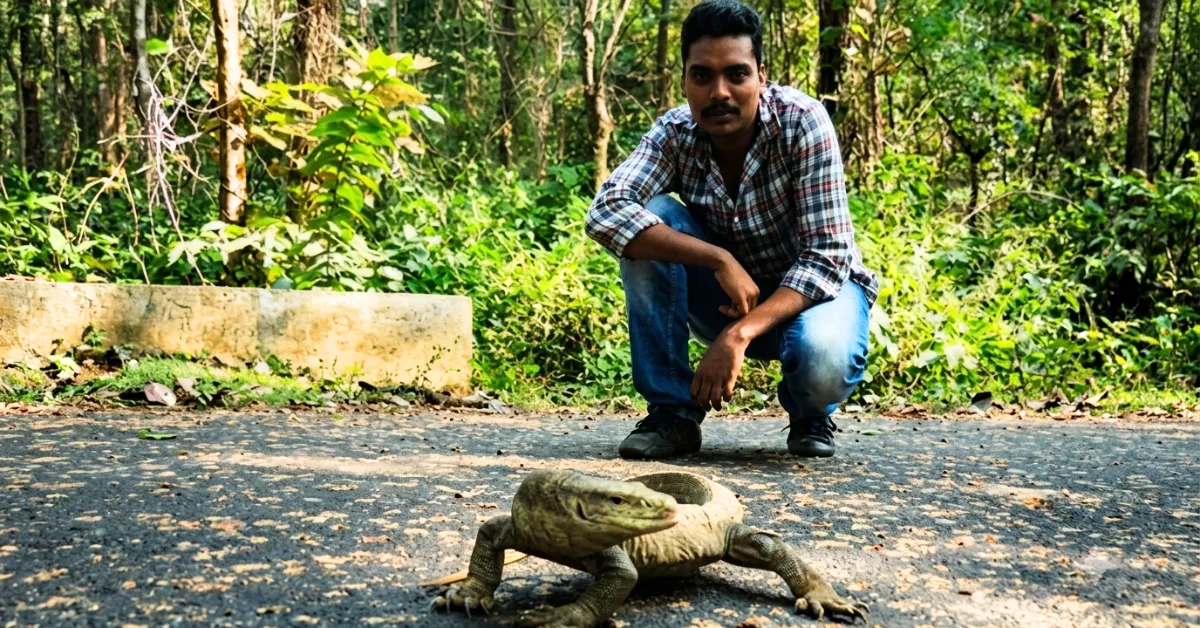
Rangers has two broad wings, one focused on domestic animals and another on wildlife. Besides snakes, its volunteers rescue monkeys, civet cats, turtles, monitor lizards and birds.
Biplab doesn’t insist on a particular educational qualification when selecting volunteers.
“He must be passionate,” he says. Training and monitoring then follow. Volunteers are taught rescue protocols, and the team tracks details such as where an animal was rescued and where it was released through geotagging.
The aim is to make sure that the rescue is safe for everyone involved.
Changing what happens after people see a snake
For Biplab, the real impact of the work is not just the number of snakes rescued, but what happens before his team even arrives.
According to district medical data he cites, snakebite deaths in Angul, which once crossed 100 annually, have fallen to double digits over the past five years. The organisation has also taken its awareness programmes to around 40 to 50 schools, helping children and communities understand that a snake does not have to be killed simply because it enters their space.
Manoj has seen that shift himself.
“Don’t kill because they’re in the food chain,” he says. “They have their own responsibilities. Those animals are required.”

For Biplab, that is the larger goal.
“There are so many cases where we have to choose people’s safety first,” he says. “Only saving animals is not our mission. Our mission is to balance between [humans and wildlife]. And our main mission is coexistence.”
His work has since expanded beyond rescue calls. He has volunteered with the Wildlife Crime Control Bureau on wildlife trafficking cases and worked with the Odisha Forest Department on conservation awareness. His work has earned two Limca Book of Records entries and a world record, while a 12-minute snake awareness film received national recognition, finishing as second runner-up in the short-film category under the Ministry of Environment, Forest and Climate Change.
But recognition has never made the work less dangerous.
Fear never really leaves
Biplab was once bitten by a highly venomous banded krait and spent five days in an ICU in Cuttack after being taken through multiple hospitals. There, he saw how many snakebite patients had delayed proper treatment after first turning to faith healers.
He has also faced danger while working against wildlife crime. While helping catch poachers involved in the killing of a spotted deer, his team was shot at. In another case involving an elephant killed for its tusks, they again came under fire.
So, is he afraid?
“Yes. Whoever says he is not afraid, he is a fool,” he says.
Fear, he admits, never really leaves. But neither does the work.
Now, his biggest dream is to build a community that can continue without him.
“For me, this is not about Biplab Mahapatra. This is about these 50 other people who have dedicated their life, their sweat, their blood for this thing.”
Because there will always be another rescue call, another frightened villager, and another animal that needs help. The hope is that, one day, there will also be enough people who know exactly what to do.
All images courtesy of Biplab Mahapatra
Disclaimer : This story is auto aggregated by a computer programme and has not been created or edited by DOWNTHENEWS. Publisher: thebetterindia.com