
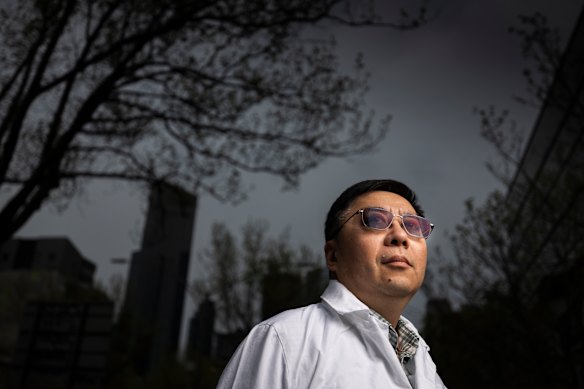
In May, Dr Ben Gu finally snapped. Gu is a neuroscientist, studying how the brain clears the plaques and tangles that build up over our lifetime – and how that process fails in people who develop Alzheimer’s.
For 13 years, his lab at the venerable Florey Institute of Neuroscience and Mental Health worked towards tests and treatments for the disease. A urine-based test for Alzheimer’s risk based on his work is now approved for sale in 14 countries.
Gu was proud to work alongside other researchers on the cutting edge of brain discovery. That was, until mid-2023, when his commercial contract with the Florey expired.
“They used this excuse to say, ‘Your contract is over, so your time in the Florey is over,’” he said this week.
Gu is not the only senior scientist to leave the institute in unhappy circumstances recently. Colin Masters, tipped as a potential Nobel laureate for his work on Alzheimer’s disease, has departed following an integrity investigation into two colleagues.
Bradley Turner, one of the world’s top motor neurone disease scientists, who leads research into Neale Daniher’s donated stem cells, had taken legal action against the institute and then resigned. Turner had been on extended leave from the institute.
Gu simmered for three years over his dismissal – and, he says, lost royalties from patents the Florey has refused to pay him. He repeatedly wrote to management, but never heard back.
So in May, he typed out an email to each member of the Florey board.
“I tried my best to bring resources into the Florey, but my loyalty was not appreciated at all,” he wrote. “It is a pity. In the end, I was persecuted by the Florey and ruthlessly exiled.”
He described his treatment by the Florey as “humiliating” and “arrogant … with no respect at all”. “I do not think it reflects well … to treat previous staff like garbage,” he wrote.
“I am not the enemy of the Florey. But if the Florey wants to make me an enemy, then I can be.”
In September, Gu filed a Federal Court lawsuit making a fair work claim against the Florey, alleging in an affidavit, provided to this masthead, years of underpayment, a botched commercial agreement, and a failure to pay royalties on his patents.
In the court documents, Gu also references his email as proof, he claims, of attempts he made to settle matters.
An investigation by this masthead can reveal Gu is not the only unhappy senior staff member to have left the 66-year-old and widely lauded institution as it grapples with a sector-wide funding squeeze.
The institute has had to cope with a major research integrity investigation that led to the departure of its star researcher, Colin Masters – who was for a time banned from setting foot at the institute’s Parkville headquarters. Masters declined to comment.
In July last year, the Florey employed 43 “group heads”, or heads of laboratories, reporting in to five top “research priority area” heads.
Six of those group heads have now left the Florey, and one of its top research priority area heads has resigned.
“It wasn’t an exodus. This is a deliberate decapitation. They sacked all these people for spurious reasons,” said a former researcher.
This masthead spoke to five current and 17 former employees of the Florey, who described a workplace that has turned “toxic” as the institute has struggled financially.
“The Florey has gone down a pathway that is Darwinian. It’s survival of the fittest,” said a current researcher. “As a workforce, we are on our own. There is a culture of paranoia.”
Another current researcher said they spent as little time as possible in the Florey’s Melbourne headquarters.
“It’s just such a horrible atmosphere,” they said. “It’s awful, it’s just awful. What’s the end game? You’re going to [financially] save the institution – but you’ll end up destroying it.”
The institute has run multimillion-dollar deficits since 2022. Commercial revenues – crucial to the Florey’s business model – have nearly halved since 2022.
Other research institutes are in a similar financial state – or worse. The sector’s peak body estimates 10 of Victoria’s 14 will be forced to close by 2030. The Hudson Institute was the first domino to fall, announcing in September plans to merge with Monash University.
“The business model is doomed,” said a source with direct knowledge of the Florey’s finances. “The only way forward is to re-merge with the University of Melbourne.”
The institute strenuously denies it has financial or cultural problems.
“The Florey is deeply disappointed by these baseless claims,” said a spokesman for the Florey. “The Florey remains in a financially sustainable position, despite a challenging funding climate for all medical research institutes across Australia.”
Still, Ben Gu is deeply concerned about the institute’s future.
“It’s not just me. A long list of names of intelligent researchers, who are so loyal to the Florey, have been expelled,” says Gu. “They are all gone. It used to be a good institute. Someone needs to save the Florey.”
‘A deliberate decapitation’
The Florey is one of Melbourne’s great blue-blooded institutions. Established in 1960, it was underwritten by Melbourne’s famous families: the Myers, the Potters, as well as the Rockefeller Foundation; a Rothschild sat on the first board. Howard Florey, who won a Nobel Prize for work on penicillin, lent it his name.
It is the dramatic exit of a scientist widely spoken about as a potential future Nobel laureate that is one focus of concern within and outside the Florey.
For the past 14 years, the Florey housed the lab of Professor Colin Masters, one of the world’s most consequential dementia researchers.
“Colin is the closest Australia has to a future Nobel Prize winner,” says a former researcher. One source with direct knowledge of his work estimates he has brought in about $90 million in taxpayer and commercial funding to the institute.
Masters, a laureate professor and distinguished Florey fellow, resigned from the organisation last September, this masthead can reveal.
“Colin Masters was thrown out,” said a source who had worked with Masters. “It’s an awful way for a man that has done so much to end.”
Masters, who is now based at the University of WA, declined to comment. The Florey denied ever pushing out researchers.
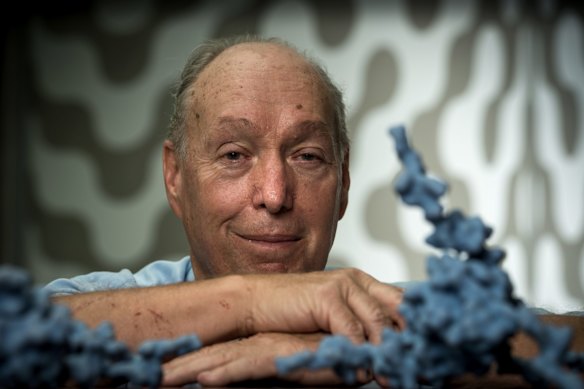
This masthead can reveal his departure was triggered by a research integrity investigation into his co-workers – which is now the subject of a federal review. Masters’ research is not under question, and no concerns have been raised about his work.
“We didn’t know what happened. But all of a sudden, overnight, he was banned from coming into the building,” said a former researcher. “He had to get all of his things out of the office. It was a very dramatic exit. Colin was one of the superstars of the Florey.”
The Florey said it “does not comment publicly on confidential arrangements concerning an individual. Any decisions about access to Florey premises are made in accordance with applicable policies.”
The institute’s second-highest-profile scientist is Professor Bradley Turner, who leads one of the largest motor neurone disease patient stem cell banks in the world – founded with cells from football legend Neale Daniher, and funded by the charity he set up to fight the disease.
Using the banked cells, Turner was able to announce in November’s edition of Nature Neuroscience a promising new treatment for MND.
“He is arguably the biggest motor neurone disease researcher in at least the southern hemisphere,” said a former researcher. A current researcher described him as a “worldwide name”.
The Florey initially told this masthead Turner was on extended personal leave.
But this masthead has obtained an internal email revealing Turner had been on leave since March “due to illness” and other reasons.
Turner was head of one of the Florey’s five Research Priority Missions, with nine group heads reporting to him.
In July, the Fair Work Commission listed a hearing between Turner and the institute to deal with an unspecified “dispute”.
The Florey declined to comment on the specifics of Masters’ or Turner’s cases.
Turner did not return multiple requests for comment.
The loss of lab heads has meant PhD students have been shuffled from team to team – at a time when, two sources familiar with the program said, the Florey made its two student support positions redundant.
The institute had also cut funding to its student association, said a person with direct knowledge of the cuts.
“The students are not getting the pastoral care and scientific guidance they should,” said a senior Florey researcher.
The Florey spokeswoman denied the association had had its funding cut. “Student support is now provided by a wider team into which all student support staff were redeployed.”
And one current staff member said the Florey did a great job supporting students. “From what I’ve seen, I don’t think the Florey as an institution has done anything to treat students poorly,” they said. “There is also a generous budget available for student group activities.”
Financial struggles
The Florey, like many medical research institutes, is in a perilous financial position.
Under the header “financial difficulties”, a confidential presentation to staff in February last year, obtained by this masthead, noted the institute had posted a $4.5 million shortfall in 2024 and was expecting another one in 2025 “and beyond”. The presentation announced several job cuts.
The presentation noted “limited grant success in 2024 funding round, below expectations”.
“We were told if they did not do the changes they would be closed within two to three years,” said a former staff member.
Taxpayer-funded research grants do not cover the full cost of doing research. The Florey aims to cover the gap with commercial activities and donations. But commercial income halved from $22 million in 2022 to just $11 million last year.
The institute acknowledged there had been a 13 per cent reduction in full-time equivalent staff between 2022 and 2025. Despite those cuts, employee expenses increased in 2025.
A spokesman for the Florey told this masthead the institute was not insolvent, but without the firm action management had taken “we were heading that way”.
“There is absolutely no secret Victorian medical research institutes are on the brink. That’s very clear,” he said. “Our sector is in a financial crisis.”
The Florey points to a $1.4 million surplus (before depreciation and amortisation) in 2025 as evidence of financial strength. “We’ve turned the corner,” the spokesman said. “But the ambient environment is still tough, so we are absolutely not complacent.”
Problems with IP
To deal with the difficult financial environment, multiple former staff said the Florey had pivoted towards a commercialisation strategy.
A road that executives hoped would lead to financial stability has turned to quicksand.
The Florey’s head of commercialisation left the institute this year. The Florey sued its business development manager last year in the Supreme Court. At one point, the commercial team was down to a single worker, although the Florey says there are now three staff.
“The commercial team is responsible for generating income for the institute,” said someone with direct knowledge of the team’s staffing. “The fact they have been obliterated should ring alarm bells.”
When the Florey tried to commercialise some of its intellectual property, it discovered it owned far less than it thought.
“They had rushed through these agreements in the past. And they didn’t have the rights they thought they had. So then they were trying to fight to get those rights,” said a former employee with direct knowledge of the issue.
And many of its researchers are focused on blue-sky problems, not drug discovery. “This is why the Florey hasn’t been able to bring anything to the clinic,” said a former staff member.
Patents, the foundation of commercialising medical research, are at the heart of Ben Gu’s problems with the Florey.
In an affidavit lodged with the Federal Court, Gu alleges the Florey filed two patents based on research he had done – one filed without his knowledge. “They did very underhanded things,” he said.
Florey then offered to sell him the patent for $200,000, he claims. Without that patent, Gu felt his future research would have been compromised, so he agreed to buy it. “I had to pay a ransom so I could continue on my study.”
Gu’s lawsuit is asking for a 30 per cent royalty from the patent – which he believes he is due under the Florey’s intellectual property policy.
Start the day with a summary of the day’s most important and interesting stories, analysis and insights. Sign up for our Morning Edition newsletter.
Disclaimer : This story is auto aggregated by a computer programme and has not been created or edited by DOWNTHENEWS. Publisher: www.smh.com.au



