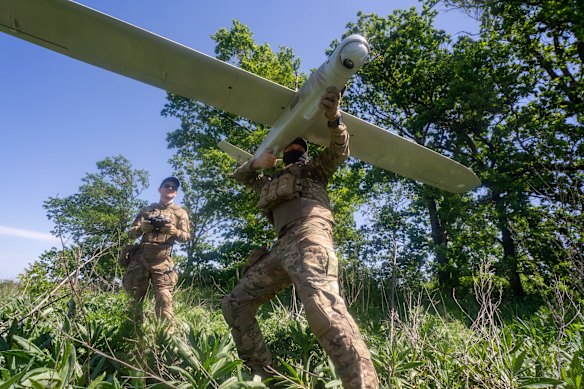

A proposed security treaty with Ukraine has been stalled for almost a year, hampering Australia’s ability to tap into Ukraine’s expertise in drones and other advanced military technologies gained from its four-year war against Russia.
Ukrainian President Volodymyr Zelensky has signed bilateral security agreements with 28 nations including the United Kingdom, Japan and Canada, as well as the European Union, making Australia a notable omission.
The deal could allow Ukrainian drone companies to set up operations in Australia, boosting the local manufacturing sector.
Negotiations on an agreement began around April last year and there were hopes Zelensky and Prime Minister Anthony Albanese could seal the deal on the sidelines of the United Nations General Assembly in New York last September.
The leaders were unable to arrange a meeting, and a possible meeting at the G7 summit in France next week was scotched when French President Emmanuel Macron did not invite Albanese to the event.
Ukraine’s ambassador to Australia, Vasyl Myroshnychenko, said: “I hope our leaders can meet soon so an agreement can be signed sooner rather than later.”
Myroshnychenko warned in a speech last month that Australia risked “fighting with one hand behind your back” unless it leverages Ukraine’s military expertise.
“If major-power warfare comes to the Indo-Pacific, Australia will have no choice but to be very good at asymmetric warfare and countermeasures. Australia does not need to learn these lessons through blood,” he told the Indo-Pacific Defence Conference in Perth.
“Ukraine is now able to work with Australia not as a supplicant, but as a genuine defence and security partner.”
Noting the array of security agreements Ukraine has struck with other countries, Myroshnychenko said: “Ukraine is ready, willing and able to exchange hard-won battlefield knowledge, operational expertise and defence technology expertise for the kinds of military support Ukraine still cannot generate alone.”
Government sources, speaking on condition of anonymity, said negotiations on a security agreement were ongoing but there was no imminent prospect of a deal being finalised.
A meeting between Albanese and Zelensky at the UN this September appears to be the best chance to sign a security pact this year, unless the prime minister decides to visit Ukraine.
A Department of Foreign Affairs and Trade spokesperson said: “Australia continues to provide meaningful and targeted support to Ukraine as it defends itself against Russia’s unprovoked and unjustified full-scale invasion, with over $1.7 billion in assistance committed to date.”
Retired major-general Mick Ryan said the lack of a bilateral security agreement meant the Australian Defence Force was missing out on crucial battlefield insights Ukraine has garnered from over four years of fighting against Russia.
“We’ve got more to learn from them than they do from us,” he said.
“A security agreement with Ukraine would be extraordinarily beneficial for Australia.”
Ryan, who has visited Ukraine six times since Putin’s 2022 invasion, said such a deal could unlock opportunities for Australian and Ukrainian troops to train in each other’s countries, expand intelligence sharing and allow the joint production of advanced military technologies.
“We need the Ukrainians to be coming here and training us in drone and counter-drone technologies, how to protect critical infrastructure and how to manage police, fire and ambulance services in a war,” he said.
“There is so much we can learn from Ukraine on the use of artificial intelligence; missile defence systems; air, sea and land drones; cognitive warfare – the list goes on.”
Australia would be expected to provide additional security assistance to Ukraine as part of the deal.
Ryan argued in a paper for the Lowy Institute published earlier this month that Australia and other Western nations had been “dangerously slow” to learn lessons of modern warfare from Ukraine, especially the central role of drones.
“Operation Kudu — Australia’s contribution to the multinational training mission for Ukrainian recruits in the United Kingdom — has had an unexpected effect: Australian soldiers are learning about drone operations and other aspects of modern war from the very recruits they are training,” he wrote.
“Yet there is no systematic process for institutionalising those insights into doctrine, force structure, or procurement priorities.”
Australia has committed over $1.7 billion in total assistance to Ukraine, including $1.5 billion worth of military aid, including tanks and armoured vehicles.
The government’s most recent support package for Ukraine included a $50 million contribution to a NATO initiative to supply Ukraine with critical military equipment.
Foreign Minister Penny Wong, alongside her British and Canadian counterparts, held a video meeting on Friday with Ukraine’s first lady Olena Zelenska.
“We recognise the immense suffering of the Ukrainian people, the immense suffering of Ukrainian women and children – the result of Russia’s unprovoked, unjustified invasion,” Wong said.
Cut through the noise of federal politics with news, views and expert analysis. Subscribers can sign up to our weekly Inside Politics newsletter.
 Matthew Knott is the foreign affairs and national security correspondent for The Sydney Morning Herald and The Age.Connect via X, Facebook or email.
From our partners
Disclaimer : This story is auto aggregated by a computer programme and has not been created or edited by DOWNTHENEWS. Publisher: www.smh.com.au