A decade since its release, Johnpaul George’s Guppy continues to occupy a special place in Malayalam cinema. It arrived without the trappings of a major commercial release, only to gradually find an audience that embraced its compassion, emotional honesty, and deeply human characters. While much of that affection naturally belongs to Chethan Jayalal’s spirited Michael, affectionately known as Guppy, the film would not have resonated as profoundly without the man who initially stands in his way.
Thejus Varkey, played by Tovino Thomas, could easily have been written as a one-note authority figure, the rigid government engineer whose sole purpose is to make life difficult for a young boy. Instead, Johnpaul George and Tovino create someone far more layered. Thejus begins as the antagonist of Guppy’s story, but over the course of the film quietly becomes one of its most affecting characters. His journey is not about dramatic redemption or heroic sacrifice. It is about learning that rules alone cannot build a community, and that sometimes the hardest thing for a man to reconstruct is not a bridge, but another person’s trust.
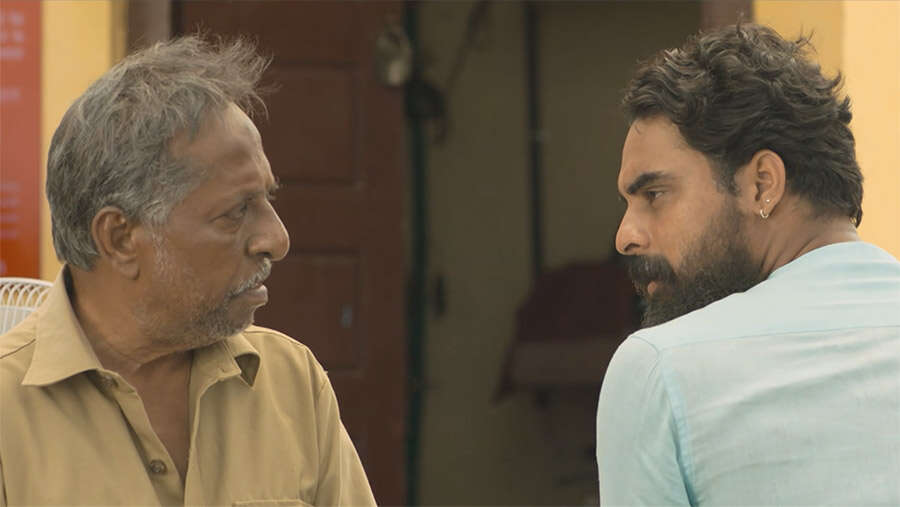
First Impressions: The Stranger Who Won’t Explain Himself
Ten years on, Thejus Varkey still feels like a provocation. He rides into the coastal village on a motorcycle, surveys the landscape like another work site, and speaks in clipped sentences that reveal little about the man behind the job. To the villagers, he is arrogant. To us, he appears destined to become the obstacle Guppy must overcome.
That is Johnpaul George’s first sleight of hand. Thejus is introduced as the antagonist not because he is cruel, but because he is impossible to read. He hides behind rules, convinced that procedure can solve problems far more human than technical.
What begins as a petty clash with a boy soon spirals into something much larger. Guppy, who breeds ornamental fish in the hope of buying a wheelchair for his disabled mother, finds himself locked in a battle against Thejus’ rigid sense of order. Small victories and small humiliations accumulate until they culminate in an act of bureaucratic cruelty. The authorities descend upon the boy’s prized fish tank and demolish it in the name of regulations and development.
The destruction hurts precisely because nobody raises a hand. It is punishment delivered through paperwork. Thejus believes he is simply doing his job. We are meant to recoil from that certainty and we do. Yet the film never loses sight of the boy’s perspective. His stubbornness is not adolescent rebellion. It stems from responsibility; from the desperate need to protect the fragile world he has built for himself and his mother. It is something Thejus fails to understand until the damage has already been done.
Tovino never reaches for the obvious. There are no fiery speeches or dramatic breakdowns. Instead, he constructs Thejus through posture, silences, and tiny shifts in expression. Even when anger surfaces, it arrives in measured bursts, as though emotion itself is an inconvenience. It is a performance that rewards repeat viewings. You begin to notice the hesitation before he answers, the way he stiffens when challenged, and the careful distance he maintains from everyone around him. Thejus always feels like a man carrying something he refuses to put into words, and Tovino trusts the audience enough to discover those cracks on their own.
The Pivot: When Silence Becomes Compassion
The film changes course after a stabbing. Faced with the opportunity to expose the person responsible, Thejus chooses silence. It is not an act of machismo. It is the moment he realises how deeply his arrival has unsettled lives that were already hanging by a thread. Guppy’s future has become even more uncertain. An elderly man’s livelihood is about to disappear because of the bridge project. For perhaps the first time, Thejus understands that every decision made on paper leaves a mark on someone beyond the file.
Johnpaul George allows the moment to breathe. There is no swelling background score instructing us how to feel, no speech announcing that the character has changed. The silence says enough.

The most beautiful aspect of Thejus’ redemption is that it remains true to who he is. There are no grand declarations or emotional confessions. Instead, he returns to the files. He questions the bridge project, challenges its viability, and slows the machinery he once defended without hesitation. Then, away from the spotlight, he begins rebuilding what he helped destroy. The canal, Guppy’s fish tank, returns through labour, materials and time. It is not charity. It is penance.
There is something deeply satisfying about that reversal. Earlier, Thejus had used the system to hurt a child. Now he uses the very same system to make things right. But the film’s narrative never mistakes redemption for a fairy tale. By the time hope reaches Guppy’s doorstep, tragedy has already arrived. Thejus can halt construction, but he cannot stop fate. That refusal to offer easy comfort remains one of the film’s greatest strengths.
The film gradually reveals the grief that shaped Thejus long before he entered the village. Personal loss has convinced him that control is the only defence against chaos. Schedules, blueprints, and regulations become emotional armour. That revelation transforms every earlier scene on a second viewing. His aloofness no longer feels like arrogance. His obsession with order feels like fear. He is not trying to dominate the world around him; he is trying to stop it from falling apart once again.

The Screenplay’s Quiet Trick
Johnpaul George writes Thejus with remarkable generosity. The early scenes flirt with the familiar grammar of the arrogant government official who exists solely to frustrate the hero. Another film might have stopped there. Guppy does not.
Instead, it allows him to fail, reflect, and most importantly, change without turning him into a saint. The screenplay also cleverly filters much of Thejus through Guppy’s eyes. We judge him exactly as the boy does. As the film gradually reveals the man beneath the stoic façade, it quietly asks us to question those first impressions as well.
Part of what makes Thejus Varkey unforgettable is that Tovino never asks us to like him. He only asks us to stay with him long enough to understand him. His heroism is wonderfully ordinary. It exists in correcting mistakes, reversing decisions, and taking responsibility without waiting for applause. Thejus discovers that repairing a life is far harder than constructing a bridge, but he does it anyway.

Watching Guppy today, Thejus Varkey feels even more relevant than he did in 2016. He reminds us that institutions are neither inherently kind nor cruel. They become one or the other through the people who operate them. His journey is built not on dramatic transformation but on self-awareness. He begins as a stranger who hides behind procedure and ends as someone who finally understands the lives affected by every signature he puts on paper. That is why he stays with us.
If Malayalam cinema over the past decade has given us many lonely men searching for change, Thejus remains one of its most understated achievements. Flawed without being irredeemable, distant without being heartless, he is also strong enough to admit when he was wrong. In the end, the bridge he leaves behind is not the one drawn on his blueprints. It is the one he slowly rebuilds to a boy whose world he once helped tear apart.
That quiet act of repair is what makes Thejus Varkey unforgettable, even ten years later.
Also Read: Tovino Thomas, Vismaya Mohanlal, Other Malayalam Celebs Face Backlash for Supporting Student Protest
Disclaimer : This story is auto aggregated by a computer programme and has not been created or edited by DOWNTHENEWS. Publisher: filmfare.com