South Pyongan province’s Sunchon chemical industrial complex is a sprawling hub as it was built up over the past decade on the site of a former vinylon plant. Satellite imagery I analyzed in 2026 shows signs of dual-use infrastructure there that could support chemical weapons production.
Using high-resolution WorldView-3 satellite imagery, I identified the complex’s main facilities stretching along the Taedong River. They run from the Sunchon Phosphatic Fertilizer Factory in the west to the Sunchon Pharmaceutical Factory and Sunchon Chemical Complex in the east. The Sunchon C1 Chemical Plant sits in the southeast. The facilities are close together and linked by road and rail, which lets raw materials and intermediate goods move easily between them.
The imagery shows ore piles and smokestack emissions at the phosphatic fertilizer factory’s storage yard. Core infrastructure has been built that includes gas scrubbers and cooling towers at the chemical complex and a methanol synthesis tower at the C1 chemical plant. Some facilities appear to be operating normally.
Thermal infrared data from the U.S. Landsat-9 satellite show clear differences in operational status across the complex. The nutrient liquid fertilizer factory at the chemical complex emitted high heat above 30 degrees Celsius, appearing in red. So did the raw material processing building at the C1 chemical plant. Both signals indicate active operation. The phosphatic fertilizer factory and pharmaceutical factory, by contrast, showed lower temperatures. That suggests minimal test runs or limited activity. Construction at the C1 chemical plant appears complete on the outside, but procurement problems for precision equipment have delayed the facility from reaching full operation. The phosphatic fertilizer factory has also yet to reach normal production, years after its completion.
I did not find direct evidence that North Korea is producing chemical weapons at the Sunchon complex, but the facilities here carry dangerous dual-use potential that could be redirected to military purposes at any time. White phosphorus is a byproduct of the dry process at the phosphatic fertilizer factory. It can be converted into a precursor for lethal nerve agents such as sarin or VX. A paint factory equipped with a security tower and helicopter landing pad could also be repurposed to produce hydrogen cyanide, a toxic gas. The pharmaceutical factory’s processes are closed and hard to observe, which makes it difficult to detect signs of illicit diversion from satellite imagery alone. Continued monitoring of the complex, using satellite resources, is needed.
A closer look at the complex
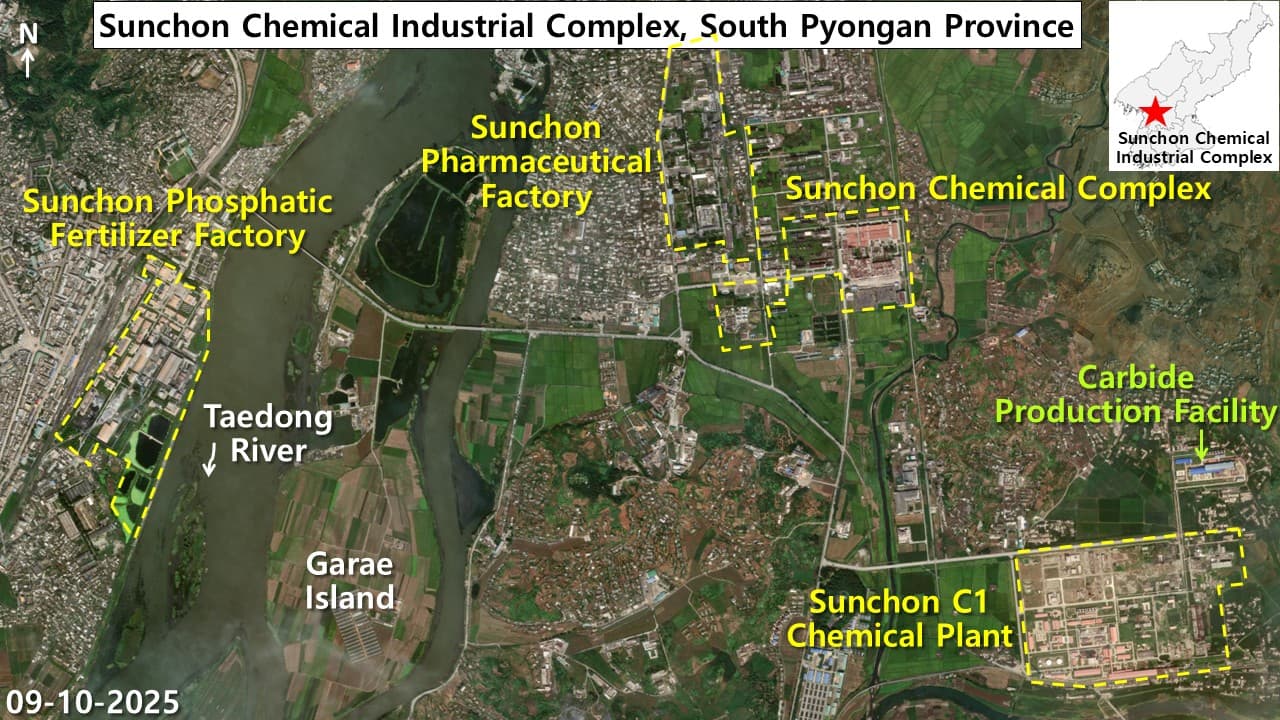
South Pyongan’s Sunchon chemical industrial complex is a key hub of North Korea’s chemical industry. It was completed after a decade of large-scale reconstruction centered on the site of the former Sunchon Vinylon Complex. Satellite imagery shows the entire complex integrated by road and rail. It starts with the phosphatic fertilizer factory on the west bank of the Taedong River and continues to the pharmaceutical factory and chemical complex, side by side on the east bank. It extends to the C1 chemical plant and a carbide production facility on the southeastern outskirts. The facilities share close geographic proximity and abundant resource infrastructure and together they form an integrated industrial cluster. Chemical raw materials and intermediate goods produced at each plant are closely supplied and circulated among one another.
Sunchon Phosphatic Fertilizer Factory
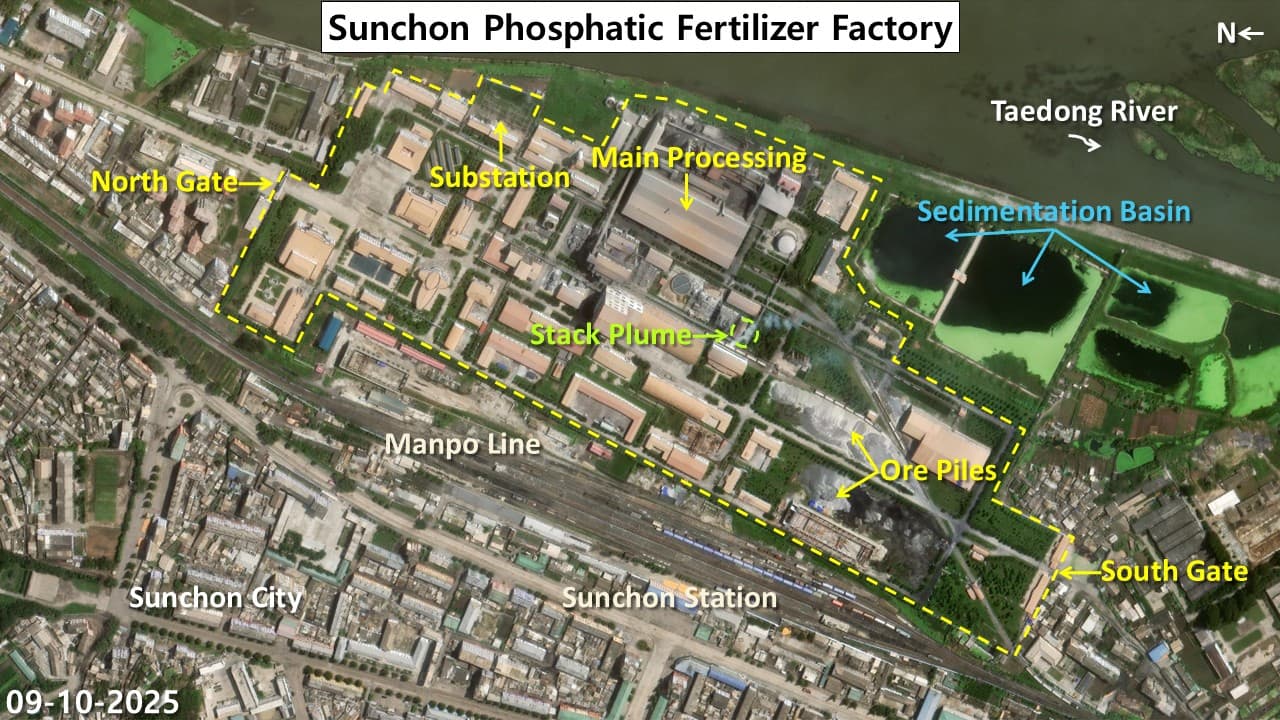
Rebuilt in 2020, the Sunchon Phosphatic Fertilizer Factory sits near Sunchon Station and the Manpo rail line to the south, which gives it convenient access for bringing in raw materials and shipping out products. The Taedong River supplies the water needed for operations. Satellite imagery shows faint exhaust rising from a smokestack at the main processing facility in the center of the plant. A large pile of what appears to be phosphate ore sits in the storage yard, while the water in a settling pond along the riverbank has remained a dark color, another sign of continued operation. The factory mainly mass-produces ammonium phosphate, an agricultural fertilizer. High-purity white phosphorus, extracted during the dry process, is a typical dual-use material as it can be used in ordinary consumer goods or be converted into lethal chemical weapons agents such as sarin or VX. The facility requires close satellite monitoring and analysis of its operational status.
Sunchon C1 Chemical Plant
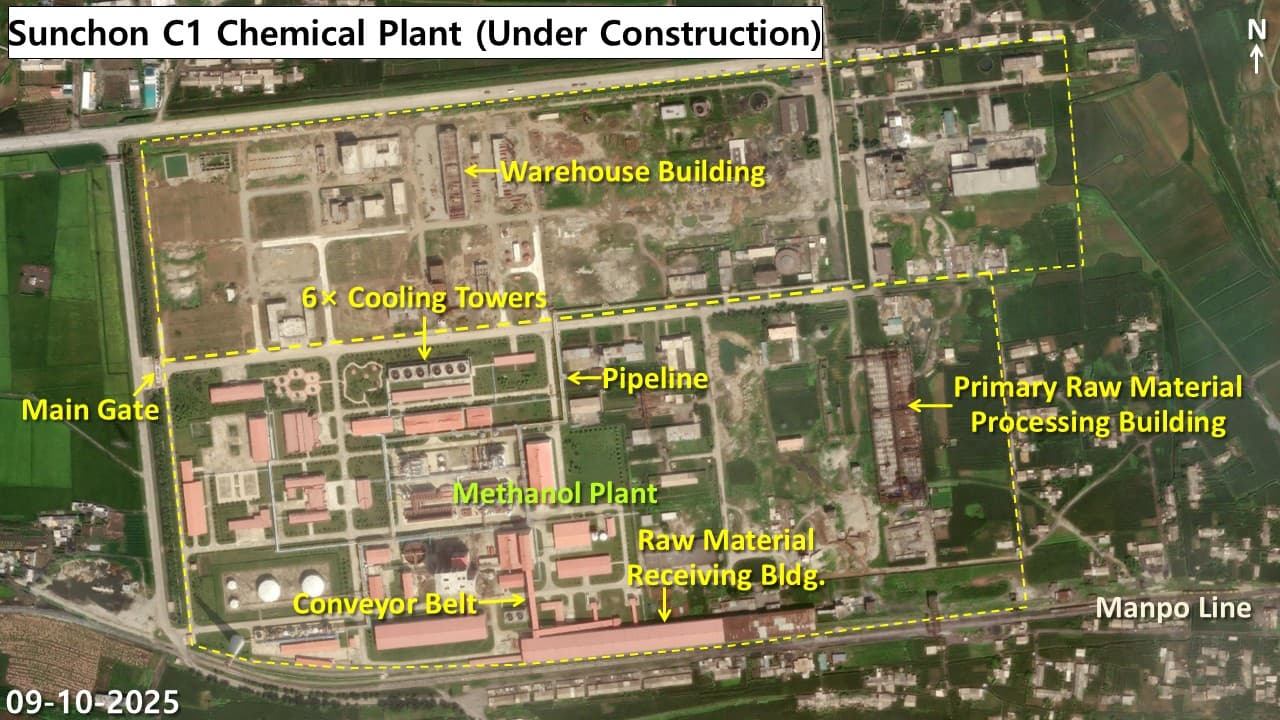
The Sunchon C1 Chemical Plant is a modern hub of North Korea’s self-reliant chemical industry. It was built to gasify domestic coal into methanol, gasoline and other hydrocarbons. Satellite imagery shows the exterior of core facilities appear complete that includes a synthesis tower and pipelines inside the methanol plant, a raw material receiving building and conveyor belt, and six cooling towers. Basic infrastructure for securing raw materials also appears in place, which includes a primary processing building on the plant’s eastern side and a connection to the Manpo rail line to the south. However, procurement problems for high-performance specialized equipment have delayed construction, including the installation of internal equipment. Satellite imagery has not yet captured decisive signs, such as smokestack emissions or raw material stockpiling, that the plant is in full operation.
Sunchon Chemical Complex
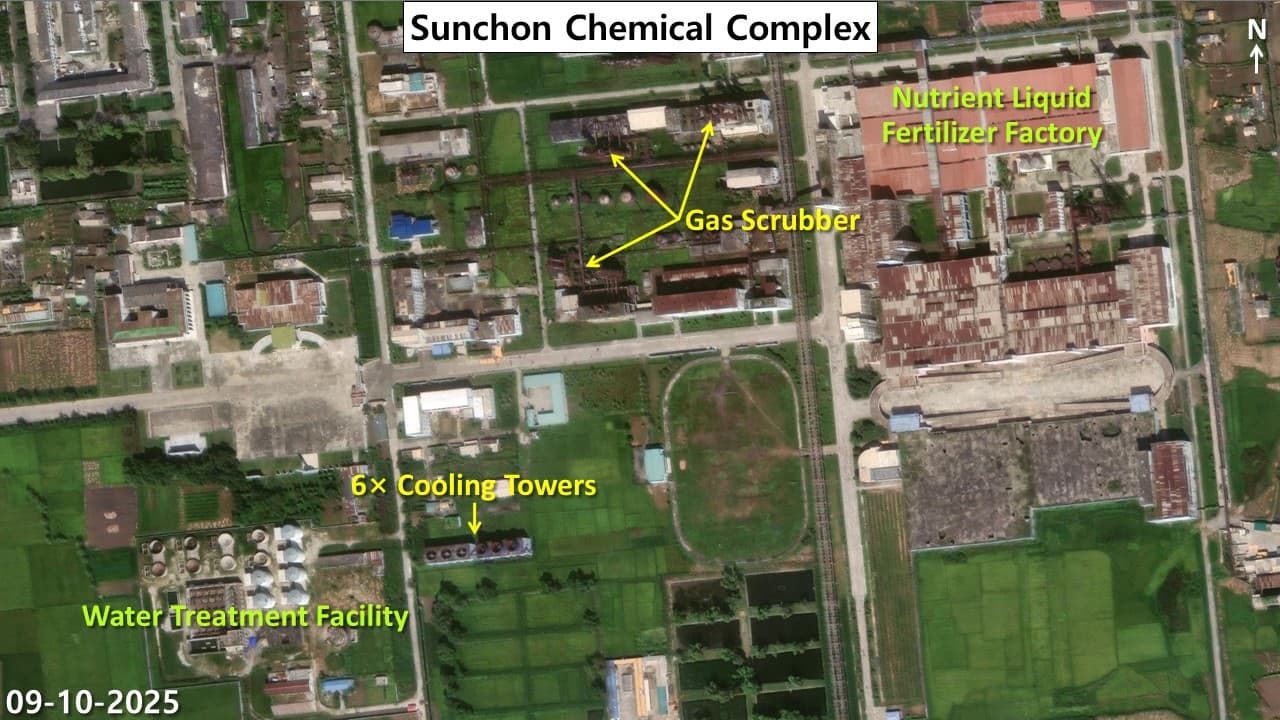
The Sunchon Chemical Complex includes a nutrient liquid fertilizer factory. It processes biological waste into fertilizer and liquid culture medium for antibiotic production at a nearby pharmaceutical factory. The complex also includes the Songyong Paint Factory, which produces paint through acrylic acid oxidation. Satellite imagery shows the fertilizer factory’s building cluster in the upper right of the site. It connects to core chemical infrastructure, including gas scrubbers, six cooling towers, and a water treatment facility in the lower left. The Songyong Paint Factory sits about four kilometers to the southwest. It stands out for unusually high security, including a helicopter landing pad and a guard tower. These features are not typical of ordinary civilian chemical facilities. I believe this is because the plant could be quickly modified to mass-produce hydrogen cyanide, a lethal chemical weapons precursor, with only minor changes to its production process.
Sunchon Pharmaceutical Factory
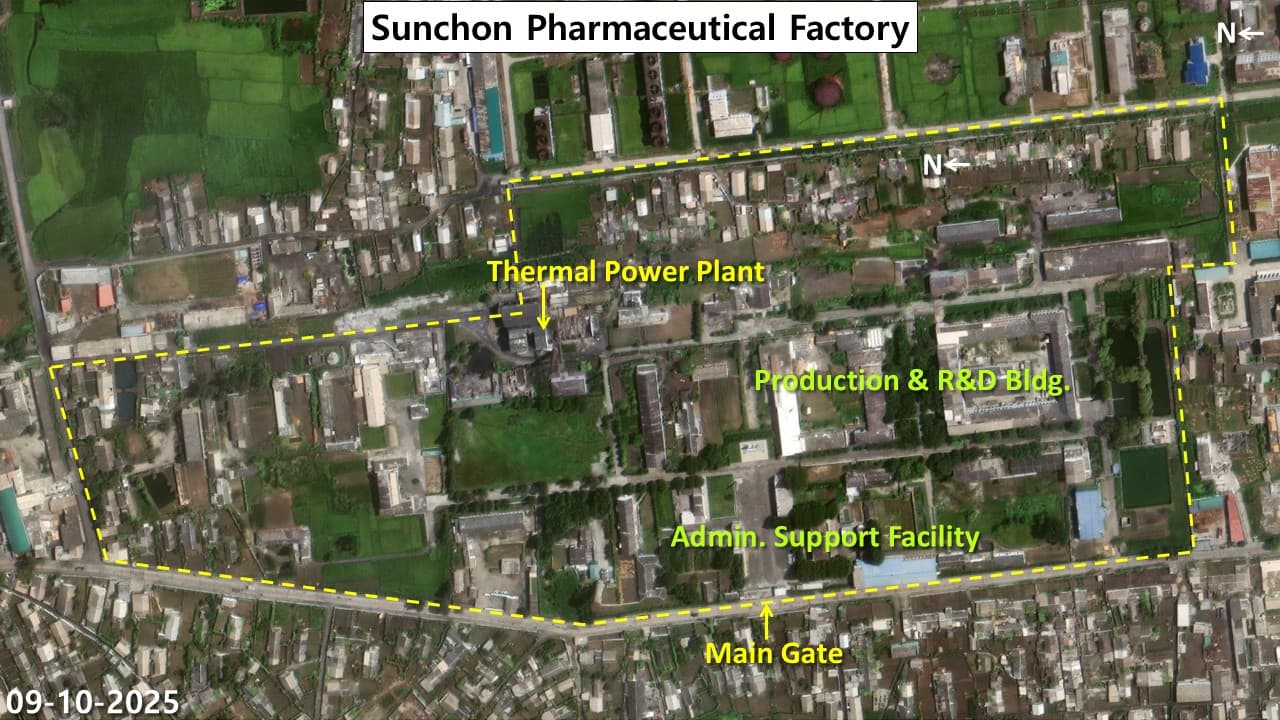
The Sunchon Pharmaceutical Factory manufactures and distributes small-molecule drugs such as aspirin, along with antibiotics including penicillin and streptomycin. Satellite imagery shows large production and research and development buildings, administrative support facilities and a main entrance on the site. A coal-fired power plant that supplies the factory’s own energy sits alongside them. The factory has also faced allegations of links to the production of benzyl cyanide, a key precursor for methamphetamine. Pharmaceutical production involves smaller volumes of material, and much of the work takes place inside closed facilities. That makes signs of illicit diversion, such as raw material stockpiling or exhaust emissions, difficult to identify from satellite imagery alone.
Thermal infrared analysis of the complex
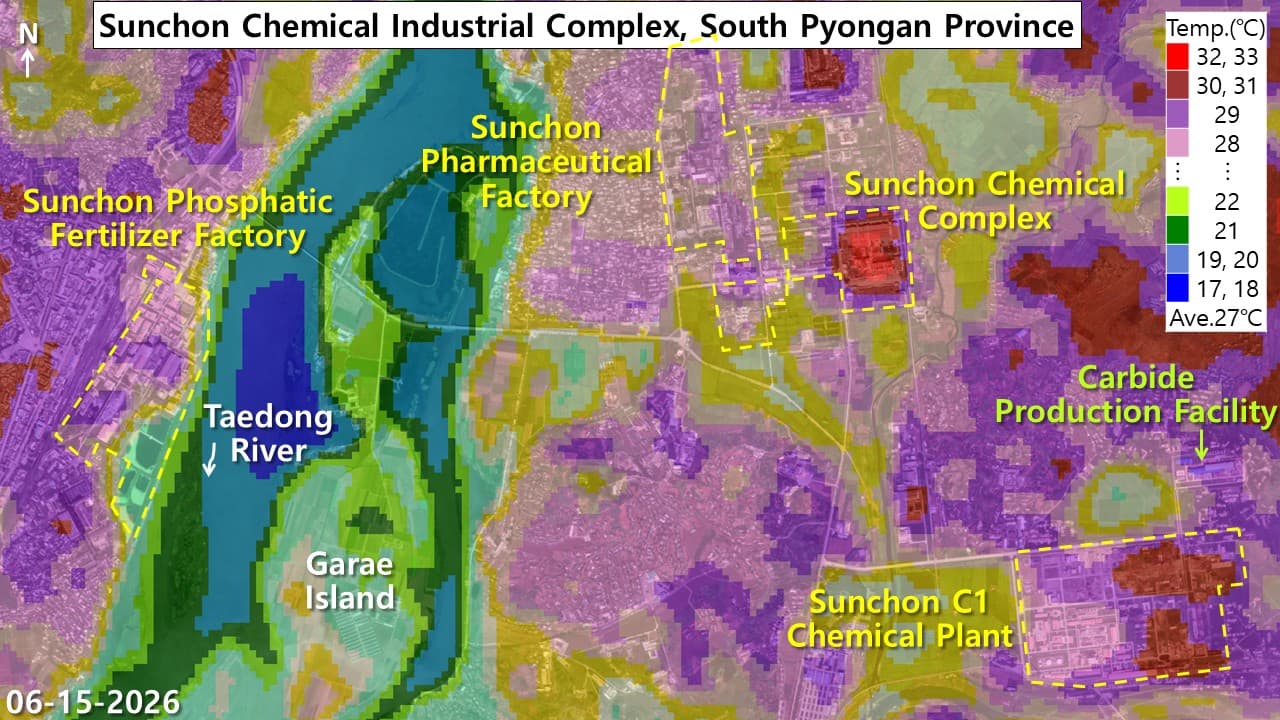
My analysis of thermal infrared imagery from the U.S. Landsat-9 Earth observation satellite shows clear temperature differences across the Sunchon complex’s key facilities. The nutrient liquid fertilizer factory at the eastern chemical complex showed the highest heat signature, 32 to 33 degrees Celsius, appearing in red. That indicates active operation. Portions of the C1 chemical plant to the southeast, including its primary raw material processing building, also showed heat signals above 30 degrees Celsius. That suggests internal equipment is operating. The phosphatic fertilizer factory on the western bank of the Taedong River, by contrast, has emitted only weak heat from a handful of facilities, six years after its completion, which suggests it remains in a test-run stage. The pharmaceutical factory likewise showed only faint heat signals in a few areas, indicating limited activity.
North Korea’s chemical weapons production potential
North Korea’s chemical weapons are less destructive than nuclear weapons, but they are cheap to produce and relatively simple to manufacture. That makes them a threatening asymmetric force, sometimes called the poor man’s nuclear weapon. Large chemical industrial hubs such as the Sunchon complex ordinarily produce civilian goods like fertilizer and paint, but with only minor changes to their production processes, they retain the potential to mass-produce lethal nerve agents such as sarin and VX, or toxic gases such as hydrogen cyanide. These facilities are closely connected to dense raw material supply chains and road and rail networks nearby. That gives them serious threat potential, given their capacity for both mass production and rapid diversion to military use.
At the same time, chemical weapons have drawbacks. Their effects vary considerably depending on wind direction and temperature. They are also difficult to manage safely, given the risk of leaks during storage and handling. Facilities with closed internal processes, like the pharmaceutical factory, are especially hard to monitor for signs of illicit diversion through satellite imagery alone. That underscores the need for more precise surveillance. There is no clear evidence that North Korea is currently producing chemical weapons directly. However, these facilities always carry the risk of being converted to military use. As such, it is essential to continue sustained, high-level vigilance through satellite-based thermal infrared analysis and other monitoring tools.
Disclaimer : This story is auto aggregated by a computer programme and has not been created or edited by DOWNTHENEWS. Publisher: dailynk.com