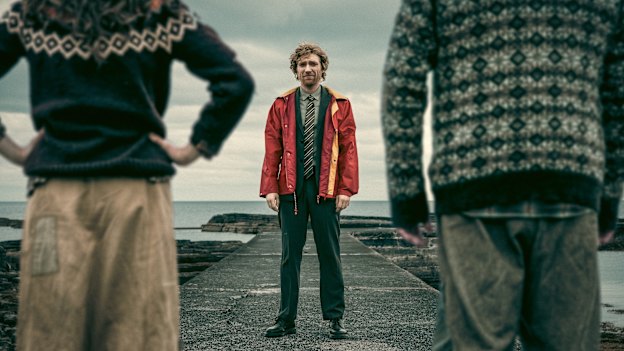
The Incomer’s Domhnall Gleeson was made to suffer for his art during a Scottish shoot that had everything.
There’s such an all-pervading fear of foreigners in The Incomer, the debut feature from Scottish writer-director Louis Paxton, that you can’t help but read it as a thinly veiled critique of Britain in the age of Farage et al.
“There’s definitely a sense that I was interested in talking about ‘Are we in it together; are we part of a community?’ ” says Paxton. “I think ultimately this film’s about the importance of connection, and that we are better together. So read into that what you will.”
If Paxton isn’t overly keen to have his movie seen as a political allegory, fair enough. It is first and foremost an utterly entertaining piece of work – by turns surreal, outlandish, hilarious and heartwarming. Above all, it is very, very Scottish.
The set-up is simple enough: Daniel (Domhnall Gleeson), a chronically shy middle manager from a seaside council, is sent to a small island to tell the last inhabitants it’s time to leave because it’s impractical to provide them with services any more. There’s a home for them on the mainland, with all the mod cons; they just need to pack their bags and get on the boat with him.
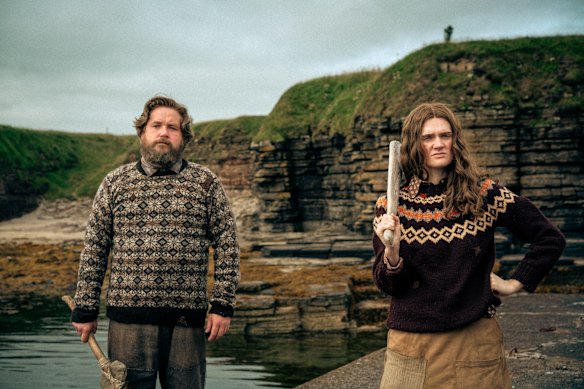
But the inhabitants have other ideas. Isla (Gayle Rankin) and Sandy (Grant O’Rourke) are siblings who have lived alone on the island for years, having been trained by their father, before he mysteriously disappeared, to fiercely resist incomers like Daniel.
They are pagan beings who communicate with the birds and the wind and the sea; Isla seeks the guidance of a Merman (John Hannah), while struggling to resist his siren call to join him in the water; they subsist on birds and myths and memories; and their first instinct upon seeing Daniel is to treat him as the enemy.
There are vague echoes of The Wicker Man, Flowers in the Attic and Local Hero in all of this. But for Paxton, there’s a deeply personal element to this story, albeit one that inevitably has political undertones too.
“My family are from the Orkney islands up in the north,” he says. “A lot of what informed the story was true stories of island evacuations over the last 100, 200 years in Scotland and Ireland; the Blasket Islands [whose last inhabitants were removed in 1954] inspired it as much as St Kilda [evacuated in 1930] or the Orkneys [which are still inhabited].
“What I was interested in exploring was geographical isolation and what that would do to you, and also a sense that even in modern society, surrounded by people, someone like Daniel can still feel isolated.”
For Gleeson, who rose to fame as the older Weasley brother in the Harry Potter films, there was an assuredness in Paxton’s writing that immediately drew him in.
“From the first paragraph it was really funny, but not in a way that was trying too hard,” he says. “It just felt like the script knew itself.”
At first glance, though, he wasn’t sure if Daniel – a Dungeons and Dragons-playing introvert who is, in his own way, as much an outsider as the siblings – was a match for the other two leads.
“They’re bigger characters, they’re wilder from the top, and it was just, like, ‘Well, is there enough in Daniel to keep [me and the audience] interested in him when he’s up against two such fiery personalities?’ ” he says. “And it felt like there was lots there. And then I talked to Louis, and it felt even more like there was lots there – still waters run deep and all the rest of it.
“Also, Shirley O’Connor, one of the producers on this film, who sent it to me, was one of my closest friends in college, so there was something amazing about doing a film with a mate from 20 years ago, something beautiful about that too.”
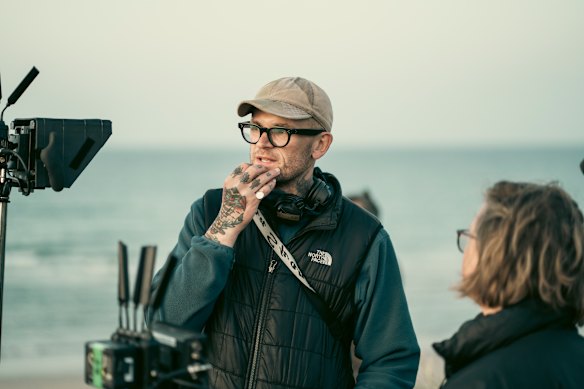
From its windswept cliffs to its isolated coves, its stone ruins and its flocks of seabirds, everything about The Incomer screams “island”. But in fact it was filmed on the mainland – albeit at the very furthest edge of it, in Caithness (the Scots county that is home to John O’Groats, officially the most north-easterly point in Britain).
“We originally wanted to shoot on the islands, but it was just prohibitively expensive,” Paxton explains. “Also, there just wasn’t enough accommodation for the crew.”
At any rate, the landscape of Caithness is, he says, very similar to that of Orkney. “It feels like the edge of the world, which is really what we were going for.”
Being so remote meant, he says, “We dealt with pretty much every challenge. The water was freezing, so any time the performers were in it, we had very limited time. We had storms a couple of days. But actually, what we were most surprised with was how hot it was, which was not what we’d planned for.”
Many of the costumes were made of wool, often with added layers of feathers. All that unanticipated sun played havoc with the pale skin of the cast and crew, who were mostly Scottish or Irish. “And then we had live birds, and midges.”
Gleeson, he says, “had a particularly traumatic experience” with Scotland’s tiny but famously persistent biting insects, in a scene in which he is dangled off the edge of a cliff.
“I knew I was in trouble when I saw the crew were in beekeeper outfits,” the actor recalls. “I was like, ‘Why are they all wearing hazmat netting, and why haven’t I got anything, why am I just bare-faced?’
“Being held over a cliff is already a little bit scary,” he continues. “But the big problem was, as we were about to call ‘action’, a swarm of them descended, and there were so many midges between the camera and my face that the shot didn’t work.”
That wasn’t the only time Gleeson suffered for his art, either. He and Rankin had to enter the water for a couple of scenes – and no matter how unseasonably warm the weather might have been, the North Sea remained icy.
“Louis can talk as much as he likes about, ‘We had limited time in the water.’ That is patently bullshit,” Gleeson jokes. “We were in there a lot, and it was cold.”
“It was a challenge for everyone to try and make it look nice,” concedes Paxton.
“That was the most acting I did in the film,” says Gleeson. “Pretending I wasn’t slowly dying in the water.”
Though he’s not a Dungeons and Dragons kind of guy (“I read The Hobbit, but I’ve never read Lord of the Rings”), Gleeson says he could identify with Daniel’s sense of not quite fitting in.
“Every time you have your first day at a table read or on a film set, which I end up doing a lot because you go from job to job, those first days where you look at a painting on the wall and pretend you’re interested in it because you don’t want to just stand there on your own, I think we all know those moments where you just feel conscious of not being in. And I think Daniel has felt like that his whole life,” he says.
“Then finally being seen [by the siblings], he’s at first challenged and scared of these people, and then learns to see and accept them for who they are, and then they grant him the same grace.
“In that journey,” says Gleeson, “there’s so much to hang onto.”
The Incomer screens as part of the British Film Festival, at Palace cinemas nationally from October 28 to December 6, and opens nationally on November 26. britishfilmfestival.com.au
Disclaimer : This story is auto aggregated by a computer programme and has not been created or edited by DOWNTHENEWS. Publisher: www.smh.com.au