
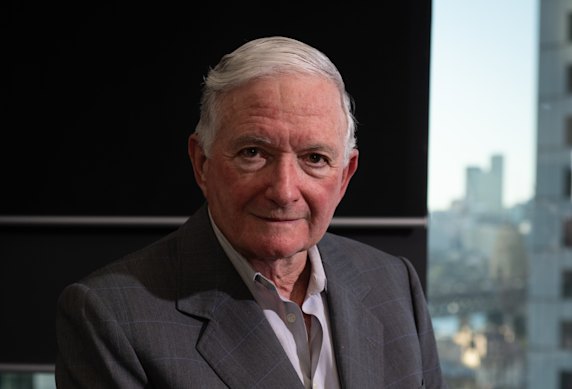
Nick Greiner says (“Greiner’s parting advice to bring Libs back from brink of extinction”, April 22), “I think most Australians are in the sensible centre, but at the moment they are without natural representation and my conclusion is that, if you aren’t in the sensible centre, you probably can’t win.” Do I detect an admission by Greiner that at present the Liberal Party is not the party of “natural representation” in the sensible centre? Can I point out that at present Labor Are Better OveRall, which coincidentally spells LABOR? Enjoy your retirement, Nick. I voted for you in the ’80s, was devastated when you were shafted and thrilled that you have now come around to the sensible centre, where Labor holds the space even though you can’t quite bring yourself to say as much.Peter Kamenyitzky, Copacabana
Nick Greiner rightly asserts the strategic importance of engaging the “sensible centre” if the Liberal Party is to regain credibility, but fails to mention climate change. Is it not abundantly clear that recognising the importance of urgent action on this formidable challenge is now absolutely mainstream? It’s hard to imagine any party winning a national election without credible and resolute policies to stem the carbon tide. Andrew FitzSimons, Wattamolla
I’ve been a leftish-leaning voter all my life and I have only recently come to realise what has driven me away from even small “l” liberalism in the voting booth. While the ALP has a long history of pursuing policies that benefit the average citizen – such as Medicare, PBS, minimum wage etc – the Liberals seem to be a one-trick pony. Privatise everything. The fact that our lives seem to be so much better than our American cousins comes down to a century of socially responsible policy that is in the very DNA of the Labor Party. If Nick Greiner thinks, “It’s winning, stupid”, is the answer to the Liberals’ woes he is a fool. It’s the policies, stupid. Donald Green, Cobargo
Nick Greiner has given his last political interview. I remember him as the man who cancelled the Maldon-Dombarton railway in 1988. Millions of dollars had been spent on the project, and further millions of dollars in compensation was paid for broken contracts, all of which was wasted. Instead of a valuable piece of transport infrastructure, the people of NSW received nothing. That is what I remember Nick Greiner for. Alan Templeman, Wyoming
I met Nick Greiner once. He was humble, self-effacing and kind. His legacy to the people of NSW is the ICAC, which, by exposing those who have acted corruptly, has prevented untold corruption over the past 34 years and will do so in the future. No other government or politician has had the guts to replicate the ICAC, though some have tried pale imitations. Andrew McDonald, Menangle
Sub-standard plan
The story about the AUKUS submarines (“AUKUS subs not a priority: US navy”, April 22) should come as no surprise. Despite all the money being “invested” directly into the American shipbuilding sector by Australia, coupled with extensive upgrades to sub-related infrastructure and manufacturing facilities in Australia, there are no guarantees we will get the subs. All the political spin and coverage in the media rarely discusses the two fundamental flaws in the AUKUS subs program. The US is under no obligation to supply them if it doesn’t want to, and if the subs aren’t supplied, there is no obligation for the US to refund our money. So it is no surprise that an American admiral in charge of the US submarine program views our AUKUS submarine program in such a cavalier manner. When you factor in the cost of walking away from the French program, Trump’s “America First” doctrine with his threats to deny maintenance support to countries using US weapons systems, and commentary by various American and Australian experts, it’s hard to believe we’ll see the subs at all, let alone on time/budget with the required capabilities. Bernard Stever, Richmond
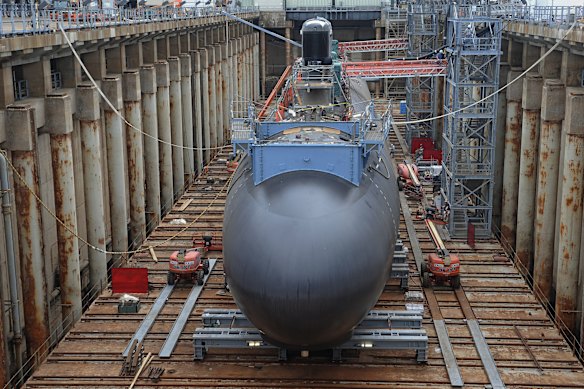
The question Defence Minister Richard Marles should ponder is not so much throwing more good billions of taxpayer dollars at the AUKUS submarine agreement but how to recoup some of the money already shovelled into this black hole and how to rescue at least a modicum of national dignity in the process. AUKUS was a bad deal when Scott Morrison tore up the contract for French boats in favour of the alluring nuclear-powered option, and has remained so ever since as some sort of mystical centrepiece of defence spending. There is no question that Australia needs to re-evaluate much of its materiel needs, especially in this burgeoning era of AI-enhanced decision-making and the rapid evolution of drone-based defensive and offensive weaponry. If the current fuel crisis has one enduring lesson, it is the need for increased self-reliance – be it on infrastructure or the revival of a vibrant manufacturing sector. The opportunity awaits, but meanwhile the breathtaking and intergenerational budgetary burden that is AUKUS will dilute our thinking and efforts. Bradley Wynne, Croydon
What most Australians have known for a long time is now confirmed by the US submarine chief himself. Both the Labor and Coalition politicians are blind to the reality that we will never get those coveted submarines. It’s time that they realised that, by cancelling AUKUS, they can fix our budget issues and will have spare funds that can be better used by spending on more suitable defence resources such than those by-then outdated submarines. Bipin Johri, Epping
Jaw is better than war
Your correspondent (Letters, April 22) selectively quotes Professor Catharine Lumby to critique “the whole gambit of left-wing intolerance”. Lumby is calling out knee-jerk responses such as cancellations and concludes, “Progressive politics is stronger when we stay pragmatic, celebrate our differences and avoid elevating extraneous issues over a common cause.” Focusing on commonalities fosters social cohesion, focusing on binaries breeds conflict. Kate Lumley, Hurlstone Park
Yes, our society cries out for the balanced and thoughtful approach of the right to the issues your correspondent mentions. The dispassionate musings of some of our right-ist politicians bring unemotional and logical contributions to every discourse, they claim: Climate change is crap; we decide your gender identity, not you; whiteness is a virtue. I see your bigotry of the left; I raise you the prejudice, wilful blindness and narrow-mindedness of the right. Graham Fazio, Cootamundra
When it comes to climate change, it is not bigotry and it is not a “point of view”. Climate change is science, backed by hard evidence, observation and experimentation (computer analysis), all peer reviewed. You have every right to question the veracity of climate change, but you must produce your evidence and observations and allow those with scientific qualifications to peer-review your results. Beliefs, opinions and points of view have no place here. Tony Lewis, Mount Victoria
Your correspondent bemoans the fact that most progressives refuse to countenance other points of view. As a progressive, I acknowledge that may be the case. But I also have believed that most conservatives refuse to countenance other points of view. Maybe it’s time we started to listen to each other. I’m certainly open to the challenge. Ian Factor, Kiama
EV charge stalls without power
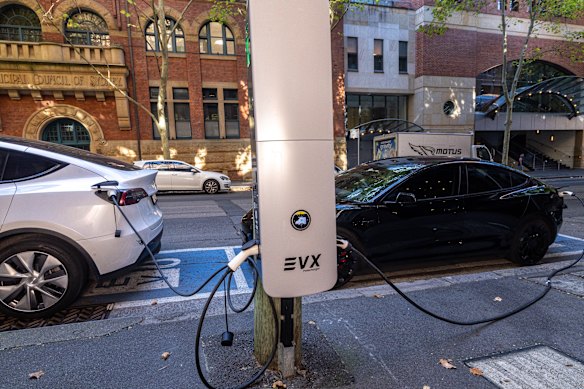
Your editorial (“In a rush to buy an EV? Now go find a charger”, April 22) is most pertinent, given the fuel crisis and the sensible need for more renewable energy solutions, including more EV charging stations. And as a resident of the Inner West Council, I could well believe I should be proud of council’s efforts. The mayor, Darcy Byrne, has been most effusive in his media releases about council’s roll-out of EV charging stations. Indeed. In my specific area two charging stations have been installed: one earlier this year and one more recently. The problem is that council has provided none of the necessary infrastructure to support their use – no signs, no designated parking spots. The units are on streets without parking restrictions, so motorists simply use the area for long-term parking during the day. One might have thought in the current fuel crisis the council and mayor might have prioritised the necessary supporting infrastructure. Peter Robertson, Stanmore
Living in the Inner West with an EV since January, we’ve had zero issues with public charging. The narrative about charger shortages feels like a deliberate scare campaign by the fossil fuel industry to protect its own interests. Daniela Catalano, Haberfield
Those ICE-ing drivers mentioned in the editorial are regularly parking in our Marrickville street in the two designated spots for EV charging. Here’s a suggestion. How about the council putting up signs displaying “No parking unless you are charging your car”? Displayed should be a hefty fine you will be required to pay. Of course, this might require parking wardens driving past all charging bays for a while, but it will all be worthwhile. More people living in apartments might be encouraged to purchase EVs. Mary Lawson, Marrickville
Your correspondent (Letters, April 22) proposes the idea of mandating service stations to install EV chargers. There is, however, a rational argument that installing EV chargers in petrol stations could be in their own self-interest. It takes from 10 to 60 minutes to fast charge an EV vehicle, according to NSW Transport. So, besides paying for this service, any customer using this has to find a way to spend that time. This equates to an economic opportunity for petrol stations to offer refreshments, reading materials, etc, to profit from this downtime. It then becomes a win-win proposition for both drivers and petrol station owners. Larry Woldenberg, Forest Lodge
Your correspondent urges the government to mandate “all existing service stations install a minimum number of EV charging bays”. While this is already being done at many highway service centres, I can’t think of a worse place to charge than a suburban servo. Many, if not most, lack any amenity and are often cramped, smelly and dirty. People would walk elsewhere to do something while charging and the owner of the servo would get zero revenue from it. EVs allow us to do things differently from the fossil fuel model – that’s what we should do. Brendan Jones, Annandale
Time to end gas free ride
I worked as a chemical engineer in the oil and gas industry for several decades and watching first hand the North West Gas development (“Iran conflict fallout puts brakes on Pocock’s push to tax gas exporters”, April 22), I was flabbergasted to witness the political negotiating ineptitude with the oil majors at the state and federal level. A revenue-based tax from day one (as in Qatar) would have secured a fair and reasonable return for our finite resource and pumped many billions into consolidated revenue or future fund. Instead, a tax scheme based on profit was established, allowing the oil majors to fiddle the books using transfer pricing rorts with consequent declarations of low profit and payment of minimal tax. The ATO, led by Chris Jordan, fought tooth and nail to curb these shenanigans and did extract payments to the tune of billions.
With the skyrocketing fossil fuel prices and the windfall for them exporting our gas, I applaud David Pocock and others for their push to claw back some of the squandered billions. Moreover, I watched these same oil majors take engineering back to Japan and the US, leaving skill development for our engineering community in Perth. The same applied to Australian manufactured kit, where Korean and SE Asian workshops mostly supplied these behemoth projects. Australia has done OK, but is far from what could and should have been. Go, Senator Pocock. Will our PM show a bit of mettle on this issue? Bruce Hall, Avalon
” loading=”eager” src=”https://static.ffx.io/images/$zoom_0.323%2C$multiply_0.7725%2C$ratio_1.5%2C$width_756%2C$x_59%2C$y_0/t_crop_custom/q_86%2Cf_auto/d64957712a77234e41a1db44b7e4075b5fabae29″ srcset=”https://static.ffx.io/images/$zoom_0.323%2C$multiply_0.7725%2C$ratio_1.5%2C$width_756%2C$x_59%2C$y_0/t_crop_custom/q_86%2Cf_auto/d64957712a77234e41a1db44b7e4075b5fabae29, https://static.ffx.io/images/$zoom_0.323%2C$multiply_1.545%2C$ratio_1.5%2C$width_756%2C$x_59%2C$y_0/t_crop_custom/q_62%2Cf_auto/d64957712a77234e41a1db44b7e4075b5fabae29 2x” class=”sc-d34e428-1 ldCIuB”>
To demonstrate his unsuitability for the prime ministership, Angus Taylor has truly written it in bold print saying that a 25 per cent tax would “close down the gas industry”. Does he seriously believe that the gas industry would pack its bags and leave if slapped with a 25 per cent tax? This industry has made billions in profits and has never paid much, if any, tax. A 25 per cent tax is a small burden for them to pay, given the free ride they have had for the past few decades. Now a strongly supported tax has Taylor being the spitting dummy for the gas industry. He is simply not credible and it is clear he places the gas industry ahead of the needs of ordinary Australians. Ross Hudson, Mount Martha (Vic)
The foreign owned energy companies and their lobby groups want us to think there is a link between them paying more tax and the supply of gas to our trading partners. They imply them paying more tax will somehow reduce supply to our trading partners. The government has given assurances to our trading partners that gas supply will be unaffected. Too many sensible Australians are saying the same thing. These foreign companies need to pay more for extracting and selling this finite Australian resource. Graham Hansen, Denistone
Migration lifts democracy
Supporters of drastic curbs on immigration imply it undermines Australian values, the first of which is democracy (“Lovin’ democracy? You’re OK then”, April 22). According to the Grattan Institute, via Ross Gittins, Australian support for democracy has been consistently strong – even growing over time. This has coincided with a significant increase in immigration and suggests immigrants actually enhance
our democracy. Gordon Koch, Ashfield
- To submit a letter to the Sydney Morning Herald, email letters@smh.com.au. Click here for tips on how to submit letters.
- The Opinion newsletter is a weekly wrap of views that will challenge, champion and inform. Sign up here.
Disclaimer : This story is auto aggregated by a computer programme and has not been created or edited by DOWNTHENEWS. Publisher: www.smh.com.au


