
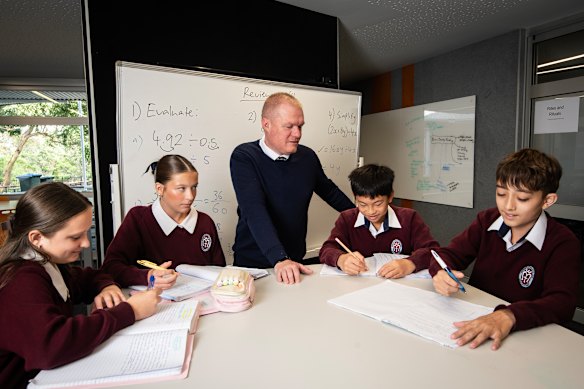

When school starts next year at Marian Catholic College in Sydney’s north-west, something will be conspicuously absent in the classrooms of years 7 to 10 students. Laptops, devices and associated technology students used during lessons simply won’t be there. “There’s a strong sentiment that devices are a problem,” principal Matthew Smith says.
A survey of teachers, students and parents this year supported the removal of tech from the Kenthurst school, which will be among a handful of schools across the state to effectively ban one-to-one technology. The school started exploring the idea of a digital purge as part of its renewed focus on explicit instruction methods, whereby a teacher explains a concept in digestible chunks. That contrasts with inquiry-based learning, where students explored concepts for themselves. “At our school, the one-to-one devices seemed to have an impact on focused attention,” Smith said.
Laptops distracted from lessons, reduced students’ working memory and created a barrier between pupils and the teacher, he says. Teachers found tech use difficult to supervise, with teenagers adept at quickly flicking between applications to disguise what they’re really up to. Feedback from teachers regarding the ban was not unanimous. “We had a handful of teachers who would have preferred a reduced use of devices,” he said.
The NSW curriculum requires students to occasionally use computers, so some laptops will be retained for selective use. Teachers will still use technology in lessons. “I do hear the argument that students should have laptops because they have them in the workplace,” he says. But he has zero concerns about students’ lack of “digital literacy” because they already spend so much time outside of school on devices. “I am more worried about the absence of critical thinking.”
Globally, academic outcomes are declining and technology uptake has been blamed for the drop in results. In Australia, primary school curriculums were last week being rewritten to shift the emphasis away from digital skills. Standardised NAPLAN writing tests will return to pen and paper for year 5 students.
NSW Education Minister Prue Car has introduced screen time caps of as little as 15 minutes per day for some school students, citing the importance of using pen and paper rather than a laptop to write due to its cognitive benefits. Public schools previously recommended parents purchase laptops and advertised buy-now-pay-later schemes for families who could not afford the full upfront cost. On Sunday, the NSW government said parents will not be required to buy expensive laptops or tablets.
Some teachers and schools that boast of iPads for every child might be getting whiplash from the sudden pivot away from digital classrooms.
The saturation of technology in schools was the result of an “edtech” industry boom which started with Kevin Rudd’s digital education revolution in the 2000s. Just over five years ago, the NSW education system relied on the digitalisation of the lessons so students could be schooled at home during the pandemic.
But every revolution must come to an end.
Marching toward their own insurrection, anti-tech parents might be clutching their own bible of sorts, perhaps an earmarked copy of Jonathan Haidt’s The Anxious Generation – a globally successful treatise which awakened the world to how big tech, screens and social media infected the minds of children.
In the US, groups such as Schools Beyond Screens are lobbying the government against digital devices while in New York, parents have held public rallies outside classrooms picketing against use of AI in schools.
In Australia, the Heads Up Alliance is leading the fightback against decades of technology in schools. Its founder, NSW father Dany Elachi, described last week’s screen time caps and NAPLAN reforms as a step in the right direction. His group believes primary school should be device-free, foundational literacy and handwriting skills must be restored as core priorities and physical books must be the default. Generative artificial intelligence has no place in schools whatsoever.
“It turns out that Australia’s Digital Education Revolution of 2008 was, in effect, a vast experiment on our children. Today, the results of that experiment have become impossible to ignore,” he said.
“The mood has shifted among parents and teachers – what was once a whisper has turned into a shout. We’re not at the stage of picketing outside of schools. But we have started a petition and hope to present it to [Education Minister] Jason Clare.”
The science is clear that handwriting is better for learning and information retention. Research has found poor transcription skills constrain thinking, planning and translating processes in students. Studies show brain connectivity patterns were far more elaborate for handwriting compared with typewriting on a keyboard. Researchers say unlike typing, handwriting requires fine motor co-ordination, visual processing and cognitive engagement, which leads to better retention, more in-depth understanding and stronger neural connections.
‘Education is not entertainment. And not everything we learn to do is instantly going to be easy and fun.’
Noella Mackenzie, Charles Sturt University
Charles Sturt University’s Adjunct Associate Professor Noella Mackenzie welcomed the push towards more analogue pen and paper, but said it must start with students having more time to perfect handwriting.
“We’ve gone so far down the digital road in schools … handwriting drops off around year 3 and students fail to develop an efficient, automated style,” she said.
The hybrid of handwriting and typing in primary meant students entered high school without being proficient in either. Other countries had reverted to pen and paper but said developing handwriting skills needs time and practice.
“It is going to be hard,” she said of the work required to help students develop their handwriting every day. “Education is not entertainment. And not everything we learn to do is instantly going to be easy and fun.”
The Catholic Diocese of Parramatta’s head of primary learning, Lisa Crampton, said in response to the evidence they were buying more physical books for their schools and focusing on handwriting.
“It is really clear that handwriting is part of the knowledge-building itself, rather than just a tool to record what we know,” she said.
She said handwriting fluency (making all the components from sentence structure to spelling, punctuation to the actual forming of the letters without having to think) helped students focus on new content they were actually learning about or reducing cognitive load.
She also said the focus on analogue methods, rather than digitised learning, helped with reading comprehension – which had a reciprocal relationship with writing. “We’re investing in purchasing physical copies of novels for students to read, to have a book in their hand, or mini-whiteboards for students to actually practise their handwriting.”
The push to purge the reliance on digital technologies is easy for politicians to announce but implementation is another issue.
La Trobe University initial teacher education lecturer Sarah Warby said in an age of teacher shortages, especially in certain hard-to-staff subjects, the edtech industry had been a useful gap filler with its learning platforms, banks of lesson plans and educational games. “If teachers are teaching out of their area of specialty, edtech comes in and fills that gap,” she said.
It might also take students some time to adjust. Warby said technology in some cases had made learning entertaining. She noted Millennial parents might also need to adjust what they thought school should be for. “The current generation of parents were mostly educated in schools with project-based learning that focused on skills and technology rather than core knowledge. As a result, these parents aren’t used to expert teacher instruction,” she said.
In the face of what might seem a sharp U-turn on digital devices, Professor Matt Bower from Macquarie University, who studies the intersection of technology and education, warns against a total rejection of technology in schools. “Many schools are using technology in a range of purposeful ways,” he said, citing how videos of ancient Rome or science simulations could bring subjects to life for students and provide clarity and understanding.
He believes schools can navigate a middle ground so students get the benefits and avoid the pitfalls of technology use such as distraction. And that is especially true with the fast expansion of AI into students’ lives. “I hope with the rapid advancements in artificial intelligence that we are adequately preparing students to both self-regulate their use of technology and benefit from all the numerous potential advantages,” he said.
Back at Marian Catholic College, Smith is confident the lack of laptops is going to make the schools a better place.
“We are still using modern, contemporary pedagogies,” he says. “But it makes the teaching more relational if you don’t have the screen sitting as a barrier – the classroom has to be interactive, relational and not passive.”
Start the day with a summary of the day’s most important and interesting stories, analysis and insights. Sign up for our Morning Edition newsletter.
From our partners
Disclaimer : This story is auto aggregated by a computer programme and has not been created or edited by DOWNTHENEWS. Publisher: www.smh.com.au



